Minh Ngọc Ng – La Valse d’Amélie
An evening pause: A pleasant way to start the weekend.
Hat tip Alton Blevins.
An evening pause: A pleasant way to start the weekend.
Hat tip Alton Blevins.
SpaceX today successfully launched another 21 Starlink satellites, its Falcon 9 rocket lifting off from Cape Canaveral.
The first stage completed its seventeenth flight, landing on a drone ship in the Atlantic.
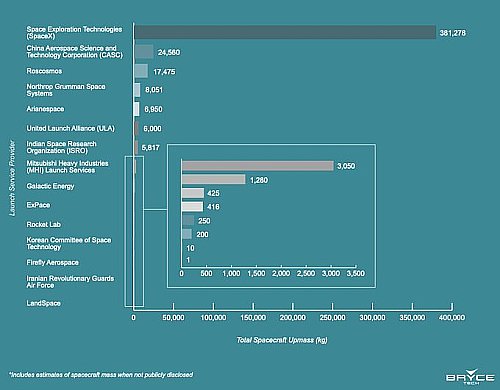
The leaders in the 2024 launch race:
101 SpaceX
46 China
11 Russia
11 Rocket Lab
American private enterprise now leads the rest of the world combined in successful launches 118 to 69, while SpaceX by itself now leads the entire world, including American companies, 101 to 86.
Courtesy of BtB’s stringer Jay. This post is also an open thread. I welcome my readers to post any comments or additional links relating to any space issues, even if unrelated to the links below.
Cool image time! The picture to the right, rotated, cropped, reduced, and sharpened to post here, was taken on June 23, 2024 by the high resolution camera on Mars Reconnaissance Orbiter (MRO). I had originally chosen to feature a different picture of this spot, taken on August 1, 2024 in order to create a stereo pair, but this week the camera team featured this first photo, providing a caption.
This disrupted surface is characterized by a collection of rounded to flat-topped mounds of various sizes connected by narrow flat floors, typical of the aptly named “chaotic terrain” on Mars.
What could have caused this flat surface to break into pieces? You might imagine that a flat surface could be broken up if it was inflated or collapsed. One hypothesis is that large amounts of water were released from deep below the ground to cause the surface break up.
Normally on Mars, especially in the mid-latitudes, chaotic terrain is associated with glacial activity, suggesting that glaciers over time erode valleys along random criss-crossing fault lines to create the mesas and canyons. This patch of chaotic terrain however suggests a different formation process.
» Read more

NASA’s bloated SLS mobile launchers
According to a new Government Accountability Office (GAO) report released yesterday, NASA’S continuing delays and technical problems building the various ground systems required for the next few Artemis launches will almost certainly cause those launches to be delayed.
The schedule at present is as follows:
The GAO report notes at length that modifications to the mobile launch platform SLS will use on the first two missions is taking longer than planned. It also notes that the problems completing the second mobile launcher continue, with the budget growing from $383 million to $1.1 billion, and the work years behind schedule with no certainty it will be completed in time for the 2028 mission. These issues are the same ones noted by NASA’s inspector general in August 2024.

Damage to Orion heat shield caused during re-entry,
including “cavities resulting from the loss of large chunks”
This report focused exclusively on the scheduling delays for the ground systems that will be used by SLS for each launch. It did not address the serious questions that remain concerning the serious heat shield damage experienced by the Orion capsule when it returned to Earth on its first unmanned mission in late 2022. NASA has been studying that problem now for two years, and as yet has not revealed a solution.
I continue to predict that the first manned landing, now scheduled for 2026, will not occur before 2030, six years behind the schedule first proposed by President Trump but actually fifteen years behind the schedule initially proposed by President George Bush Jr in 2004. All in all, it will take NASA almost a third of a century to put American astronauts back on the Moon, assuming the landing occurs in 2030 as I now predict. Compare that with the development time of SpaceX’s Starship/Superheavy. Proposed in 2017, it is already flying, and will almost certainly complete its first private manned lunar mission and its first test missions to Mars by 2027. The contrast is striking.
More and more the entire part of Artemis run by NASA is proving to be the failed disaster I predicted it would be in 2011. No wonder former New York mayor Michael Bloomberg wrote an op-ed yesterday calling for its cancellation. Like most politicians, reality is finally percolating into his thick skull, though several decades late.
The Commerce department today announced that it has issued three new rulings that will ease the regulations and licensing procedures that American rocket and satellite companies have to go through in order to launch from international facilities.
The first rule will ease licensing for launches from Australia, Canada, and the United Kingdom. This will make it easier for American rocket companies to launch from the new spaceports being built in these nations, as well as allow satellite and orbital tug companies to launch their spacecraft from these nations using non-American rockets.
The second rule, still in its interim stage of approval, would ease the export licensing for satellites and spacecraft “to over 40 allies and partners worldwide, reducing licensing requirements for the least sensitive components for most destinations, and broadening license exceptions to support additional National Aeronautics and Space Administration (NASA) cooperative programs.” It appears this ruling focuses specifically on the countries who have signed the Artemis Accords, joining NASA’s Artemis program.
The third rule, which is at present only proposed, will remove from the State Department’s strict ITAR regulations many space-related defense technology, transfering their licensing to the much more relaxed Commerce department. This ruling appears aimed at helping the new burgeoning orbital tug, refueling, and satellite servicing industry, which uses rendezvous and proximity technology that was previously considered military in nature.
While it appears this easing of regulation goes against the Biden administration general policy of tightening regulations, the changes make sense if we recognize that these regulations also loosen access to American technology for many international partners, something this administration favors.
All in all, however, the changes are thoughtfully worked out, and will likely help energize the American space industry without releasing important technology to the wrong nations.
The European Space Agency (ESA) yesterday awarded the company OHB Italia a €63 million preliminary contract to begin work on mission dubbed Ramses that will launch in 2028 and rendezvous with the potentially dangerous asteroid Apophis when it flies past the Earth on April 13, 2029 at a distance of less than 20,000 miles.
The contract award is preliminary because the entire project still has to be approved by the ESA ministral council of nations, meeting in 2025. Because of the short development time, however, ESA’s management found funds from its existing budget to begin work.
To speed work, the project is also using as its design basis the Hera asteroid spacecraft, which was recently launched to study the binary asteroids Didymos-Dimorphos. That mission was also built remarkably fast for a European space project, going from contract to launch in just four years.
NASA has already re-tasked its OSIRIS-REx asteroid mission to head for Apophis, renaming it OSIRIS-APEX for reasons that baffle me. The mission had successfully delivered samples from the asteroid Bennu, but after completing that mission had sufficient fuel and was well placed to do this additional rendezvous as well.
ULA has recovered some of the debris that fell to earth after the nozzle on one of Vulcan’s two solid-fueled strap-on boosters fell off during the early stages of the rocket’s second launch on October 4, 2024.
Julie Arnold, a ULA spokesperson, confirmed to Ars that the company has retrieved some of the debris. “We recovered some small pieces of the GEM 63XL SRB nozzle that were liberated in the vicinity of the launch pad,” Arnold said. “The team is inspecting the hardware to aid in the investigation.”
The booster was built by Northrop Grumman. Vulcan can use from from two to six on each flight (in pairs), depending on the mass of its payload and the mission requirements. At the moment ULA has 35 of these boosters in storage awaiting future flights. It is expected that once the company has an idea of the root cause of the failure, it will have to inspect each booster to avoid a repeat of the problem.
Though ULA has not announced any changes in its plans to launch twice more before the end of the year, both for the Pentagon, that schedule is now uncertain due to this problem. For example, there as yet is no word on whether the military is willing to certify the launches. It had required ULA to complete two test flights of Vulcan before doing so, and the nozzle issue has cast a cloud on that plan.
An evening pause: Performed live 2000.
Hat tip John Jossy.
Courtesy of BtB’s stringer Jay. This post is also an open thread. I welcome my readers to post any comments or additional links relating to any space issues, even if unrelated to the links below.
And to prove my analysis, NASA’s official even said that China could sign the accords if it wished. So much for defending freedom, capitalism, and private ownership.

The obvious reasons why killing the leaders
of Hamas and Hezbollah is a good thing.
Courtesy of Doug Ross.
The confirmation today that Israel had finally killed Hamas leader Yahha Sinwar, considered the main architect behind the October 7, 2023 murder, rape, and torture of more than a thousand Israeli men, women, children, and babies near Gaza is good news, but it only is one small victory in what is now clearly Israel’s decision to go for nothing less than total victory against the terrorists who have been hounding and killiing its citizens wantonly for decades.
You see, since the 1973 Yom Kippur war, all of Israel’s responses against terrorist groups like Hamas and Hezbollah have been limited and targeted, and ended quickly with fake ceasefires that allowed those terrorist groups to not only regroup, but actually expand their capabilities.
The most blatent and best example of this what happened in connection with Israel’s 2006 month-long invasion of Lebanon, launched in an attempt to defeat Hezbollah. The invasion bogged down, and as a result Israel and Hezbollah ended up agreeing to UN resolution 1701, which had Israel evaculate southern Lebanon and the UN take on the task of keeping the peace. The agreement also created a demilitarized zone in southern Lebanon, where Hezbollah was forbidden.
That agreement was an utter failure. Neither the UN nor Lebanon had the ability or even the desire to limit Hezbollah, and so before long it had made that demilitarized zone a launchpad for rocket attacks into Israel. In Israel’s most recent campaign to clear out that zone, it has also discovered tunnels and large weapons caches clearly designed for Hezbollah’s own planned October 7th-type invasion.
After October 7th, what I labeled Israel’s Pearl Harbor, Israel was clearly no longer going to accept this failed piecemeal and limited negotiating approach, administered by dishonest third parties like the UN and even the United States. Instead, it decided to go by an old American concept of “unconditional surrender,” first made plain by Grant during the Civil War and then underlined by Eisenhower and Roosevelt in their insistence on “total victory” in World War II.
In other words, Israel would only accept a ceasefire or peace treaty if it involved the surrender and capture of the leadership of Hamas and Hezbollah. If they refused to do this, then Israel resolved to kill them.
It has now demonstrated its ability to do so, with gratifying success.
Israel’s military actions since October 7th however also illustrate a major change in strategy and tactics. » Read more
Cool image time! The picture to the right, cropped, reduced, and sharpened to post here, was taken by the Hubble Space Telescope as part of a long term program to monitor changes in the R Aquarii binary star system, located about 700 light years away.
R Aquarii belongs to a class of double stars called symbiotic stars. The primary star is an aging red giant and its companion is a compact burned-out star known as a white dwarf. The red giant primary star is classified as a Mira variable that is over 400 times larger than our Sun. The bloated monster star pulsates, changes temperature, and varies in brightness by a factor of 750 times over a roughly 390-day period. At its peak the star is blinding at nearly 5,000 times our Sun’s brightness.
When the white dwarf star swings closest to the red giant along its 44-year orbital period, it gravitationally siphons off hydrogen gas. This material accumulates on the dwarf star’s surface until it undergoes spontaneous nuclear fusion, making that surface explode like a gigantic hydrogen bomb. After the outburst, the fueling cycle begins again.
This outburst ejects geyser-like filaments shooting out from the core, forming weird loops and trails as the plasma emerges in streamers. The plasma is twisted by the force of the explosion and channeled upwards and outwards by strong magnetic fields. The outflow appears to bend back on itself into a spiral pattern. The plasma is shooting into space over 1 million miles per hour – fast enough to travel from Earth to the Moon in 15 minutes! The filaments are glowing in visible light because they are energized by blistering radiation from the stellar duo.
The press release likens these filaments to the spray thrown out by a water sprinkler, and I must say that’s an apt description.
Since 2014 scientists have taken regular pictures of R Aquarii, and found that the central structures have been changing in a perceptible manner, despite their gigantic size. Below is a movie created from five photos taken from 2014 to 2023.
» Read more