
First parachute drop test for The Exploration Company’s Nyx capsule a success
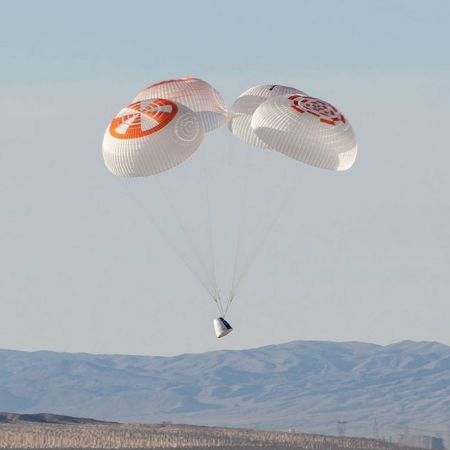
The French capsule startup The Exploration Company on May 19, 2026 successfully completed the first parachute drop test for its Nyx capsule in the Mojave desert in California.
I have embedded the company’s video of the test below. The screen capture to the right shows the capsule descending on its four main parachutes.
This test focused on one of the most critical phases of spacecraft recovery – the transition from drogue parachutes to the main parachutes that bring the vehicle safely to the ground. For this campaign, TEC used a dedicated drop test vehicle, or DTV, built specifically to evaluate parachute deployment, handover timing and vehicle dynamics during this phase of descent. The DTV was not designed to be a full spacecraft. It was designed to answer a precise engineering question: does the recovery system deploy in the right sequence, at the right time, with the expected behavior? This distinction matters. It allows us to focus effort and investment where it has the most impact – on the recovery system itself.
For this campaign, the DTV replicated the relevant mass properties, aerodynamic profile and key structural interfaces of the Nyx capsule, while using a robust internal structure and sacrificial outer panels to support ground impact, hardware recovery and future test campaigns.
The drop occurred when the helicopter carrying the DTV reached about 1.7 miles altitude. As the DTV dropped it appeared the parachute system worked perfectly, with the drogue chutes followed by the four parachutes releases as planned.
The company is targeting 2028 for the first orbital demo flight of Nyx itself. Its relatively fast-paced development in a sense puts to shame the American space industry, which except of SpaceX has not been able to develop such large orbital capsules. Northrop Grumman’s Cygnus capsule might be flying, but much of its development occurred not in the U.S. but in Europe. Meanwhile, Boeing’s Starliner and Sierra Space’s Dream Chaser both remain grounded and unused after more than a decade of development.

On Christmas Eve 1968 three Americans became the first humans to visit another world. What they did to celebrate was unexpected and profound, and will be remembered throughout all human history. Genesis: the Story of Apollo 8, Robert Zimmerman's classic history of humanity's first journey to another world, tells that story, and it is now available as both an ebook and an audiobook, both with a foreword by Valerie Anders and a new introduction by Robert Zimmerman.
The print edition can be purchased at Amazon or from any other book seller. If you want an autographed copy the price is $60 for the hardback and $45 for the paperback, plus $8 shipping for each. Go here for purchasing details. The ebook is available everywhere for $5.99 (before discount) at amazon, or direct from my ebook publisher, ebookit. If you buy it from ebookit you don't support the big tech companies and the author gets a bigger cut much sooner.
The audiobook is also available at all these vendors, and is also free with a 30-day trial membership to Audible.
"Not simply about one mission, [Genesis] is also the history of America's quest for the moon... Zimmerman has done a masterful job of tying disparate events together into a solid account of one of America's greatest human triumphs."--San Antonio Express-News
Hélène Huby has been both consistent and disciplined—The Exploration Company reminds me a little of Rocket Lab, though starting off with a different product. A CEO who is willing to get their hands dirty, and has both practical experience and a vision. Too often we get one or the other, or worse, neither. If she can bring manned launch to Europe and sell rides to the likes of Vast, Axiom, et al., the more power to her.
I was very impressed with the company’s video of this drop test: almost no dramatic background music, an understated narration focused on what is going on, and no fake interviews spouting blather about how wonderful the company is. Simple, honest, detailed, and to the point.
I wish more companies would follow this approach. It would make them more convincing.
In two places you refer to “three” main chutes. I count four.
Dick: Fixed. Age also limits one’s ability to count. :)
Helicopter is a civilian Boeng-Vertol CH-47 Chinook. It’s been in service with the US Army since 1960 and highly developed versions fly today, replacing the Sikorsky CH-54 Tarhe in the heavy lift role.. It was much in demand in Afghanistan due to its ‘high and hot’ capabilities. It is capable of both internal and sling loads. How do you replace an old Chinook? You buy a new one.
TEC is expected to reveal a reusable rocket somewhere between Falcon 9 and Falcon Heavy in payload, soon: https://x.com/dpoddolphinpro/status/2062588204239220902?s=46