
Want to know how big the Sun is?
Want to know how big the Sun really is? Go here for a great image.
Very brief descriptions, with appropriate links, of current or recent news items.
Want to know how big the Sun really is? Go here for a great image.
The political space war continues. The Senate Commerce Committee is going to propose on July 15 one extra shuttle flight and the immediate move to develop a “heavy-lift” rocket (which is merely another name for the Ares rocket).
The arrival of a new unmanned Progress freighter at ISS has gone wrong, with the freighter drifting past the station by several miles. What happened is not yet clear, but as far as I know from my research into the Russian space station program, this is the first time the automatic docking of a Progress freighter has failed this wildly. There have been some near collisions, but to miss by miles is unprecedented.
Whether they can redirect the freighter back to the station also remains as yet unknown.
Alan Boyle on his Cosmic Log webpage today has a nice report on astronaut photographer Douglas Wheelock and the spectacular pictures he is taking in his stint on ISS.
Here is another example of why I remain skeptical of any claims that the science of global warming is settled. Ken Stewart, a retired school teacher in Australia, decided to make a very detailed comparison between the raw data and adjusted data of all thirteen weather stations in the state of Victoria, and found that, for unknown reasons, the adjusted “data [has] been arbitrarily adjusted to cool earlier years,” thereby creating the illusion that the region’s climate has been warming since the 1930s.
Take a look at the many graphs on his webpage. It will make you wonder.
Why I never use Wikipedia. Key quote:
The larger moral of this story is that Wikipedia itself is a fundamentally flawed and unreliable source. In fact, it is wrong even to describe — much less to use — Wikipedia as a source. Wikipedia is merely a platform. Since anyone and everyone can edit Wikipedia entries and since they can do so anonymously, Wikipedia is, by its very nature, susceptible to constant manipulation.
Mission operators at the Applied Physics Lab in Maryland did a 35 second course correction yesterday on the New Horizon’s mission to Pluto, increasing its velocity by one mile per hour. The planned fly-by now set for July 14, 2015.
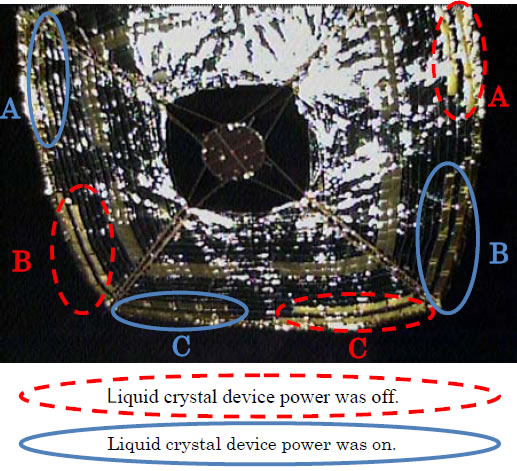
A new picture of the Japanese solar sail Ikaros has been released, showing the sail in operation. By turning power on and off to different sections along the sail’s rim, engineers can change the way light reflects off those sections to control the sail’s attitude in space without using fuel. Note also that the power comes from sunlight, not from batteries. The picture below illustrates this, with different parts of the rim either bright or dark, depending on whether they are powered or not.
NASA has now made it official: they have set the dates for the last two shuttle flights, extending the program into late February 2011. Considering the dissatisfaction in Congress and with the public over the lack of any replacement for the shuttle, don’t be surprised if at least one more shuttle flight gets added to the schedule.
Want to get a sense of the subtleties and complexity of rocket engineering? Go to this Chris Bergin report at nasaspaceflight.com about the unusual number of visible streaks of light that were seen in the engine plume of the shuttle’s main engines during the last flight of Atlantis. Who would have thought this matters? It does.
Enough with depressing space news. Take a break and watch Andrew Klaven’s totally untrue but very silly analysis of how global warming broke up the Gore marriage.