February 10, 2023 Zimmerman/Batchelor podcast
Embedded below the fold in two parts.
To listen to all of John Batchelor’s podcasts, go here.
» Read more
Very brief descriptions, with appropriate links, of current or recent news items.
Embedded below the fold in two parts.
To listen to all of John Batchelor’s podcasts, go here.
» Read more
Courtesy of BtB’s stringer Jay.
When you read what this deal really entails, you will laugh. It is typical of the kind of engineering achievements we have come to expect from Blue Origin: Empty PR campaigns having nothing to do with actually building something that will fly in space.
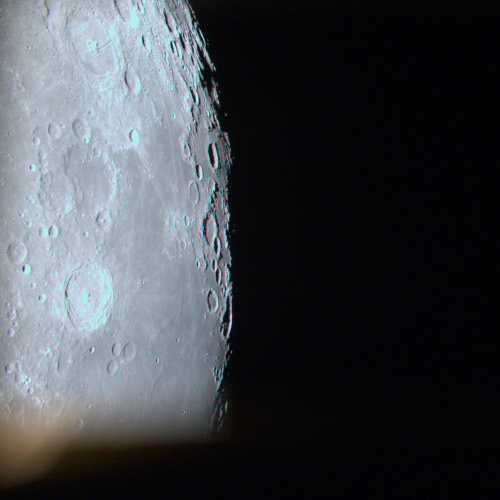
The release at the link is entirely in Japanese. According to Jay, “As of February 3 JAXA has now narrowed the cause of the RCS [reaction control system] failure to blockage of the diaphragm at the helium tank outlet.”
The picture at the link is hilariously pure science fiction. This ain’t happening, ever.
No blacklist column today. Been too busy with personal matters.
Cool image time! The picture to the right, rotated, cropped, reduced, and sharpened to post here, was taken on November 19, 2022 by the high resolution camera on Mars Reconnaissance Orbiter (MRO). It shows a collection of terraced mesas covered with dust of a variety of colors.
The bluish colors suggest exposed bedrock, while the different shades of tan suggest areas covered by dust and volcanic ash. That the tan areas are likely dust is strengthened in that it is found between and on these rough mesas, where dunes are also seen. The dust gets blown in but gets trapped there.
The tan colors however could also indicate different types of bedrock, especially because different terraces seem to be of different shades. We will need more data to determine which, or whether this is a combination of all these geological processes.
» Read more
Using its high resolution camera, the Curiosity science team has now released a November 2022 panorama looking south into Gediz Vallis, the Martian slot canyon that the rover will be entering in the near future.
The panorama above, cropped and reduced to post here, shows that canyon. The red dotted line indicates Curiosity’s approximate path since the panorama was taken, circling around behind Chenapua.
The mosaic is made up of 18 individual images that were stitched together after being sent to Earth. The color has been adjusted to match lighting conditions as the human eye would see them on Earth.
Not only should you definitely look at the original, at full resolution, but also compare it with the black and white mosaic I posted in December 2022, taken by the rover’s navigation camera looking in the same direction though from a slightly different position. The color definitely underlines the spectacular nature of the landscape.
NASA yesterday awarded Blue Origin the launch contract for its smallsat ESCAPADE Mars orbiter mission, set to launch in late 2024.
ESCAPADE will launch on Blue Origin’s New Glenn rocket from Space Launch Complex-36 at Cape Canaveral Space Force Station in Florida. Launch is targeted for late 2024. Blue Origin is one of 13 companies NASA selected for VADR contracts in 2022. NASA’s Launch Services Program, based at the agency’s Kennedy Space Center in Florida, manages the VADR contracts. As part of VADR, the fixed-price indefinite-delivery/indefinite-quantity contracts have a five-year ordering period with a maximum total value of $300 million across all contracts.
NASA’s VADR program is designed to give contracts to higher risk contractors to help those launch companies develop their rockets. Since New Glenn is years behind schedule and as-yet unlaunched, this contract is an attempt to help change that. Note however that it is fixed price, and does not set a deadline for Blue Origin to launch.
ESCAPADE will actually be two orbiters designed to study the faint artifacts of Mars’ magnetosphere left over from its past.
On its second launch attempt tonight, India’s SSLV rocket (Small Satellite Launch Vehicle) successfully reached orbit and deployed all three of its smallsat payloads.
On the first launch attempt in August 2022, the engine on the fourth stage, used to put the satellites in their preferred orbits, shut down prematurely due to a failure of its guidance system. Today, all worked as planned.
The hope of India’s space agency ISRO is that this rocket can garner some of the growing smallsat business. That it is three years delayed because of ISRO’s panic over Wuhan makes fulfilling that hope more difficult, because so much of that business has now been grabbed by other companies.
The 2023 launch race:
9 SpaceX
5 China
2 Russia
1 Rocket Lab
1 Japan
1 India
American private enterprise still leads China 10 to 5 in the national rankings, and the entire world combined 10 to 9.
Embedded below the fold in two parts.
To listen to all of John Batchelor’s podcasts, go here.
» Read more
Courtesy of BtB’s stringer Jay.
The video is an hour long, but well worth the watch.
I don’t believe her. You would have to be incredibly naive to not expect the Ukraine to use this tool in any way it could in its desperate fight against the Russians, especially in the early part of the war when Russia occupied gigantic parts of the Ukraine.

Government endorsed segregation in California
“Segregation today, segregation tomorrow, segregation forever!” A civil rights complaint has been filed by the organization Parents Defending Education against the Pajaro Valley Unified School District in Santa Cruz County, California, for offering a segregated teacher support program that specifically excluded some races from attending.
As the program’s leaflet to the right shows, the program for “people of color” would not only give only certain races beneficial training, it would also give those participants “a stipend” that was forbidden to some employees due to their race.
It also appears that the program is also discriminatory on who it hires, as the coaches shown on that flyer are all minorities. Apparently, whites (and especially white males) need not apply.
You can read the actual civil rights complaint here [pdf]. As it notes bluntly:
» Read more

Today’s Superheavy static fire test
SpaceX today successfully completed a 7-second-long static fire test of 31 of 33 Raptor-2 engines at the base Superheavy #7. The test ran for its full duration, and it appears no damage occurred to the launchpad. One engine shut down prior to test, and one shut down prematurely during the test. If this had happened during launch, the booster would still have had enough energy to get Starship to its required velocity to reach orbit.
The company will now have to analyze the test to determine whether it was sufficient to proceed to a March orbital launch. Certainly they will roll the booster back to the assembly building to exchange out the two engines that misfired.
All in all, it appears an orbital test flight of Starship could occur sometime in the next two months, assuming the FAA gets out of the way and issues the launch license.
EARLIER UPDATE:
—————-
Propellant loading is underway, and a rough time estimate for the actual static fire test is now 3 pm (Central).
Musk has now confirmed in a tweet that they are going to proceed to the test. It now appears that they have almost completed propellant loading. It appears they have filled the oxygen tanks, but not the methane tanks, and will probably not fill the methane tanks entirely for the test itself.
Original post:
—————-
No specific schedule has been announced of SpaceX’s attempt today to complete the first full 33-engine static fire test in Boca Chica of its seventh prototype of Superheavy, but a live stream is available from NASAspaceflight.com. I have embedded that live stream below.
The test will validate numerous systems, including the ground systems, the launchpad, the engines, and the systems for igniting all 33 in the proper sequence. Starship prototype #24 is not stacked on top of Superheavy in order to prevent any damage to it in case this test goes ugly. If so, SpaceX already has Superheavy prototype #9 ready to go in the nearby assembly building.

Curiosity’s view of the marker band on January 17, 2023, the red dotted line the planned future route. Click for full image.
The science team for the Mars rover Curiosity today revealed that the marker band layer where the rover present sits shows some of the best evidence of liquid water and waves yet seen on Mount Sharp, and it has been found much higher on the mountain than expected.
Having climbed nearly a half-mile above the mountain’s base, Curiosity has found these rippled rock textures preserved in what’s nicknamed the “Marker Band” – a thin layer of dark rock that stands out from the rest of Mount Sharp. This rock layer is so hard that Curiosity hasn’t been able to drill a sample from it despite several attempts. It’s not the first time Mars has been unwilling to share a sample: Lower down the mountain, on “Vera Rubin Ridge,” Curiosity had to try three times before finding a spot soft enough to drill.
Scientists will be looking for softer rock in the week ahead.
As Curiosity climbs the mountain it transitions onto new younger layers of rock. Based on Curiosity’s earlier data lower down the mountain, scientists had assumed it had gone from layers that had been under a past lake to layers that were at the lake’s shoreline to layers where only running water once flowed. They had thought the marker layer and other higher layers would only show evidence of running water. Instead, in the marker layer they have once again found evidence of an ancient lake.
This quote by Ashwin Vasavada, Curiosity’s project scientist, sums things up nicely: “Mars’ ancient climate had a wonderful complexity to it, much like Earth’s.”
ISRO on January 30, 2023 successfully completed a static fire test of a throttleable version of its Vikas rocket engine, used in the upper stage of both its PSLV and GSLV rockets as well as in the GSLV’S first stage, running the engine at 67 percent power for a time period of 43 seconds.
The ability to adjust the power level of the engine during launch will give ISRO the ability to attempt the recovery of the first stages, as well as expand the ability of these rockets to place more satellites per launch in different orbits.
Engineers from the United Arab Emirates (UAE) yesterday revealed that they are in the process of changing the orbit of their Al-Amal Mars orbiter so that it will be able to do several close fly-bys of the Martian moon Deimos.
Two of the three required manoeuvres have already been made, allowing it to reach a new orbit between 20,000km and 43,000km with a 25-degree incline towards the planet. “Previously, we didn’t have any reason to move the orbit,” Ms Al Matroushi said. “But now we’re exploring a new adventure and science mission.”
Engineers are using the probe’s three main science instruments to capture images and data of the moon. These include an exploration imager ― a high-resolution camera ― to photograph the moon, and the infrared and ultraviolet spectrometers to measure its temperature and observe its thermophysical properties, including its regolith, or dust.
The first Deimos fly-by took place in late January, and as the probe moves to its closest approach to the moon, it will take high-resolution images.
Eventually Al-Amal will dip as close as 60 miles of Deimos.
FCC has now given Amazon its license to launch the first 3,236 satellites in its Kuiper internet constellation, including with that license new de-orbiting requirements that exceed the FCC’s actual statutory authority.
The Federal Communications Commission approved Amazon’s plan Feb. 8 to deploy and operate 3,236 broadband satellites, subject to conditions that include measures for avoiding collisions in low Earth orbit (LEO).
Amazon got initial FCC clearance for its Ka-band Project Kuiper constellation in 2020 on the condition that it secured regulatory approval for an updated orbital debris mitigation plan. The FCC said its conditional approval of this mitigation plan allows “Kuiper to begin deployment of its constellation in order to bring high-speed broadband connectivity to customers around the world.” The conditions include semi-annual reports that Kuiper must give the FCC to detail the collision avoidance maneuvers its satellites have made, whether any have lost the ability to steer away from objects, and other debris risk indicators.
In the order, the FCC also requires Kuiper to ensure plans to de-orbit satellites after their seven-year mission keep inhabitable space stations in addition to the International Space Station in mind.
According to the license, Amazon must launch 1,600 of these satellites by 2026.
The de-orbit requirements are part of the FCC’s recent regulatory power grab, and has no legal basis. The FCC’s statutory authority involves regulating the frequency of signals satellites use, as well as acting as a traffic cop to make sure the orbits of different satellites do not interfere with other satellites. Nowhere has Congress given it the right to determine the lifespan of satellites, or the method in which they are de-orbited.
Right now however we no longer live in a republic run by elected officials. In Washington it is the bureaucracy that is in charge, Congress being too weak, divided, and corrupt to defend its legal power. Thus, the FCC can easily grab new powers that it has no right to have.
The European Space Agency (ESA) has successfully unfurled a solar sail from a cubesat in order to test using that sail to help de-orbit that cubesat more quickly.
The sail was deployed from a package measuring 3.93 by 3.93 by 3.93 inches (10 by 10 by 10 centimeters). The unfurling process was captured by an integrated camera onboard the Ion satellite carrier, which is operated by the Italian company D-Orbit.
The satellite will eventually burn up in the atmosphere, providing a quicker, residue-free method of disposal, according to ESA.
A short video of that unfurling can be viewed here.
This flight was intended as a proof of concept. Thus, ESA like many similar NASA test projects will now close the project down, which is dubbed ADEO, having no specific plans to do anything with what was learned. Private cubesat companies, however, might adopt this solar sail deployment technology, but I suspect less for de-orbit purposes but instead as a method of maneuvering their satellite in orbit.
The uncertainty of science: Astronomers have confirmed the existence of an uneven ring encircling the dwarf planet Quaoar, orbiting far enough from the planet that, according to present theories, the ring should have quickly coalesced into a small Moon.
At 1,110 km (690 miles) in diameter Quaoar is one of the largest objects known in the outer solar system. Its single moon, named Weywot, spans about 160 km and was discovered in Hubble images in 2007. But the first signs of material around Quaoar didn’t come until 2018; even then, evidence was insufficient to call it a ring, says Morgado. He began studying Quaoar in 2020 with the European Space Agency’s CHEOPS space telescope, originally designed to find and characterize exoplanets. Rather than looking for exoplanet transits, Morgado used CHEOPS to observe stellar occultations, when Quaoar passed in front of distant stars and momentarily blocked their light.
Now Morgado has extended his work, working with others to observe Quaoar’s stellar occultations using other telescopes. The team first predicted a few occultations and recorded them. Then, after those observations hinted at a ring, the researchers went back through previous occultation records. “We saw the ring in nine different regions, from observations taken between 2018 and 2021,” Morgado explains.
In Nature, the team reports the presence of a ring 4,100 kilometers from the center of Quaoar, far beyond its classical Roche limit of 1,780 km. Morgado says the ring is dense and irregular. “It has a very thin region about 5 km wide and also a large region about 300 km wide, depending on which part of the ring was probed,” he notes. If the material could all be collected into a single moon, it would be about 10 km in diameter, less than a tenth of Weywot’s size.
According to astronomers, they would expect such a ring at that distance to coalesce in just a matter of decades. Either their theories of the Roche limit are incorrect, or the creation of this ring is very very recent, caused by the collusion of two objects that were orbiting Quaoar.
Russia today completed its second launch of 2023, successfully using its Soyuz-2 rocket to send a Progess freighter on its way to ISS.
The capsule will dock with the leaking Zvezda module on ISS on February 11th.
The 2023 launch race:
9 SpaceX
5 China
2 Russia
1 Rocket Lab
1 Japan
American private enterprise still leads China 10 to 5 in the national rankings, and the entire world combined 10 to 8.
Link here. The key takeaway is that this commercial privately built and operated lunar smallsat is doing what it was designed to do, even as its operators continue to overcome periodic technical problems.
For example, beginning January 26th the spacecraft stopped receiving commands from ground controllers. The problem solved itself when on February 6th “an automatic command-loss timer rebooted” the spacecraft. Meanwhile,
CAPSTONE has completed more than 12 orbits in its near-rectilinear halo orbit – the same orbit [that will be used by Lunar] Gateway – surpassing one of the mission’s objectives to achieve at least six orbits. The mission team has performed two orbit maintenance maneuvers in this time. These maneuvers were originally scheduled to happen once per orbit, but the mission team was able to reduce the frequency while maintaining the correct orbit. This reduces risk and complexity for the mission and informs plans for future spacecraft flying in this orbit, like Gateway.
Essentially, mission controllers are figuring out the best and most efficient methods for eventually maintaining Lunar Gateway’s orbit around the Moon, when it gets there.
Because of thruster failures shortly after its December 11, 2022, NASA’s technology test lunar orbiter cubesat Lunar Flashlight has been unable to reach its planned orbit around the Moon.
Instead, first engineers have attempted an improvisation with the one thruster that had not initially failed, and when that did not work are now hoping to instead use the Earth’s gravity to shift its present path so that it will periodically fly over the Moon’s south pole, when it could possible still use its lasers reflectometer to gather data in the permanently shadowed craters there.
[Other than the thrusters, t]he rest of the CubeSat’s onboard systems are fully functional, and the mission recently successfully tested its four-laser reflectometer. This mini-instrument is the first of its kind and is designed and calibrated to seek out surface ice inside the permanently shadowed craters at the Moon’s South Pole.
As a engineering test satellite, everything that has happened has been to the good, as it has allowed these engineers to push this cutting edge cubesat technology to the limit.
Courtesy of BtB’s stringer Jay.
It appears from the tweet that the main topic was the propulsion systems to be used.
The tweet provides little information, other than a short uninformative video with stirring music.
The contract is part of the Space Force’s effort to have the ability to launch on 24 hours notice. Both Rocket Lab and Virgin Orbit are competing for similar contracts.
Lots of whining about SpaceX, as well as the difficulty of rocket science. Translation: Competition and rocketry demands the best from you. Don’t complain, deliver.
Though the manned orbital mission is presently slotted for 2024, it is very unlikely that target date will be met.
For this last quick link a hat tip to reader Richard M.