Russian astronauts repair oxygen regeneration unit

Russian astronauts on ISS have successfully repaired the oxygen regeneration unit on the Zvezda module.

From the TASS article was this additional information:

The Elektron-VM oxygen supply system developed by Russia’s Research and Design Institute of Chemical Machine-Building (NIIChimMash) has been operational aboard the space station since its creation. The system can generate from 25 to 160 liters of oxygen per hour and additionally from 50 to 320 liters of hydrogen per hour. In April 2010, it took the ISS crew several days to fix the broken system.

No word yet on any new information on the “fracture” that is causing the slow leak.

1 comment

SpaceX launches another 60 Starlink satellites

Capitalism in space: SpaceX today successfully launched another 60 Starlink satellites, raising the constellation to more than 800 satellites.

The first stage successfully landed, for the sixth time, on a drone ship. The company also recovered both fairings, which were making their third flight. With one fairing’s recovery however the net broke on the ship, which might have damaged it this time.

The leaders in the 2020 launch race:

26 China
17 SpaceX
11 Russia
4 ULA
4 Europe (Arianespace)

The U.S. had regained the lead over China, 27 to 26, in the national rankings.

7 comments

Another high altitude balloon company enters the space tourism market

Capitalism in space: Another high altitude balloon company, this time from Spain, is now vying for the space tourism market.

EOS-X Space, a Spanish startup, wants to take 10,000 people to the frontier of space within the next 10 years. With EOS-X Space, the journeys won’t be in rockets or ultrasonic planes. They’ll instead take place in a pressurized capsule propelled by a balloon that will rise to an altitude of up to 40 kilometers, or nearly 25 miles.

This means space tourists won’t have to wear a suit for the duration of the trip, nor will they have to do any physical preparation. Depending on the weather, each trip is set to last four or five hours.

They are targeting the same market as the American company Space Perspectives, which hopes to begin flying tourists on its stratospheric balloon, dubbed Neptune, by ’24.

5 comments

Spaceport America in New Mexico fires its head

The board of Spaceport America, Virgin Galactic’s launchsite for its SpaceShipTwo suborbital manned spacecraft, yesterday fired its long time Executive Directory Dan Hicks, at the same time governor of New Mexico removed one board member.

Hicks, the spaceport’s CEO since 2016, has been on administrative leave since June while allegations of mismanagement and abuse of authority have been under investigation by the New Mexico State Auditor and the New Mexico Spaceport Authority, the public body governing the spaceport.

The McHard Accounting Consulting firm, a forensic accounting firm based in Albuquerque, conducted an investigation which was then referred to the state auditor. Keyes informed a state legislative committee this summer the allegations included potential criminal activity.

Spaceport American had been made gigantic promises by Richard Branson back in the mid-2000s, including hundreds of tourist flights per year on SpaceShipTwo, all of which would bring lots of cash to the spaceport and to New Mexico. All came to naught. I suspect those failed promises are somehow connected to the accusations here.

0 comments

Delta 4 Heavy launch now delayed indefinitely due to launchpad issues

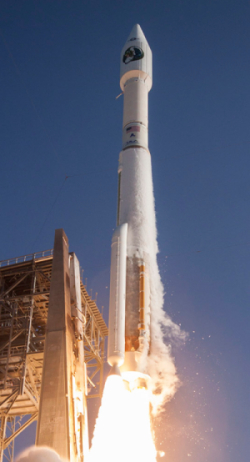
ULA has now delayed indefinitely the launch of a military reconnaissance satellite using its Delta 4 Heavy rocket because of ongoing issues in the swing arms on the launch tower.

According to ULA’s CEO, Tory Bruno:

..ULA was “working through an issue with pad hydraulics” associated with the swing arm retraction system at the Delta 4 launch pad. Three swing arms feeding propellants and conditioned air to the rocket and its satellite payload are designed to retract as the Delta 4-Heavy lifts off.

“Fixing is always easy,” Bruno tweeted. “Making sure something stays fixed takes more work and lots of discipline.”

This launch has been delayed numerous times in the past two months, almost always because of a variety of different problems, most related to the launchpad, with two scrubs occurring as launch aborts at launch. As the article at the link correctly notes,

The repeated problems with different parts of the Delta 4-Heavy’s launch pad have raised questions about aging infrastructure at pad 37B, which was originally built to support Saturn rocket launches in the 1960s, then mothballed until Boeing took over the facility in the 1990s for the Delta 4 program.

Boeing built the towering mobile gantry for the Delta 4 rocket, along with a then-new fixed umbilical tower with huge swing arms designed to pull away from the launcher as it climbs away from the pad.

The age of the launchpad, combined with the expensive complexity of the Delta 4 Heavy that results in very few launches spread over many years, cannot result in reliable operations.

1 comment

Chang’e-4 and Yutu-2 awake for 23rd lunar day on far side of the Moon

The new colonial movement: China’s Chang’e-4 lander and Yutu-2 rover have both been reactivated for their 23rd lunar day on far side of the Moon.

Yutu 2 is set to continue its journey northwest from the landing site and will target a roughly 12-inch (30 centimeters) rock on the rim of a nearby crater for analysis with a spectrometer. The rover has used that instrument to analyze a range of specimens in Von Kármán crater, notably causing a stir when it discovered an impact melt breccia initially described as “gel-like.”

It is the hope of the Chinese scientists that this rock will be ejected material from that crater and will have come from the lunar interior.

Also, though you need to read Chinese to understand how to access it, the project has released to the public another batch of data from both spacecraft.

0 comments

ArianeGroup completes testing of all three Ariane 6 rocket engines

Capitalism in space: ArianeGroup, the joint private partnership that is building Europe’s new Ariane 6 rocket, has successfully completed all testing of the three different engines the rocket will use.

The first stage has a core engine with side strap-on solid rocket motors, while the upper stage has a different engine entirely. All three have now passed qualification tests, allowing full design and construction of the rocket itself.

1 comment

Old launch tower burns down at Firefliy launchpad at Vandenberg

Capitalism in space: Apparently workers dismantling the old launch tower at Firefliy’s new launchpad at Vandenberg started a fire that burned the tower down.

A photo showing the former Delta II rocket’s Space Launch Complex-2 facility with flames and a huge column of black smoke rising from the distinctive blue tower began circulating on social media sites on Thursday night.

The launch site, most recently used for liftoffs of United Launch Alliance’s Delta II rockets, has been handed over to Texas-based Firefly Aerospace, which is developing a new family of rockets as an economical way to carry small- to medium-sized satellites into space.

The firm has a long-term lease to use the site with hopes of saving money by using some of the existing facilities. Firefly has plans to dismantle the historic tower, and a contractor armed with welding equipment reportedly sparked the blaze Thursday.

No word yet on whether this fire will delay Firefly’s planned first launch in the spring.

1 comment

Leak on ISS traced to “fracture”

Not good news: According the Russian news source TASS, Russian astronauts have pinpointed the location of the slow leak on ISS to ” a fracture in the intersection compartment of the Russian Zvezda module.”

The astronaut also called it a “scratch,” which means the fracture is not yet confirmed. They will do more testing to find out if this is the leak source in the coming days.

If it is a fracture, the ramifications could be very serious. It appears the “intersection compartment” is the area where the aft docking port is located, which is also the area where many Progress freighters have docked in the twenty years since Zvezda was launched. Thus, this could be a stress fracture that can only get bigger with time. Its location might also preclude further dockings at this port, limiting arrivals of future Progress cargo ships.

Fun fact: They pinpointed this location using a floating tea bag.

The tea bag’s sway in zero gravity conditions towards the air leak overboard the space station was registered by cameras, the cosmonaut said. “We believe that we have really identified the probable leakage area. We have distributed a tea bag [in the Zvezda module] before closing the transfer chamber,” Ivanishin said.

The tea bag’s movement was recorded, the Russian cosmonaut said.

12 comments

Update on InSight’s mole: It is now underground

InSight's mole now completely buried
Click for full image.

An update today on the mole digging tool on the Mars lander InSight has revealed that the mole appears to finally be completely buried, though it remains unclear whether its most recent digging effort had succeeded in digging downward.

We found that during the first two rounds of hammering and during the first half of the third round of hammering, the scoop went further into the sand. Since the Mole was hidden under the scoop, the penetration of the probe itself could not be observed directly.

During the hammering, the flat tether running to the probe moved considerably, but these could only be clearly identified as forward movements during the hammering on 22 August. Overall, we could estimate from the movements of the scoop that the Mole moved at most one centimetre further into the ground. It was interesting to observe that during the second half of the round of 250 hammer blows on 19 September, the scoop did not go any further, probably because it encountered duricrust. This was certainly a desired outcome, as it allowed a second Free Mole Test to be conducted. In fact, the probe continued to move according to the movements of the tether, but it could not be clearly determined that these movements brought the Mole deeper into the ground.

The image shows InSight’s arm above the filled hole, with the mole’s flat tether coming out of the ground.

They are now going to fill the hole more, and then press down with the scoop during later drilling efforts to see if this allows the mole to proceed downward. If it fails I’m not sure if there is anything else they will be able to do to get the mole to work.

9 comments

Threatened collision between two big pieces of space junk does not happen

Follow-up observations of the two big pieces of space junk, a Soviet-era defunct satellite and a Chinese upper stage, that had a high chance of colliding yesterday has confirmed that no collision occurred.

Shortly after the time of probable collision, the CZ-4C stage passed over the Kiwi Space radar tracking station in New Zealand. According to LeoLabs, “Shortly after [time of probable collision], we will have a direct pass of CZ-4C R/B over our Kiwi Space Radar in New Zealand. We have scheduled a search mode scan during this time to ensure we only see two objects as expected and hopefully confirm that no new debris is detected.”

This is exactly what happened, with the only observed object being the single CZ-4C stage — indicating no collision had occurred.

It is fortunate nothing happened. Though the collision point was about 360 miles higher than the orbit of ISS, the debris from a collision would have been flung in all directions, some of which might have crossed the space station’s path.

0 comments

Study: Almost impossible to contract COVID-19 on an airplane

New research into the air filtration systems on commercial passenger jets has found that it is almost impossible to contract COVID-19 while on an airplane.

A new military-led study unveiled Thursday shows there is a low risk for passengers traveling aboard large commercial aircraft to contract an airborne virus such as COVID-19 — and it doesn’t matter where they sit on the airplane.

Researchers concluded that because of sophisticated air particle filtration and ventilation systems on board the Boeing 767-300 and 777-200 aircraft — the planes tested for the study — airborne particles within the cabin have a very short lifespan, according to defense officials with U.S. Transportation Command, the Defense Advanced Research Project Agency (DARPA) and Air Mobility Command, which spearheaded the study.

You can read the report [pdf] here. I especially like this quote from their conclusions:

For the 777 and 767, at 100% seating capacity transmission model calculations with a 4,000 viruses/hour shedding rate and 1,000 virus infectious dose show a minimum 54 flight hours required to produce inflight infection from aerosol transmission.

In other words, you can fly around the world more than twice on the same plane, without stopping, without any real risk of getting infected.

Need I add that the use of a mask will likely make no difference either, while probably increasing your chances of catching some disease simply because the long term use of any single mask is unsanitary and almost guarantees it will be carrying pathogens on your face where you breathe?

9 comments
1 851 852 853 854 855 2,413