Sunspot update: The number of sunspot continues to decline

For only the second time since I started this website in 2010, I forgot last month to do my monthly sunspot update. No matter. The Sun’s behavior in producing sunspots in the past two months was actually amazingly similar, so doing both months at once works.

According to NOAA’s monthly graph of the sunspot activity on the Earth-facing hemisphere, the amount of sunspots in both March and April continued to be low, well below the predictions put forth by NOAA’s panel of scientists in their April 2025 prediction.

That graph is below, annotated with extra information by me to illustrate the larger scientific context.
» Read more

11 comments

China imposes extensive regulations on its pseudo-commercial space industry

China's communists to its citizens
China’s communists to its citizens “Nice business you got here.
Shame if something happened to it.”

As I predicted when China announced in the fall 2025 that it was creating a special agency to supervise the pseudo-companies in its faux commercial space industry, the Chinese government last week announced the release of what it calls its “Commercial spaceflight standards system,” covering all aspects of the operations its pseudo-private companies.

The standards cover six different areas, but the first best expresses the government’s overall goal:

‘Industry Governance Standards’ focuses on the sector’s characteristics of rapid development, agile response, and short delivery times, alongside space safety concerns such as debris mitigation and protection. With subcategories including market access, safety supervision, space environment governance, certification, energy conservation, and occupational health, it is intended to establish hard regulatory constraints as the compliance foundation for orderly commercial space development. [emphasis mine]

The screen capture from a Monty Python skit to the right says it all. The communists running China apparently did not like the chaotic free nature of this pseudo-industry, with the different companies coming up with many wild and innovative ideas, some of which were bound to fail. The communists also saw that some of these pseudo-companies were also making a lot of money that the communists weren’t getting.

And so, the government formed this agency, and it called the companies together to lay down the law.
» Read more

4 comments

Genesis cover

On Christmas Eve 1968 three Americans became the first humans to visit another world. What they did to celebrate was unexpected and profound, and will be remembered throughout all human history. Genesis: the Story of Apollo 8, Robert Zimmerman's classic history of humanity's first journey to another world, tells that story, and it is now available as both an ebook and an audiobook, both with a foreword by Valerie Anders and a new introduction by Robert Zimmerman.

The print edition can be purchased at Amazon or any other book seller. If you want an autographed copy the price is $60 for the hardback and $45 for the paperback, plus $8 shipping for each. Go here for purchasing details. The ebook is available everywhere for $5.99 (before discount) at amazon, or direct from my ebook publisher, ebookit. If you buy it from ebookit you don't support the big tech companies and the author gets a bigger cut much sooner.


The audiobook is also available at all these vendors, and is also free with a 30-day trial membership to Audible.
 

"Not simply about one mission, [Genesis] is also the history of America's quest for the moon... Zimmerman has done a masterful job of tying disparate events together into a solid account of one of America's greatest human triumphs."--San Antonio Express-News

Is SpaceX buying a 200-plus square mile patch of Louisiana?

Pecan Island SpaceX facility?

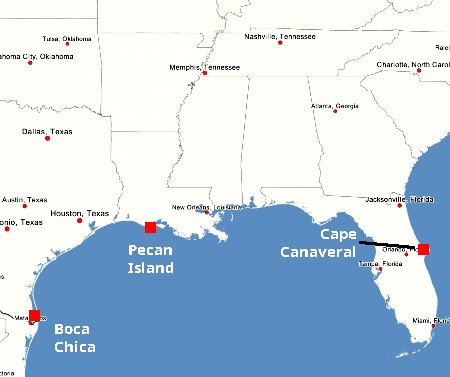
According to a real estate agent in Louisiana, there is credible but unconfirmed evidence that SpaceX is in the process of buying a 136,000 acre plot of land owned by Exxon on the coast of Louisiana west of New Orleans, near the unincorporated town of Pecan Island.

The rumor — repeated in private group chats, in coffee shops in Abbeville, and in hunting camps from Forked Island to Grand Chenier — is that SpaceX has acquired or is in the process of acquiring approximately 136,000 acres of coastal Louisiana marshland straddling Pecan Island and Freshwater City in Vermilion Parish. The footprint reportedly stretches from south of Highway 82 down to the Gulf of America, encompassing some of the most ecologically rich and economically untouched wetlands in North America.

If true, this would be the single largest private land acquisition in the modern history of Vermilion Parish. To put it in perspective: 136,000 acres is roughly 212 square miles — bigger than the entire city of New Orleans. SpaceX’s existing Boca Chica/Starbase facility in South Texas, which has reshaped Brownsville’s economy and real estate market in just five years, is built on a footprint of less than 100 acres. A 136,000-acre Louisiana site would not be a launch pad. It would be an industrial campus on a scale never before seen in American aerospace.

I must emphasize that this agent is speculating, and that there is no confirmed evidence that SpaceX is the rumored buyer. At the same time, the agent has done his homework. This purchase by SpaceX would make sense on multiple levels. It would give it a very large facility smack dab between Boca Chica and Florida, on the Gulf, so that if Starships are manufactured here they could be easily shipped both east and west to those launch sites. This facility would also give SpaceX to option of shifting more of its operations out of unfriendly California and to a more friendly state, something Elon Musk has been doing since the Covid panic.

It would allow for the construction of larger data centers and satellite manufacturing factories, without much opposition from local communities.

Finally, there is the possibility this location could also serve as a spaceport, though it would only work well for polar orbits.

Stay tuned. If this speculation is true we should find out momentarily.

Hat tip reader Steve Golson.

27 comments

SpaceX launches South Korean Earth imaging satellite plus 44 other smallsats

SpaceX at about midnight tonight successfully launched a South Korean Earth imaging satellite as well as 44 other smallsats, its Falcon 9 rocket lifting off from Vandenberg Space Force Base in California. As of posting the satellites had not yet been deployed.

The first stage (B1071) completed its 33rd flight, landing back at Vandenberg, 50 days after its previous flight. With this flight, the booster moves into a third place tie with the Atlantis shuttle shuttle in the rankings of the most reused launch vehicles:

39 Discovery space shuttle
34 Falcon 9 booster B1067
33 Atlantis space shuttle
33 Falcon 9 booster B1071
32 Falcon 9 booster B1063
31 Falcon 9 booster B1069
28 Columbia space shuttle
27 Falcon 9 booster B1077
27 Falcon 9 booster B1078

Sources here and here.

The leaders in the 2026 launch race:

54 SpaceX
23 China
8 Russia
6 Rocket Lab

For the third straight year SpaceX leads the entire world combined in total launches, 54 to 44.

0 comments

Conscious Choice cover

Now available in hardback and paperback as well as ebook!

From the press release: In this ground-breaking new history of early America, historian Robert Zimmerman not only exposes the lie behind The New York Times 1619 Project that falsely claims slavery is central to the history of the United States, he also provides profound lessons about the nature of human societies, lessons important for Americans today as well as for all future settlers on Mars and elsewhere in space.

 
Conscious Choice: The origins of slavery in America and why it matters today and for our future in outer space, is a riveting page-turning story that documents how slavery slowly became pervasive in the southern British colonies of North America, colonies founded by a people and culture that not only did not allow slavery but in every way were hostile to the practice.  
Conscious Choice does more however. In telling the tragic history of the Virginia colony and the rise of slavery there, Zimmerman lays out the proper path for creating healthy societies in places like the Moon and Mars.


“Zimmerman’s ground-breaking history provides every future generation the basic framework for establishing new societies on other worlds. We would be wise to heed what he says.” —Robert Zubrin, founder of the Mars Society.


All editions are available at Amazon, Barnes & Noble, and all book vendors, with the ebook priced at $5.99 before discount. All editions can also be purchased direct from the ebook publisher, ebookit, in which case you don't support the big tech companies and the author gets a bigger cut much sooner.


Autographed printed copies are also available at discount directly from the author (hardback $29.95; paperback $14.95; Shipping cost for either: $6.00). Just send an email to zimmerman @ nasw dot org.

Leaving Earth cover

Leaving Earth: Space Stations, Rival Superpowers, and the Quest for Interplanetary Travel, can be purchased as an ebook everywhere for only $3.99 (before discount) at amazon, Barnes & Noble, all ebook vendors, or direct from my ebook publisher, ebookit.

If you buy it from ebookit you don't support the big oppressive tech companies and I get a bigger cut much sooner.


Winner of the 2003 Eugene M. Emme Award of the American Astronautical Society.

 
"Leaving Earth is one of the best and certainly the most comprehensive summary of our drive into space that I have ever read. It will be invaluable to future scholars because it will tell them how the next chapter of human history opened." -- Arthur C. Clarke

$2 bill that Gene Cernan carried on three missions sells for more than $90K

The $2 bill that astronaut Gene Cernan carried on all three of his space missions in 60s and 70s has now sold at auction for $91,519.

Signed and flight-certified by Cernan, the bill is encapsulated and graded by Paper Money Guaranty (PMG) as Choice Fine 15. The holder notes its provenance as having been flown aboard Gemini 9A (1966), Apollo 10 (1969), and Apollo 17 (1972), and traces its origin to Cernan’s personal collection.

A signed letter of provenance from Cernan states that the bill was originally owned by his father and later carried by the astronaut on each of his spaceflights. The letter documents its presence during low Earth orbit on Gemini 9A, lunar orbit on Apollo 10, and on the lunar surface during Apollo 17.

This auction was space-focused and realized a total of $1,764,603. It included items from a number of other Gemini and Apollo missions, including an American flag that astronaut Dave Scott flew on Gemini 8, the mission that achieved the first docking in space but then had to due an emergency splashdown because a thruster began firing uncontrollably. It sold for $47,406.

Hat tip reader Wayne DeVette.

2 comments

No Starliner mission to ISS this year

Though in February 2026 NASA officials suggested there might be a Starliner cargo mission to ISS sometime in April 2026, the new schedule released today for ISS manned and cargo missions for the rest of this year shows no Starliner missions at all.

The press release hinted an extra Starliner mission could be added, but don’t but too much faith in this:

Launch opportunities for NASA’s uncrewed Boeing Starliner-1 cargo mission remain under review as teams continue working through technical issues discovered during the Crew Flight Test in 2024, as well as final actions from the Program Investigation Team report. The agency is assessing operational readiness and space station traffic to determine the earliest feasible launch window.

What I think is happening in NASA is that the agency under Isaacman wants a better assurance from Boeing that the problems with Starliner have been fixed, and Boeing is having trouble satisfying them. If so, it seems he is doing what I suggested in February, demand from Boeing the highest quality work or don’t buy anything from it at all. If so kudos to Isaacman.

It is also possible Isaacman doesn’t want to spend extra money paying Boeing for this extra cargo mission to prove out Starliner’s systems. Boeing’s contract for Starliner is fixed price, and the capsule’s multiple problems has now cost the company more than a billion dollars. It is unlikely it will have make a profit on it, which is why it wants NASA to pay for that cargo flight.

Either way, the first operational manned mission using Starliner continues to recede into the future, to the point where ISS might be gone before the capsule is finally okayed for manned flights.

14 comments

May 1, 2026 Quick space links

Courtesy of BtB’s stringer Jay. This post is also an open thread. I welcome my readers to post any comments or additional links relating to any space issues, even if unrelated to the links below.

5 comments

SpaceX launches 29 more Starlink satellites

SpaceX today successfully placed another 29 Starlink satellites into orbit, its Falcon 9 rocket lifting off from Cape Canaveral Space Force Station in Florida.

The first stage (B1069) completed its 31st flight, landing on a drone ship in the Atlantic, 63 days after its previous flight. It remains in 6th place in the rankings of the most reused launch vehicles:

39 Discovery space shuttle
34 Falcon 9 booster B1067
33 Atlantis space shuttle
32 Falcon 9 booster B1071
32 Falcon 9 booster B1063
31 Falcon 9 booster B1069
28 Columbia space shuttle
27 Falcon 9 booster B1077
27 Falcon 9 booster B1078

Sources here and here.

The leaders in the 2026 launch race:

53 SpaceX
23 China
8 Russia
6 Rocket Lab

For the third straight year SpaceX continues to lead the entire world combined in total launches, 53 to 44.

2 comments

Next Artemis mission will be later than promised

Artemis logo

It appears that NASA has already recognized that the next Artemis mission, dubbed Artemis-3 and changed from a lunar landing to an Earth orbit test flight, will not happen on the schedule as first proposed by NASA administrator Jared Isaacman.

During the hearing on Monday, Congressman Hal Rogers (R-Ky.), chairman emeritus of the committee, asked Isaacman about his confidence that Artemis 3 would remain on schedule, given the amount of money allocated for the mission’s landers.

“I’ve received responses from both vendors [SpaceX and Blue Origin],” Isaacman said, “to meet our needs for a late 2027 rendezvous, docking and test [of] the interoperability of both landers in advance of a landing attempt in 2028.”

That’s a shift from Isaacman’s statements during his Feb. 27 Artemis strategy presentation, during which he said, “Artemis 3 will have its opportunity, if we can, by mid-2027, which sets us up for an early ’28 and a late ’28 opportunity [for Artemis 4 and 5].” [emphasis mine]

In other words, Artemis-3 has already shifted from mid-’27 to late-’27. Though Isaacman is pushing hard to speed up the launch cadence of the entire Artemis program, reality is once again proving stronger. We should fully expect Artemis-3 to shift into 2028, partly because the lunar landers — especially Blue Origin’s Blue Moon — might not be ready but mostly because SLS is simply too cumbersome a rocket to stack quickly. Isaacman wants to speed up its launch cadence to once a year. The best we should expect is 18 months to two years.

As for getting two manned lunar landings in 2028, Isaacman might want it but the odds are slim to none. If Artemis-3 flies in late ’27 it will be almost impossible to get SLS ready for a landing mission before the end of ’28.

In the end, these delays will illustrate the need to replace SLS with private commercial launchers.

26 comments

FCC approves new spectrum rules to give new constellations more capacity

The Federal Communications Commission (FCC) yesterday approved new spectrum rules proposed by SpaceX that will increase the capacity of all the new low-Earth-orbit constellations by as much as seven times.

The commission introduced the new rules earlier this month before approving them at a Thursday meeting. The revamp targets the Equivalent Power Flux Density (EPFD) rules, which were developed in the late 1990s and limited the amount of energy satellite systems could transmit to and from ground equipment. The regulations were also designed to prevent radio signal interference between higher-orbiting geostationary satellites and lower-orbiting systems. But during the vote, Carr said the decades-old existing rules were “holding back” newer satellite internet offerings.

“Modern satellite designs make it far easier to share spectrum than what yesterday’s regulations assumed. We can do a lot better,” he said. Carr touted the 7x increase when the commission found the revamped rules could enable “eight satellites to provide service simultaneously in a given geographic area and frequency band, instead of being effectively limited to one satellite under current EPFD limits.”

The FCC was sold on this change after SpaceX conducted its own tests in orbit, using Starlink satellites, to demonstrate it could work. The rule change will benefit all the new constellations, which is why Amazon’s Leo constellation supported the change as well.

The speed in which the FCC acted on this matter must also be noted. It did not bother with long studies of its own. It quickly reviews SpaceX’s work, realized it made sense, and scheduled the vote at its very next meeting. This constrasts starkly with the FCC during the Biden administration, which routinely slow-walked or even opposed such suggestions.

4 comments
1 14 15 16 17 18 2,929