
Sunspot update: The number of sunspot continues to decline
For only the second time since I started this website in 2010, I forgot last month to do my monthly sunspot update. No matter. The Sun’s behavior in producing sunspots in the past two months was actually amazingly similar, so doing both months at once works.
According to NOAA’s monthly graph of the sunspot activity on the Earth-facing hemisphere, the amount of sunspots in both March and April continued to be low, well below the predictions put forth by NOAA’s panel of scientists in their April 2025 prediction.
That graph is below, annotated with extra information by me to illustrate the larger scientific context.
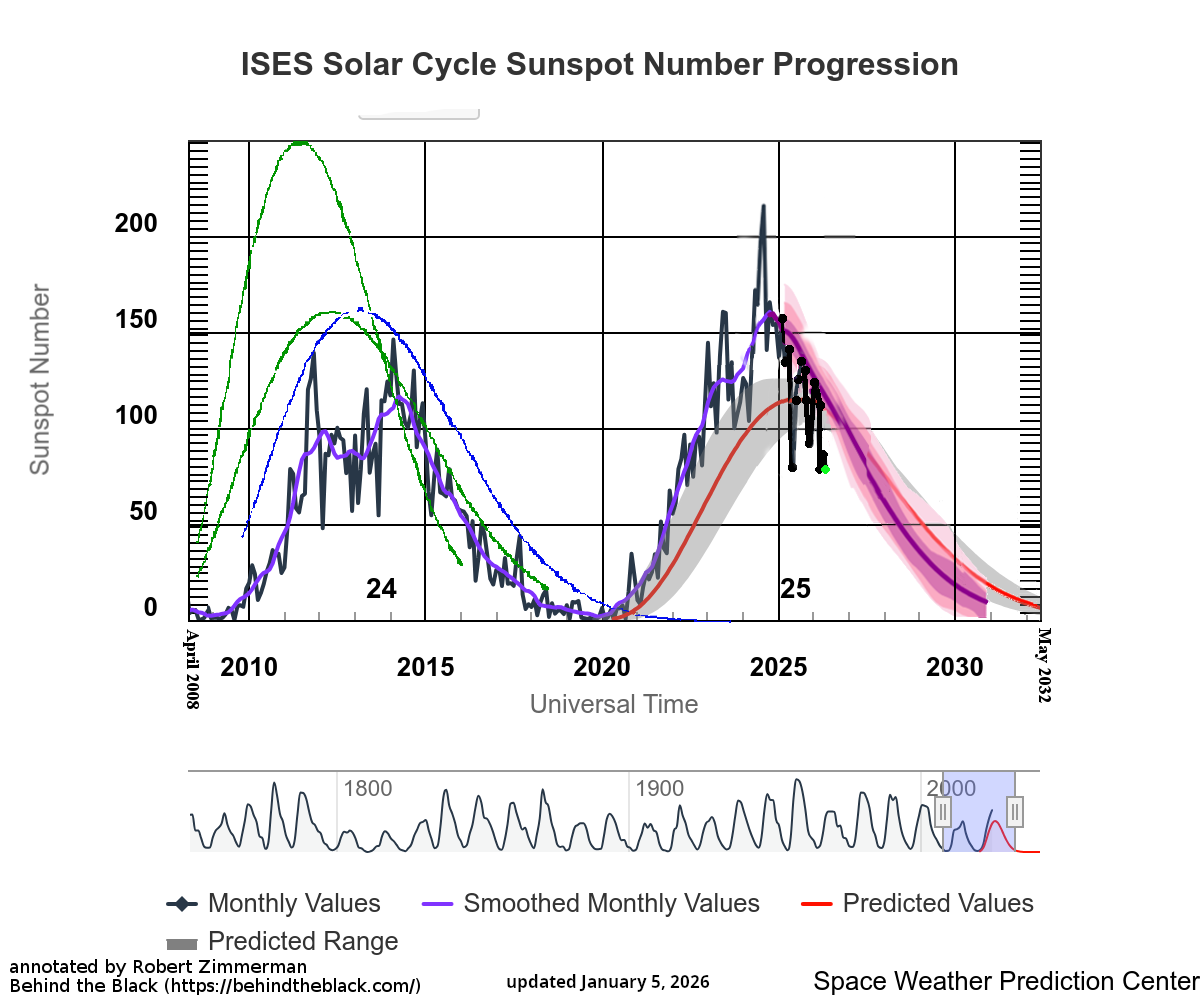
The graph above has been modified to show the predictions of the solar science community for both the previous solar maximum as well as the ongoing maximum. The green curves show the community’s two original predictions from April 2007 for the previous maximum, with half the scientists predicting a very strong maximum and half predicting a weak one. The blue curve is their revised May 2009 prediction. The red curve is the new prediction, first posted by NOAA in April 2020. At the beginning of April 2025 NOAA’s panel of solar scientists added the purple/magenta curve line, predicting that solar maximum was over, and that the ramp down to minimum had begun.
The green dot marks the activity in April, only slightly higher than the low set in February, which had the fewest sunspots in a month since 2022, including three consecutive days in which the Sun had no visibile sunspots at all.
As has been routine since I started doing these updates, the Sun’s behavior has not matched the predictions. While for most of this solar cycle, the ramp up to solar maximum was much faster and more active than predicted, the ramp down has generally been faster but less active than predicted.
And while the predictions for the last cycle (the blue and green curves) said it would be more active than it was, the prediction for the ongoing cycle (the red curve) said it would less active than it was.
All in all, it appears this solar cycle will be as unprecedented as the previous one. Both cycles were relatively weak but short in length, with the ongoing cycle trending to be even shorter than the last. In the past, short cycles were always associated with very active sunspot activity, while long cycles were linked to weak cycles.
The past two cycles now appear to break that pattern.
The weakness of the past two cycles might also explain why the climate stopped heating up in the past two decades. The global warming activists that poison the climate field have labeled this simply “a pause” in global warming, when they admit it exists at all. They have no explanation for that “pause”, because in general they try to minimize the Sun’s importance in determining the Earth’s climate.
And yet, the Sun is the primary determinate of that climate. Furthermore, there is ample evidence (though circumstantial) that high sunspot cycles cause a warming on Earth, while low sunspot cycles (as we have seen in the past two cycles) cause the Earth’s climate to cool, as suggested by that “pause.” There are theories as to what causes this link, though none have been confirmed.
Of course, all this assumes the Sun’s ramp down to minimum will continue, following the trend of the past two years. This remains a dangerous assumption. We don’t understand the fundamentals that cause this cycle, so to assume anything about its future behavior is risky and likely to be wrong.

On Christmas Eve 1968 three Americans became the first humans to visit another world. What they did to celebrate was unexpected and profound, and will be remembered throughout all human history. Genesis: the Story of Apollo 8, Robert Zimmerman's classic history of humanity's first journey to another world, tells that story, and it is now available as both an ebook and an audiobook, both with a foreword by Valerie Anders and a new introduction by Robert Zimmerman.
The print edition can be purchased at Amazon or from any other book seller. If you want an autographed copy the price is $60 for the hardback and $45 for the paperback, plus $8 shipping for each. Go here for purchasing details. The ebook is available everywhere for $5.99 (before discount) at amazon, or direct from my ebook publisher, ebookit. If you buy it from ebookit you don't support the big tech companies and the author gets a bigger cut much sooner.
The audiobook is also available at all these vendors, and is also free with a 30-day trial membership to Audible.
"Not simply about one mission, [Genesis] is also the history of America's quest for the moon... Zimmerman has done a masterful job of tying disparate events together into a solid account of one of America's greatest human triumphs."--San Antonio Express-News
The climate alarmists would jump on the “sun causes climate change” bandwagon if only they could figure out a way to monetize it.
“””with half the scientists predicting a very strong maximum and half predicting a weak one.”””
Reminds me of the gamblers at the Roulette Tables. The one’s that place bets on both the red and black. They can attest to always “winning.”
PS – What is the number of accumulated anecdotes that must accrue in order to become evidence? We were born and raised in the San Francisco Bay area. We have spent the last 30 years in the Greater Sacramento area. WITHOUT FAIL, every time there is a significant, unseasonal drop in temperature, for weeks or an entire month, coincides with the Sunspot report of less or none.
And the question remains:
How much is the increasing level of CO2 in earth’s atmosphere effecting the number of sunspots and the output of the sun?
Another mystery of the universe to solve.
Cotour: Heh.
It always pays to ask cutting edge questions, and with those cutting-edge questions sometimes you can begin to see the actual answers in a way you might not expect.
And here I think an answer presents itself: It always starts with compassion: https://youtube.com/shorts/5hI51RDyARA?si=W5Ym9m0TQvJ3hBvp
Seeks to point to the cosmic rays-cloud formation theory. High sunspot activity, magnetic forces of sun fewer cosmic rays hit the earth’s atmosphere, lessening cloud formation leading to warming. Low sunspot activity, more cosmic rays hit earth, more clouds hence a cooling effect.(Dr. Svensen’s theory?)
Jerry Greenwood – sunspot tax coming in 3, 2, 1. The only question is whether the tax will be on more sunspots or less. Maybe both if they can tie it to ‘interstate commerce’.
Contour is definitely “onto something!” Now, where can be found “Grant” money?
Correction on my previous comment. I was referring to a Danish physicist,Henrik Svensmark ,who has been researching cosmic rays and their effect on cloud formation hence heating or cooling the earth. Linking said cosmic rays to magnetic effect of varying levels of sunspots.
Raymond Adams: Svensmark’s work has been covered here, back in 2011, though in that report it is Jasper Kirkby who is listed as chief scientist behind the experimental work.
Shh, Cotour..they’ll say it was poor Sol huffing spent Falcon upper stages…nasty habit, that.
At least the meth scabs are healing over