
Looking Way Out There From Way Out There: The Future of Space Astronomy

On Christmas Eve 1968 three Americans became the first humans to visit another world. What they did to celebrate was unexpected and profound, and will be remembered throughout all human history. Genesis: the Story of Apollo 8, Robert Zimmerman's classic history of humanity's first journey to another world, tells that story, and it is now available as both an ebook and an audiobook, both with a foreword by Valerie Anders and a new introduction by Robert Zimmerman.
The print edition can be purchased at Amazon or any other book seller. If you want an autographed copy the price is $60 for the hardback and $45 for the paperback, plus $8 shipping for each. Go here for purchasing details. The ebook is available everywhere for $5.99 (before discount) at amazon, or direct from my ebook publisher, ebookit. If you buy it from ebookit you don't support the big tech companies and the author gets a bigger cut much sooner.
The audiobook is also available at all these vendors, and is also free with a 30-day trial membership to Audible.
"Not simply about one mission, [Genesis] is also the history of America's quest for the moon... Zimmerman has done a masterful job of tying disparate events together into a solid account of one of America's greatest human triumphs."--San Antonio Express-News
Become a Super Amateur: Amateurs astronomers do original research
Epsilon Aurigae: Astronomy’s longest-running mystery show
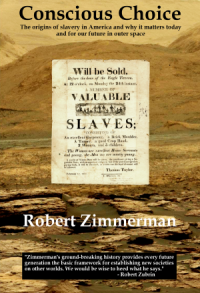
Now available in hardback and paperback as well as ebook!
From the press release: In this ground-breaking new history of early America, historian Robert Zimmerman not only exposes the lie behind The New York Times 1619 Project that falsely claims slavery is central to the history of the United States, he also provides profound lessons about the nature of human societies, lessons important for Americans today as well as for all future settlers on Mars and elsewhere in space.
Conscious Choice: The origins of slavery in America and why it matters today and for our future in outer space, is a riveting page-turning story that documents how slavery slowly became pervasive in the southern British colonies of North America, colonies founded by a people and culture that not only did not allow slavery but in every way were hostile to the practice.
Conscious Choice does more however. In telling the tragic history of the Virginia colony and the rise of slavery there, Zimmerman lays out the proper path for creating healthy societies in places like the Moon and Mars.
“Zimmerman’s ground-breaking history provides every future generation the basic framework for establishing new societies on other worlds. We would be wise to heed what he says.” —Robert Zubrin, founder of the Mars Society.
All editions are available at Amazon, Barnes & Noble, and all book vendors, with the ebook priced at $5.99 before discount. All editions can also be purchased direct from the ebook publisher, ebookit, in which case you don't support the big tech companies and the author gets a bigger cut much sooner.
Autographed printed copies are also available at discount directly from the author (hardback $29.95; paperback $14.95; Shipping cost for either: $6.00). Just send an email to zimmerman @ nasw dot org.
cover story, What is Wrong With the Sun?
The Cassell Cave Project, Monograph #3 of the West Virginia Speleological Survey
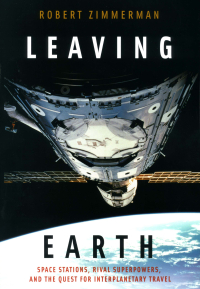
Leaving Earth: Space Stations, Rival Superpowers, and the Quest for Interplanetary Travel, can be purchased as an ebook everywhere for only $3.99 (before discount) at amazon, Barnes & Noble, all ebook vendors, or direct from my ebook publisher, ebookit.
If you buy it from ebookit you don't support the big oppressive tech companies and I get a bigger cut much sooner.
Winner of the 2003 Eugene M. Emme Award of the American Astronautical Society.
"Leaving Earth is one of the best and certainly the most comprehensive summary of our drive into space that I have ever read. It will be invaluable to future scholars because it will tell them how the next chapter of human history opened." -- Arthur C. Clarke
Biologists Struggle to Solve Bat Deaths
Sun’s Behavior Flummoxes Solar Scientists
Light from the Unknown
Cosmic Cataclysms: The Merger of Supermassive Black Holes
Understanding Beta Lyrae: A Very Messy Star Seen for the First Time
Taking Venus by Storm: The results from Venus Express
Cover story: The Life and Death of Super Suns: the secrets of Wolf-Rayet stars
Web essay, May 25, 2008 posting
What Makes Mira Tick?
Witness to Cosmic Collisions The Swift Telescope Helps Unlock the Mystery of Short Gamma Ray Bursts
The Man Who Doubled the Sky: John Herschel’s Survey of the Heavens
Gamma-Ray Burst Mystery Unraveled
History’s Moment of Truth
The next five years will determine, for good or ill, the future of U.S. manned space exploration for decades to come. More significant, a confluence of forces will accelerate that process.
Several of these forces rely on the decisions of Michael Griffin, NASA’s administrator. Just as crucial will be the actions of Congress and the public, and the success or failure of several private entrepreneurs, including a former programmer who is trying to rebuild the American rocket industry single-handed.
Consider first the decisions of Griffin. He faces a serious problem trying to complete and supply the International Space Station. Because his predecessor, Sean O’Keefe, chose to rely solely on the space shuttle to ferry supplies, crew and new construction modules to the station, Griffin remains entirely dependent on the Russians, because the trio of remaining shuttles was grounded after the Columbia accident in 2003.
Worse, unless Griffin can get a shuttle replacement designed and built by 2010, he will have no way to ferry supplies or crew to ISS after that, if the shuttle is retired that year as planned.
» Read more
Signs of a Renaissance
There may be many problems apparent at NASA and among the U.S. aerospace giants these days, but there also are signs that space exploration is about to undergo a renaissance, with an explosion of creativity unseen in decades.
To explain this conclusion will require telling a personal anecdote, which begins in the mid-1980s.
» Read more