More images of Ikaros

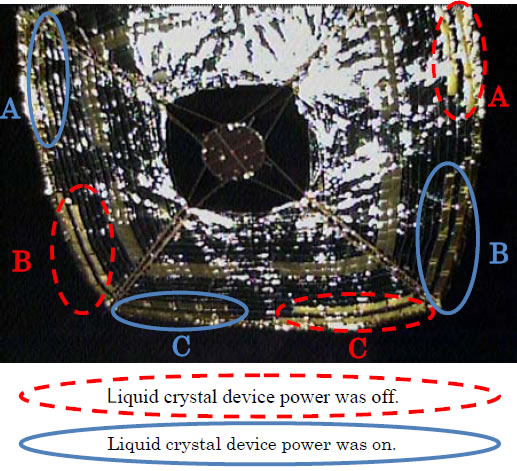
A new picture of the Japanese solar sail Ikaros has been released, showing the sail in operation. By turning power on and off to different sections along the sail’s rim, engineers can change the way light reflects off those sections to control the sail’s attitude in space without using fuel. Note also that the power comes from sunlight, not from batteries. The picture below illustrates this, with different parts of the rim either bright or dark, depending on whether they are powered or not.

Ikaros as seen on June 19, 2010

0 comments

Genesis cover

On Christmas Eve 1968 three Americans became the first humans to visit another world. What they did to celebrate was unexpected and profound, and will be remembered throughout all human history. Genesis: the Story of Apollo 8, Robert Zimmerman's classic history of humanity's first journey to another world, tells that story, and it is now available as both an ebook and an audiobook, both with a foreword by Valerie Anders and a new introduction by Robert Zimmerman.

The print edition can be purchased at Amazon or any other book seller. If you want an autographed copy the price is $60 for the hardback and $45 for the paperback, plus $8 shipping for each. Go here for purchasing details. The ebook is available everywhere for $5.99 (before discount) at amazon, or direct from my ebook publisher, ebookit. If you buy it from ebookit you don't support the big tech companies and the author gets a bigger cut much sooner.


The audiobook is also available at all these vendors, and is also free with a 30-day trial membership to Audible.
 

"Not simply about one mission, [Genesis] is also the history of America's quest for the moon... Zimmerman has done a masterful job of tying disparate events together into a solid account of one of America's greatest human triumphs."--San Antonio Express-News

Conscious Choice cover

Now available in hardback and paperback as well as ebook!

From the press release: In this ground-breaking new history of early America, historian Robert Zimmerman not only exposes the lie behind The New York Times 1619 Project that falsely claims slavery is central to the history of the United States, he also provides profound lessons about the nature of human societies, lessons important for Americans today as well as for all future settlers on Mars and elsewhere in space.

 
Conscious Choice: The origins of slavery in America and why it matters today and for our future in outer space, is a riveting page-turning story that documents how slavery slowly became pervasive in the southern British colonies of North America, colonies founded by a people and culture that not only did not allow slavery but in every way were hostile to the practice.  
Conscious Choice does more however. In telling the tragic history of the Virginia colony and the rise of slavery there, Zimmerman lays out the proper path for creating healthy societies in places like the Moon and Mars.


โ€œZimmermanโ€™s ground-breaking history provides every future generation the basic framework for establishing new societies on other worlds. We would be wise to heed what he says.โ€ โ€”Robert Zubrin, founder of the Mars Society.


All editions are available at Amazon, Barnes & Noble, and all book vendors, with the ebook priced at $5.99 before discount. All editions can also be purchased direct from the ebook publisher, ebookit, in which case you don't support the big tech companies and the author gets a bigger cut much sooner.


Autographed printed copies are also available at discount directly from the author (hardback $29.95; paperback $14.95; Shipping cost for either: $6.00). Just send an email to zimmerman @ nasw dot org.

Leaving Earth cover

Leaving Earth: Space Stations, Rival Superpowers, and the Quest for Interplanetary Travel, can be purchased as an ebook everywhere for only $3.99 (before discount) at amazon, Barnes & Noble, all ebook vendors, or direct from my ebook publisher, ebookit.

If you buy it from ebookit you don't support the big oppressive tech companies and I get a bigger cut much sooner.


Winner of the 2003 Eugene M. Emme Award of the American Astronautical Society.

 
"Leaving Earth is one of the best and certainly the most comprehensive summary of our drive into space that I have ever read. It will be invaluable to future scholars because it will tell them how the next chapter of human history opened." -- Arthur C. Clarke

A quick analysis of the new Obama Space Policy

You can read it here, if you have a mind. It is filled with the typical go-gooder blather that you find in every policy statement produced by every politician and his or her policy wonks, from either party.

Nonetheless, the Obama policy is far different from the Bush policy. The Bush philosophy for NASA is probably best ipitomized by this speech by Mike Griffin, former NASA administrator during the Bush administration. The key quote:

I am convinced that leadership in the world of the 21st Century and beyond will go to the nation that seeks to fulfill the dreams of mankind. We know what motivates those dreams. Exploring new territory when it becomes possible to do so has defined human striving ever since our remote ancestors migrated out of the east African plains. The human imperative to explore new territories, and to exploit the resources of these territories, will surely be satisfied, by others if not by us. What the United States gains from a robust, focused program of human and robotic space exploration is the opportunity to define the course along which this human imperative will carry us.

In other words, the focus during the Bush years was to have the United States lead the way in exploring and colonizing the solar system, with NASA in charge.

The Obama philosophy in this new space policy is far less interested in exploration. Instead, the focus is on international cooperation and sharing the universe with everyone. Here is for me the key quote from the policy statement:

As established in international law, there shall be no national claims of sovereignty over outer space or any celestial bodies. The United States considers the space systems of all nations to have the rights of passage through, and conduct of operations in, space without interference. Purposeful interference with space systems, including supporting infrastruction, will be considered an infringement of a nation’s rights.

In other words, space is a communal farm, shared by everyone.

The sense I also get from reading the Obama policy is a focus not in pushing outward to explore the unknown, to go where no one has ever gone before, but on looking back at the Earth to make things on Earth better. Both the “Principles” and “Goals” as outlined in the Obama Policy (pages 2 and 3) say very little about exploration. Instead, the focus is on stimulating the world’s space industry in order to improve life on Earth. The proposal to send humans to an asteroid and eventually to Mars is listed near the end of the document, almost as an afterthought.

Some will like this new approach. Others will detest it. From my perspective, it is simply naive.

First of all, the fantasy that territory in space will remain communal property, unowned by any person or nation, is foolish. The space colonists who will go there to live are eventually going to tell us to go to hell, and will then set up their own nations — with property rights — if only to guarantee that they have the same rights that we here on Earth enjoy.

Second, the exploration of space is not being done to make life on Earth better. That is certainly a significant side benefit, but the people sweating to build new rockets and spaceships are not doing it for these reasons. They are doing it because they want to explore and colonize the solar system. And they are doing it because they want to make money at it.

In the end, the problem with establishing a policy that is not based on reality is that reality will eventually bite back. Just because the United States wants to play nice with everyone and share space with the rest of the world does not mean that the rest of the world will do the same. In fact, it almost guarantees that they won’t. Other nations are going to immediately try to fill the vacuum this Obama policy creates.

Unfortunately, for the near future things do not look good for the American effort in space.

0 comments

Space War between Congress and Obama: Apparently Not So Hot

Revised.

Though it has appeared that many if not most members of Congress have been unhappy with the Obama administration’s efforts to shut down the Constellation program, I have always believed that in the end, Congress wouldn’t have the fortitude to force its desires on the President. The action yesterday by the House appropriations subcommittee that funds NASA to take a neutral position on Obama’s proposals demonstrates this. They are willing to give NASA the extra money that Obama propopses, but they also have said that a compromise between Congress and the President on the future of the manned program must be agreed to before the money can be spent. See also this story in today’s Wall Street Journal.

In other words, the appropriations committee has passed the buck to the House Science and Technology committee. I expect that committee will find a way to pass the buck somehow as well. And if they don’t pass the buck, I suspect they will work out a compromise that on the surface will allow committee members to claim they “saved” NASA, but in reality will do nothing of the kind.

In the end, I believe the American government manned space program is going to die. Whether the new emerging private space industry can pick up the slack in today’s American Soviet-style bureaucratic society remains an unknown.

1 comment

Behind the Black

At the end of the last spacewalk during this last servicing mission to Hubble, astronaut John Grunsfeld took a few moments to reflect on Hubble’s importance. This was Grunsfeld’s third spaceflight and eighth spacewalk to Hubble, and no one had been more passionate or dedicated in his effort to get all of Hubble’s repairs and upgrades completed.

“As Arthur C. Clarke says,” Grunsfeld said, “the only way of finding the limits of the possible is by going beyond them into the impossible.”

For most of human history, the range of each person’s experience was of a distant and unreachable horizon. This untouchable horizon defined “the limits of the possible.” No matter how far an individual traveled, there was always a forever receding horizon line of unknown territory tantalizingly out of reach before him.

In earliest prehistoric times, the size of the known territory within that horizon line was quite small. Each villager knew a region ranging from ten to fifty miles in radius. He or she knew there were people and villages beyond the horizon, but never saw them. Moreover, even the most traveled explorer had a limit to his range, and knew that at some distant point what lay beyond that horizon was a complete mystery.

Later, as human civilization progressed, the size of known territory within that horizon line expanded. Different cultures met, exchanged information about each other, and recorded the data so that even those who did not travel far from their homes could know something of distant lands beyond their personal horizon. Still, explorers who pushed the horizon found that it continued to forever recede. No matter how far they traveled, the horizon was always ahead of them, an impossible goal beckoning them onward to find new lands unexplored.

Then humans reached the ocean and the sailors took over. To the mariner, there was still a forever receding horizon of great mystery, but he initially feared traveling out towards it because it was dangerous and risky. The ocean was a vast desert, with no food or water. Worse, that desert could suddenly become violent, heaving his ship about and tearing it to shreds.

With time, ship designs improved, and the mariners began journeying outward. The Vikings sailed out into the northern seas to find more lands and more endless unknown territories. Later, using better ships that were more reliable, Columbus pushed the western horizon and this time the visit was permanent. Even for Columbus, however, the horizon was still an impossible goal out of reach. He had sailed west, hoping to reach China and thus circumscribe the very limits of the horizon. Instead he discovered the New World, with its vast new territories and unlimited possibilities.

Nonetheless, the impossibility of touching that horizon had never been a deterrence, for either Columbus or anyone else. As the poet Robert Browning wrote, “Ah, but a man’s reach should exceed his grasp,/Or what’s a heaven for?” People from all cultures felt compelled to reach for that unreachable distant goal, “to go beyond the possible and try to touch the impossible.”

It was with Magellan, however, that the impossible became possible, and the limits of the horizon were finally reached. For though he set out “to sail beyond the sunset,” traveling west as far as he could go, the horizon did not recede forever away from him into unknown lands. Instead, the survivors of Magellan’s epic voyage circled the globe and found themselves back where they had started, in a known place. The unknown horizon was gone. Humanity for the first time knew the limits of the world. The impossible no longer existed.

For the next five centuries the human race was consumed with learning and exploring and settling the limits of this Earth, delving into its every corner, from the freezing poles to the bottom of the ocean to the highest mountaintop. In all cases, however, the Earth was a prison, placing a curb to exploration. No matter how deeply humans probed, they were still trapped on a spherical world, a giant prison floating in the blackness of space. There was no visible but untouchable horizon to reach for.

The Hubble Space Telescope, along with all the early manned and unmanned space probes of the past half century, have given us that horizon back. We are no longer trapped on this Earth. We now can travel outward with increasing sophistication, either in manned spaceships or with unmanned robots like Hubble, pushing against a new infinite horizon that — instead of a horizon line — is a black sky above us and receding away from us in all directions.

Perhaps the best and most noble of all human behaviors has been the never-ending effort to push back against that infinite blackness, to find out what lies behind it and get some fundamental answers to our questions about life, the universe, and existence itself. For me, it is essential that all of us always ask that next question, always challenge what is known so as to find out what is unknown, and always reach out for that “unreachable star.”

Grunsfeld finished his last spacewalk to Hubble by adding this one small thought, “As Drew [Feustel] and I go into the airlock, I want to wish Hubble its own set of adventures, and with the new set of instruments we’ve installed, that it may unlock further mysteries of the universe.”

Hubble, as well as all human exploration, has given us the first detailed and clear glimpse of what lies hidden in the black untouchable horizon above us. May we not shirk from that adventure, but reach out to grasp it fully, even if we cannot ever really touch its limits.

Revised from the afterword of the paperback edition of The Universe in a Mirror.

56 comments
1 2,915 2,916 2,917 2,918 2,919 2,930