
FCC grants waiver to Amazon Leo constellation, despite its failure to launch on time

Amazon Leo logo

The Federal Communications Commission (FCC) yesterday granted [pdf] a license waiver to Amazon, allowing it to continue deploying its Leo constellation even though the company will fail to meet its license requirement to get half its constellation (1,616 satellites) into orbit by July 2026.

While granting the waiver, the FCC also made it clear Amazon still needs to meet the license’s deadline for full deployment of all 3,232 satellites by July 30, 2029.

In the event Amazon Leo fails to satisfy the final milestone on July 30, 2029, this will result in reduction of the total number of Amazon Leo’s authorized satellites to the total number of satellites that are operational on that date.

In other words, the Leo constellation will be truncated if Amazon fails to get the full constellation up on time.

To further encourage Amazon to meet future deadlines, the FCC also stated that the satellites of Amazon’s first-half constellation that are launched late — after the July 2026 deadline — will lose certain spectrum rights for the next 20 months, “or until 50% of the constellation is launched and operational, whichever occurs first.” This order is expressly designed to encourage the company to accelerate its launch pace.

Finally, the FCC declared that Amazon will forfeit its surety bond for not meeting its July 30, 2026 launch obligation.

Launching almost 3,000 satellites in the next three years is still going to be challenging. Right now Amazon is dependent mostly on two grounded and as yet unproven rockets (Vulcan and New Glenn) and a third (Ariane-6) that cannot launch at a very quick pace for at least another two years. And its additional a ten-launch contract with SpaceX won’t be sufficient to get the entire constellation in orbit on time.

In other words, unless Vulcan and New Glenn get fixed quickly and resume launches, Amazon is going to have trouble meeting the FCC’s final deadline.

14 comments

ULA’s Atlas-5 rocket launches 29 Leo satellites for Amazon

ULA this evening successfully placed 29 more Leo satellites into orbit for Amazon, its Atlas-5 rocket lifting off from Cape Canaveral Space Force Station in Florida.

ULA is in the process of retiring the Atlas-5 rocket. It now has only seven Atlas-5 rockets left in stock, with one reserved for Leo launches and six for Boeing’s Starliner manned capsule (though there is a good chance some if not all of the Starliner launches will be switched to other payloads). Because its Vulcan rocket, intended to replace Atlas-5, is presently grounded, the company appears to be accelerating Atlas-5 launches, with the last few launches space only about a month apart.

With this launch, Amazon now has 331 Leo satellites in orbit, out of the 1,616 it needs to launch by July to meet its FCC license requirement. It is not going to meet that requirement, because two of the five rockets it contracted for launches are presently grounded (ULA’s Vulcan and Blue Origin’s New Glenn), and only one launch is presently scheduled before July, by Arianespace’s Ariane-6. Furthermore, ULA has only one more Atlas-5 scheduled for Leo, and the ten launches Amazon had purchased from SpaceX are not scheduled. For these reasons, Amazon has asked for a time extension, which the FCC is presently considering.

As this was only the fourth launch by ULA in 2026, the leader board for the 2026 launch race remains unchanged:

63 SpaceX
30 China
8 Russia
7 Rocket Lab

For the third straight year SpaceX leads the entire world combined in total launches, 63 to 54.

3 comments

Blue Origin’s next New Glenn rocket explodes during static fire test on the launchpad

New Glenn explosion

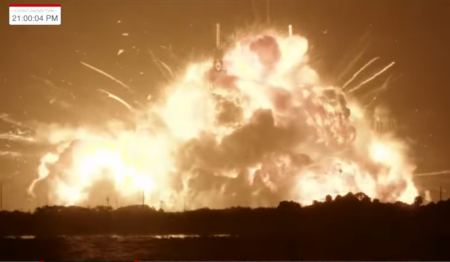
During a static fire test of the first stage tonight in preparation for the next launch scheduled for June 4), Blue Origin’s New Glenn rocket exploded just as the test began, destroying the first stage and much of the only launchpad the company has to launch this rocket.

The link above is cued to just before the explosion, shown in a screen capture to the right. BtB’s stringer Jay just sent me a link to a different video view, from farther away but is in some ways as spectacular. According to Blue Origin’s statement, all workers are accounted for, so fortunately there were no fatalities.

The rocket was to launch 48 Amazon Leo satellites. As those satellites were not on the rocket during this test, they are safe and can be launched elsewhere.

The failure will likely prevent any further New Glenn launches by Blue Origin for at least three to six months. Not only does the company have to determine and fix the cause of the failure, it will need to rebuild the launchpad. At best I expect the company will at best manage one test launch before the end of the year.

As for Amazon, this puts it in a big bind. It has only 302 satellites in orbit, but is required to have launched 1,616 by July, according to its FCC license. It has requested a waiver but the FCC has not yet responded. At the moment of the four companies it has hired to launch the satellites, two are now grounded:

  • ULA’s Vulcan rocket: 39 launches [GROUNDED]
  • Blue Origin’s New Glenn rocket: 24 launches (reduced from 27) [GROUNDED]
  • Arianespace’s Ariane-6 rocket: 18 launches (2 completed)
  • SpaceX’s Falcon-9: 13 launches (3 completed)
  • ULA’s Atlas-5 rocket: 8 launches (6 completed)

There is no timeline for when Vulcan and New Glenn will fly again. Arianespace hopes to do four to six more launches in ’26, but only one is an Amazon Leo launch, in June. ULA has six additional Atlas-5 rockets in stock, purchased by Boeing to launch its Starliner capsule to ISS. It is very possible a deal could be arranged with Boeing to switch some of those flights to Leo, since at present there are no plans to launch Starliner in the near future.

All in all, Amazon’s only remaining option is SpaceX. Of the ten unflown launches in the SpaceX contract, none are as yet scheduled. It is now likely Amazon will negotiate a deal with SpaceX to accelerate that schedule. While SpaceX’s own launch manifest is quite crowded (launching its own Starlink constellation), making such a deal difficult, the company has also demonstrated its willingness to help competitors. It launched OneWeb satellites when that company’s deal with the Russians fell through. And it quickly launched those first three Leo missions, faster than anyone else.

This also will impact NASA’s just announced unmanned lunar lander program. One mission planned for this year, Blue Origin’s Blue Moon Mark-1 unmanned lander, was scheduled to launch on a New Glenn. In addition, a second New Glenn was set to launch NASA’s Viper rover next year. Neither will happen as scheduled.

68 comments

Several major American satellite companies release a joint guide on “orbital safety”

Working with the American Institute of Aeronautics and Astronautics (AIAA), the American satellite companies building large orbital constellations — SpaceX, Amazon, Iridium, and Eutelsat — have now released a joint reference guide for building and operating their satellites, dubbed “Satellite Orbital Safety Best Practices 3.0.”

  • Emphasizes the design phase for improved orbital safety
  • Stresses pre-launch coordination and collision avoidance analysis, especially near crewed vehicles, mitigating hazards during post-launch identification and cataloging of new orbital objects
  • Provides guidance on data sharing across design and operations emphasizing the critical importance of sharing and screening high quality ephemeris with covariance from deployment through disposal
  • Includes an Appendix with data exchange recommendations to mitigate conjunctions

The companies have apparently decided they needed to get together to make sure they were not stepping on each other’s toes. I would expect other companies to soon join this cooperative effort, as it is in no one’s interest to have satellites colliding in orbit.

12 comments

FCC approves new spectrum rules to give new constellations more capacity

The Federal Communications Commission (FCC) yesterday approved new spectrum rules proposed by SpaceX that will increase the capacity of all the new low-Earth-orbit constellations by as much as seven times.

The commission introduced the new rules earlier this month before approving them at a Thursday meeting. The revamp targets the Equivalent Power Flux Density (EPFD) rules, which were developed in the late 1990s and limited the amount of energy satellite systems could transmit to and from ground equipment. The regulations were also designed to prevent radio signal interference between higher-orbiting geostationary satellites and lower-orbiting systems. But during the vote, Carr said the decades-old existing rules were “holding back” newer satellite internet offerings.

“Modern satellite designs make it far easier to share spectrum than what yesterday’s regulations assumed. We can do a lot better,” he said. Carr touted the 7x increase when the commission found the revamped rules could enable “eight satellites to provide service simultaneously in a given geographic area and frequency band, instead of being effectively limited to one satellite under current EPFD limits.”

The FCC was sold on this change after SpaceX conducted its own tests in orbit, using Starlink satellites, to demonstrate it could work. The rule change will benefit all the new constellations, which is why Amazon’s Leo constellation supported the change as well.

The speed in which the FCC acted on this matter must also be noted. It did not bother with long studies of its own. It quickly reviews SpaceX’s work, realized it made sense, and scheduled the vote at its very next meeting. This constrasts starkly with the FCC during the Biden administration, which routinely slow-walked or even opposed such suggestions.

4 comments

Two launches yesterday

Both SpaceX and Arianespace successfully completed orbital launches yesterday. First, SpaceX placed another 24 Starlink satellites into orbit, its Falcon 9 rocket lifting off from Vandenberg Space Force Base in California. The first stage completed its 13th flight, landing on a drone ship in the Pacific.

Next, Arianespace placed 32 more Amazon Leo satellites in orbit, its Ariane-6 rocket lifting off from France’s French Guiana spaceport in South America. The expendable Ariane-6 launched for the second time in its most powerful configuration, with four side boosters. This was also Arianespace’s second launch this year, so it remains off the leader board below. It is also the second launch in Arianespace’s 18-launch contract with Amazon to launch Leo satellites. The satellites were placed at an orbit of 465 kilometers, which SpaceX has claimed violates its Starlink orbital territory. Amazon has agreed what it is doing is a violation, but says it will continue to do so for this and two more launches.

With this launch, Amazon now has 302 Leo satellites in orbit, out of the 1,616 it needs to launch by July to meet its FCC license requirement. The company’s request for a time extension is presently pending at the FCC.

The leaders in the 2026 launch race:

52 SpaceX
23 China
8 Russia
6 Rocket Lab

For the third straight year SpaceX continues to lead the entire world combined in total launches, 52 to 44.

Russia was also supposed to do a test suborbital launch of its new Soyuz-5 rocket. As of posting I have not been able to confirm whether the launch took place.

8 comments

ULA launches 29 Leo satellites

ULA last night successfully launched another 29 Amazon Leo satellites into orbit, its Atlas-5 rocket lifting off from Cape Canaveral Space Force Station in Florida.

ULA is in the process of retiring the Atlas-5 rocket. It now has only eight Atlas-5 rockets left in stock, with two reserved for Leo launches and six for Boeing’s Starliner manned capsule (though there is a good chance some if not all of the Starliner launches will be switched to other payloads). Because its Vulcan rocket, intended to replace Atlas-5, is presently grounded, the company appears to be accelerating Atlas-5 launches, with this launch only about 24 days after the previous launch.

With this launch, Amazon now has 270 Leo satellites in orbit, out of the 1,616 it needs to launch by July to meet its FCC license requirement. Because it is not expected to meet that requirement, the company has asked for a time extension, which the FCC is presently considering.

As this was only the third launch by ULA in 2026, the leader board for the 2026 launch race remains unchanged:

50 SpaceX
23 China
8 Russia
6 Rocket Lab

For the third straight year SpaceX continues to lead the entire world combined in total launches, 50 to 43.

2 comments

Amazon buys Globalstar satellite constellation

Amazon Leo logo

As part of an effort by Amazon to make its Leo internet constellation more competitive with SpaceX’s Starlink constellation, the company has just completed a deal for about $11 billion to acquire the Globalstar satellite constellation, which includes Globalstar’s partnership with Apple and its Iphones.

The Seattle-based company’s agreement to acquire the satellite operator behind Apple’s iPhone Emergency SOS feature promises to give it a new constellation of operating satellites, a key slice of mobile spectrum, and Apple as a flagship partner.

…Under a separate long-term agreement announced along with the deal, Amazon Leo will power satellite features on future iPhone and Apple Watch models, including Emergency SOS, messaging, Find My location sharing, and roadside assistance. Amazon will also continue supporting the Apple devices that already rely on Globalstar’s existing network.

In other words, Amazon’s Leo internet constellation is now primed to also provide extensive cell phone service, service that at the moment appears superior to the cell service that Starlink can offer.

Or not. Amazon is playing catch-up, with Starlink operational and owning the market with millions of signed-up customers. It needs to offer a superior product to convince people to eithe buy it or switch to it. This deal is part of that effort.

2 comments

Amazon to begin commercial availability of Leo internet service in mid-2026

Amazon Leo logo

In an annual letter [pdf] to shareholders, Amazon’s CEO Andy Jassy announced the company plans on inaugurating its Leo internet constellation to customers in “mid-2026,” assuming the company can get a significant more satellites in orbit in the next few months.

Jassy’s wording was interestingly vague, however, suggesting this target date is very uncertain.

Over the last seven years, we’ve built a low Earth orbit satellite network (Amazon Leo) and put more than 200 satellites into space (which is the third-largest low Earth orbit network operating today). With a few thousand more satellites launching in the coming years, the constellation is expanding rapidly.

…While Amazon Leo is officially scheduled to launch in mid-2026, we already have meaningful revenue commitments from enterprises and governments.

To be precise, Amazon presently has launched 241 satellites, out of the 1,616 it needs to launch by July 2026 to meet its FCC license requirement. Because it is not expected to meet that requirement, the company has asked for a time extension, which the FCC is presently considering. The entire first generation constellation is supposed to have 3,232 satellites, so it seems unlikely Amazon will be able to provide internet service by mid-2026, as promised. It won’t have enough coverage with less than a fourth of its constellation in orbit.

0 comments

ULA launches 29 Leo satellites for Amazon

ULA early this morning successfully placed 29 Leo satellites for Amazon’s internet constellation, its Atlas-5 rocket lifting off from Cape Canaveral Space Force station in Florida.

This was the heaviest Atlas-5 payload so far launched by ULA, and ULA’S fifth launch for Amazon’s Leo constellation, which now has 241 satellites in orbit, out of the 1,616 it needs to launch by July to meet its FCC license requirement. Because it is not expected to meet that requirement, the company has asked for a time extension, which the FCC is presently considering.

ULA is in the process of retiring the Atlas-5 rocket. It now has only nine Atlas-5 rocket left in stock, with three reserved for Leo launches and six for Boeing’s Starliner manned capsule (though there is a good chance some if not all of the Starliner launches will be switched to other payloads).

This was also ULA’s second launch in 2026, which means the leader board for the 2026 launch race remains unchanged:

41 SpaceX
16 China
5 Rocket Lab
5 Russia

SpaceX continues to lead the entire world combined in total launches, as it did in both ’24 and ’25.

12 comments

Amazon responds to SpaceX’s FCC complaint about its last Leo satellite launch

Amazon Leo logo

Amazon yesterday submitted a letter [pdf] to the Federal Communications Commission (FCC) responding to SpaceX’s FCC complaint earlier this week that accused it of using Arianespace’s Ariane-6 rocket to place 32 Leo satellites in a 450 kilometer orbit — 50 kilometers more than its license allowed — causing SpaceX to maneuver 30 of its own Starlink satellites to avoid any collisions.

In its response, Amazon claimed the higher orbit was not a violation, that its original license allowed for orbits “at or above 400 kilometers”, and that the problem was really caused by SpaceX’s decision in the past few months to lower the orbits of its Starlink satellites to a 462 to 485 kilometers. It also accused SpaceX of refusing to compromise when Amazon proposed a solution. Instead, SpaceX demanded Amazon stop launching at this orbit height, a change that Amazon claimed would delay the next few Ariane-6 launches by months.

Despite these claims, Amazon then backed off:

Even so, Amazon Leo has made significant operational changes in response to SpaceX’s concerns. Working with Arianespace, Amazon Leo has committed to lowering its target insertion altitude, beginning with its fourth Ariane mission. Similarly, Amazon Leo is working with its other launch providers to determine if they can lower insertion altitudes without impacting Amazon Leo’s schedule.

In other words, Amazon will do as SpaceX requests, but only do so after it completes three more Ariane-6 launches at this higher orbit.

The FCC now has a choice. If it demands Amazon immediately concede SpaceX’s point, this will likely cause a delay in three Ariane-6 launches of approximately 100 Leo satellites. Amazon’s FCC license requires it to launch 1,616 Leo satellites by July 2026, and at present it only has a little more than 200 satellites in orbit. Because Amazon doesn’t expect to meet this goal, it has already asked the FCC for a time extension.

Thus, it appears this dispute with SpaceX might actually benefit Amazon. If the FCC denies Amazon’s request to launch the next three Ariane-6 missions at this higher orbit, it will also be agreeing to a delay in Leo satellite launches. It will thus be forced to grant Amazon’s request for that time extension. And even if it does allow Amazon to launch at the higher orbit, requiring the two companies to work out any orbital conflicts, that permission will confirm the FCC is going to grant Amazon’s time extension request as well.

7 comments

FCC chairman blasts Amazon and its Leo satellite constellation

FCC logo

Brendan Carr, the chairman of the Federal Communications Commission, yesterday harshly criticized Amazon for filing papers opposing SpaceX’s application to place a million new satellites into orbit while failing to meet its own FCC license requirement to get 1,600 Amazon Leo satellites in orbit by July 2026.

Amazon should focus on the fact that it will fall roughly 1,000 satellites short of meeting its upcoming deployment milestone, rather than spending their time and resources filing petitions against companies that are putting thousands of satellites in orbit.

To put it mildly, Carr’s point is well taken. In legally protesting SpaceX’s proposed constellation while failing to launch on time as promised, Amazon is following what appears to be standard Jeff Bezos’ practice, epitomized by his rocket company Blue Origin. When customers begin favoring others because the Bezos company either submits a poor bid or fails to meet schedules, the Bezos companies routinely go to court in an attempt to squelch that better competition.

Carr is demanding Amazon stop this, and focus instead on getting its own job done for once. Carr is also signaling the FCC’s position on both SpaceX and Amazon. It is likely going to reject Amazon’s filing and give its okay to SpaceX’s million-satellite constellation, in one form or another.

Carr is also telling Amazon that it faces some push back for failing to launch the required number of Amazon Leo satellites on time. Though it is extremely unlikely the FCC will cancel Amazon’s Leo license, the FCC might fine it heavily. Or it could impose new limits on the constellation. Carr is also indicating the FCC will treat future Amazon license applications much more stringently.

7 comments

Amazon buys ten more launches from SpaceX to place its Leo satellites in orbit

Amazon Leo logo

Hidden in Amazon’s submission last week to the FCC, requesting more time to launch its Leo internet constellation, was this tidbit:

Less than two years after the Commission granted its authorization, Amazon Leo announced the largest commercial launch procurements in history to deploy its initial constellation. It has since added to this launch capacity, and today has contracted for 102 launches across four providers: 18 launches on Arianespace’s Ariane 6, 24 launches on Blue Origin’s New Glenn, 38 launches on ULA’s Vulcan Centaur, 9 launches on ULA’s Atlas V, and 13 launches on SpaceX’s Falcon 9. [emphasis mine]

The highlighted phrases indicate the significant changes. In my initial post last week I was focused solely on whether the FCC would grant Amazon the time extension to get its constellation in orbit. At the moment it has only 180 satellites operating in orbit, and to meet its license requirement it must have 1,616 launched by July.

Thus, I didn’t look closely at these launch contract numbers. While the number of launches for Arianespace (18) and ULA (47) appears to match Amazon’s contract numbers from its original 2022 announcement, Blue Origin’s total has dropped by three launches, 27 to 24.

SpaceX in turn has gained another ten launches, on top of its original already completed 2023 three-launch contract. (In 2023, faced with a stockholder lawsuit for ignoring SpaceX’s Falcon 9, the only operational rocket among all of these at the time and by far the cheapest, Amazon’s management quickly signed SpaceX to that three-launch contract.)

The submission last week tells us that sometime recently Amazon signed SpaceX to a new contract for ten more launches. The numbers also suggest that the company took three launches away from Blue Origin’s New Glenn. Apparently, Amazon is not happy with Blue Origin’s launch pace, and signed SpaceX to help get more satellites in orbit. Without question, SpaceX will get these ten additional launches off faster than ULA, Arianespace, or Blue Origin combined. In fact, I bet it gets all ten done before the middle of this year, assuming Amazon can deliver it the satellites.

6 comments

Amazon asks FCC for time extension for launching its Leo constellation

Amazon yesterday submitted a request to the Federal Communications Commission to extend the July deadline on its license for its Leo internet satellite constellation, which presently requires it to have 1,616 satellites in orbit by that date.

At present Amazon has 181 satellites in orbit, all launched in the last ten months. At that pace there is no chance the company can meet its FCC requirement. From its FCC submission:

While Amazon Leo will meet the deadline for full deployment of its constellation established by its license and the Commission’s rules, launch delays will cause it to fall short of the interim milestone requirement to deploy half of its originally authorized constellation by July 30, 2026. The Commission’s rules provide for extension of such milestones where, as here, delay arises from unforeseeable circumstances beyond an operator’s control or overriding public interest considerations favor an extension.

Because it meets both criteria, Amazon Leo respectfully requests a 24-month extension of its 50% milestone to July 30, 2028, or alternatively, a waiver of this interim requirement.

In its submission Amazon claims the delay is entirely the fault of the rocket companies it was relying on to launch the satellites, but that is a bogus claim. It initially choose to depend almost entirely on three new rockets (Blue Origin’s New Glenn, ULA’s Vulcan, and Arianespace’s Ariane-6), all of which had not launched and were still under development. To expect these to launch on time was absurd.

Furthermore, its ULA contract also called for launches using company’s already operational Atlas-5 rocket, which Amazon claims were delayed because of “unexpected anomalies and delays caused by issues with its vehicle fairings and solid rocket boosters.” I don’t buy it, and suspect the real cause was that Amazon was unable to produce the satellites on time.

Faced with these delays and a stockholder lawsuit, Amazon subsequently signed SpaceX to do three launches, which that company did quickly, in less than four months. If Amazon had truly wanted to get its Leo satellites in orbit on time, it would have given SpaceX more launches and gotten it done.

Nonetheless, it is likely the FCC will agree to Amazon’s extension request. The company has now shown it is committed to the process and intends to get its constellation in orbit. It is not sitting on its license doing nothing. I would not be surprised however if the FCC imposes some new requirements in an effort to force Amazon to launch more satellites more quickly.

8 comments

Two launches early today

Both China and the American company ULA successfully completed launches since yesterday.

First, China placed the third satellite in an new Earth observation constellation, its Long March 4B rocket lifting off from its Taiyuan spaceport in northeast China.

Developed by the China Academy of Space Technology, the satellite will join the Ziyuan III 02 and 03 satellites already in orbit to form a high-precision observation constellation. Equipped with a stereoscopic mapping camera, multispectral camera, and laser altimeter, it will capture high-resolution 3D imagery critical for geographic data collection and natural resource management.

It appears however that this constellation is used by China’s military, so I suspect its purposes do not exactly match this description. China’s state-run press also provided no information as to where the rocket’s lower stages, using very toxic hypergolic fuels, crashed inside China.

Next, ULA launched another 27 Leo satellites for Amazon, its Atlas-5 rocket lifting off from Cape Canaveral in Florida. Amazon now has 181 satellites in orbit, with a requirement to get about 1,600 in orbit by July 2026 to meet its FCC license obligations. As it took about eight months to get those first 181 satellites into space (with SpaceX launching 72), Amazon’s three launch providers, ULA (42 launches), Arianespace (18 launches), and Blue Origin (27 launches), will have to ramp up their launch rate significantly to get even close to meeting those obligations in the next six months. There is also a question whether Amazon can manufacture enough satellites at a fast enough pace for those rockets.

As for the rocket, ULA now has only ten Atlas-5 rocket left in stock, with four reserved for Leo launches and six for Boeing’s Starliner manned capsule.

This was also ULA’s sixth launch in 2025. The leaders in the 2025 launch race:

166 SpaceX
84 China (a new record)
16 Rocket Lab
15 Russia

SpaceX now leads the rest of the world in successful launches, 166 to 138.

3 comments

Components for the first Ariane-6 Amazon’s Leo launch shipped to French Guiana

The components for the first Ariane-6 launch in its 18-launch contract with Amazon are now on their way by boat to French Guiana for a launch earlier in 2026.

Amazon’s low Earth orbit satellite network, Amazon Leo, reached another milestone this week as Arianespace’s hybrid industrial cargo ship, Canopée, departed from Bordeaux, France, transporting essential components of the Ariane 6 rocket for its first Amazon mission planned for early next year.

…Canopée’s voyage is supporting Amazon Leo’s inaugural mission on Ariane 64—an Ariane 6 variant featuring four additional boosters for maximum satellite launch capacity. The vessel will transport the rocket’s central core stage, upper stage, and other critical components on a weeks-long journey across the Atlantic to the European Spaceport in Kourou, French Guiana. Once there, the components will undergo final assembly and integration in preparation for the LE-01 mission.

Though Ariane-6 has successfully launched four times, none of those versions were this most powerful version. The plan is for it to place in orbit 32 Leo satellites, some of which Amazon has already shipped to French Guiana.

Arianespace plans six Ariane-6 launches in 2026, though it is unclear how many of these launches will be for Amazon. Amazon, which has about 154 satellites in orbit, needs to get about 1,450 more launched by July to meet its FCC license obligations. Both ULA and Blue Origin say they will be ramping up their launch pace in 2026 to meet this need, but it remains unclear if all three rocket companies can get the job done on time.

4 comments

Kazakhstan expanding its access to multiple internet satellite constellations

It appears the Kazakhstan government is making multiple internet satellite constellations available to its citizens in an effort to increase competition and lower costs.

Kazakhstan first engaged with Starlink in 2023, following government frustration over the slow pace of domestic telecom expansion. The project initially connected 2,000 rural schools, and by mid-2024 nearly 1,800 had access to satellite internet.

Authorities briefly considered banning satellite internet services operated from abroad late last year, citing national security concerns, but withdrew the proposal after a public backlash.

Meanwhile, competition in the country’s nascent satellite internet market is heating up. In September 2024, Kazakhstan signed an agreement with Amazon to bring its Project Kuiper satellite network to the country, setting up a future rival to Starlink. Prime Minister Olzhas Bektenov said the move would help improve affordability and service quality. Chinese firm Spacesail Kazakhstan, a subsidiary of Spacesail International, has also registered at the Astana International Financial Centre (AIFC) with $17mn in capital, positioning itself as another potential player in the mega-constellation internet sector.

When Kazakhstan opened Starlink to all its citizens in June 2025, I noted how this deal indicated the country’s move away from Russia. Its willingness now to add Kuiper and Spacesail deals accelerates that move, in numerous ways. It not only wants its citizens to have capabilities that Russia cannot control, it wants to encourage competition to lower costs for those citizens. What a concept!

Like the Ukraine, Kazakhstan is working hard to exceed Russia in technology, in order to make it much harder for its big and very power-hungry neighbor to dominate or even invade it.

0 comments

Lawsuit against Amazon for favoring Blue Origin over SpaceX to launch Kuiper satellites gets new hearing

The lawsuit originally filed in 2023 against Amazon because it favored other less reliable rockets, including Blue Origin’s forever-delayed New Glenn, instead of using SpaceX to launch its Kuiper constellation of satellites, got a new hearing yesterday after the suit was dismissed in February.

The suit is now being pursued a pension fund that apparently invested in the Kuiper constellation, and claims Jeff Bezos used his influence to convince Amazon to avoid using SpaceX when it signed launch contracts with ULA, Arianespace, and Blue Origin in 2022, even though none of those rockets were even operational at the time. Even now they appear unable to meet Amazon’s launch requirements.

Amazon has until 2026 to send up the first 1,600 satellites and three more years to launch the next batch. That broader backdrop barely came up during the appeal proceedings, which zoomed in on allegations that the board made no effort to oversee self-dealing by Bezos as he directed billions from Amazon to his own rocket company, Blue Origin, despite SpaceX’s superior capabilities.

Vivek Upadhya, counsel for the pension fund, stressed the “billions of dollars flowing directly from Amazon to a company owned and controlled by Amazon’s CEO and chairman.” The sheer scale of the conflict of interest made the Blue Origin contract “a truly exceptional transaction” requiring attentive board supervision, regardless of the actual role Bezos played in negotiations, according to Upadhya. “Delaware law doesn’t require that directors harbor some innate suspicion” before taking steps to manage conflicts, but the board “failed to lift a finger,” he said.

Following the filing of the 2023 lawsuit, Amazon signed SpaceX to a three-launch contract, which SpaceX has now completed. Meanwhile, only ULA has managed any of the other launches, three also. As for Arianespace and Blue Origin, it is not clear when either will begin doing any Kuiper launches.

It does appear Amazon’s board played favorites here, and did so in a way that was harmful to the company’s bottom line. Whether this can be proved to the satisfaction of the court however is very uncertain.

0 comments

Three launches in the past day

Even as all eyes focused on SpaceX’s 11th test launch of Starship/Superheavy yesterday, there were three other launches in the past fourteen hours taking place on three different continents by China and two different American companies.

First, China placed a technology test satellite into orbit, its Long March 2D rocket lifting off from its Jiuquan spaceport in northwest China. The only information about the satellite is that it will test “new optical imaging.” No information at all was released on where the rocket’s lower stages, using very toxic hypergolic fuels, crashed inside China.

Next, SpaceX placed 24 of Amazon’s Kuiper satellites into orbit, its Falcon 9 rocket lifting off from Cape Canaveral in Florida. The first stage completed its second flight, landing on a drone ship in the Atlantic.

With this launch, Amazon now has 154 satellites in orbit, out of a planned constellation of about 3,200. Its FCC license requires it to have about 1,600 in orbit by July of ’26, but that goal seems increasingly unlikely to be met. With this launch SpaceX completed its three-launch contract for Amazon. It has contracts with ULA for 46 launches (having so far completed three in 2025), and that company appears ready to launch regularly in the coming months. Amazon’s other launch contracts with Blue Origin’s New Glenn (27 launches) and ArianeGroup’s Ariane-6 (18 launches) however are more uncertain. Neither company has achieved any launches on their contracts, and it is not clear when either company, especially Blue Origin, will ever begin regular launches.

Finally, this morning Rocket Lab placed the seventh radar satellite into orbit for the company Synspective, its Electron rocket lifting off from one of its two launchpads in New Zealand. Rocket Lab has a contract for another twenty Synspective launches over the next few years. The launch also featured a larger fairing that will give the company the ability to launch bigger-sized satellites with Electron.

The leaders in the 2025 launch race, now including yesterday’s Starship/Superheavy launch:

131 SpaceX
60 China
13 Russia
13 Rocket Lab

SpaceX now leads the rest of the world in successful launches, 131 to 101.

0 comments

Amazon gets first airline customer for its Kuiper constellation

Amazon yesterday signed up its first airline customer, JetBlue, the airline agreeing to provide in-flight WiFi to its passengers using the Kuiper constellation.

Amazon’s satellite internet service, Project Kuiper, will partner with JetBlue to provide in-flight Wi-Fi starting in 2027. It’s Project Kuiper’s first deal with an airline as it aims to keep up with the SpaceX-owned Starlink, which has already snagged satellite internet agreements with United Airlines, Hawaiian Airlines, Air France, and several others.

JetBlue must have gotten a truly great deal to go with Kuiper. It could start providing Starlink to passengers now if it wished, instead of waiting until 2027 with Kuiper. And even that date remains uncertain, considering how few satellites Amazon has so far launched (just over a hundred) when it needs at least 1,600 by next July to meet its FCC license requirements.

2 comments
1 2 3 4