China shuts down its first space station

Though still in orbit, China has turned off Tiangong-1, its first space station, launched in 2011 and since visited by three manned crews.

The news story, from the state-run Chinese news organization, notes that the module’s orbit will slowly decay and eventually burn up in the atmosphere. It does not say how the Chinese intend to control that re-entry, since Tiangong-1 is likely large enough for some parts of it to survive and hit the ground.

0 comments

China plans first commercial rocket company

The competition heats up: A Chinese company has announced plans to start a new commercial rocket company to compete for the burgeoning space launch market.

China Sanjiang Space Group Co. is preparing to enter the commercial-rocket business with a launch slated for 2017, Xinhua reported Tuesday, citing the companyโ€™s chief engineer Hu Shengyun. Some Internet companies have expressed interest in collaborating on commercial launches, Hu said.

The Kuaizhou-11, translated as โ€œfast vessel,โ€ rocket is being developed by the Fourth Academy of China Aerospace Science & Industry Corp., a major missile supplier to the Peopleโ€™s Liberation Army, according to China Daily.

There is not much information at the link. The rocket was first launched in 2013, but not much has been revealed about it since.

3 comments

More details about China’s space station, planned for launch in 2020

The competition heats up: The chief designer of China’s human space program revealed more details today about their planned space station in talking with reporters at China’s on-going parliamentary sessions.

Zhou Jianping, speaking to state media on the sidelines of Chinaโ€™s ongoing parliamentary sessions, explained that the project will include three modules, two 30m solar panel ‘wings’, two robotic arms and a telescope dubbed ‘China’s Hubble’. Zhou, who is a member of Chinaโ€™s top consultative body currently in session in Beijing, said the space station will comprise of a core module and two labs forming a T-shape, each weighing about 20 tons.

The core module is scheduled to be launched in 2018, by the new heavy lift Long March 5 rocket, which will make its maiden flight in September and be capable of lifting 25 tonnes to low Earth orbit.

“China’s Hubble” will be a module flying near the station so that if it needs maintenance the station astronauts will be able to do the work.

0 comments

China’s next manned mission

The competition heats up: The next Chinese manned mission will occur in the fall of 2016 and will have the astronauts remain in space for 30 days on a new space station launched during the summer.

After the astronauts have completed their flight, China will then launch their first unmanned cargo craft, dubbed Tianzhou-1, to dock with the station, using a new medium-lift rocket, Long March 7, which will get its first test flight this coming June.

0 comments

China releases images from lunar rover and lander

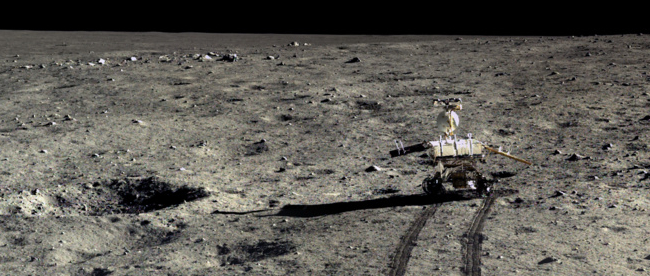
Yutu on the Moon

China has made available a new batch of very cool images taken by its Chang’e 3 lander and Yutu rover, and Emily Lakdawalla at the Planetary Society has figured out how to view them.

In a recent guest blog post, Quanzhi Ye pointed to the Chinese version of the Planetary Data System, and shared the great news that Chang’e 3 lander data are now public. The website is a little bit difficult to use, but last week I managed to download all of the data from two of the cameras — a total of 35 Gigabytes of data! — and I’ve spent the subsequent week figuring out what’s there and how to handle it.

So, space fans, without further ado, here, for the first time in a format easily accessible to the public, are hundreds and hundreds of science-quality images from the Chang’e 3 lander and Yutu rover. I don’t usually host entire data sets (PDS-formatted and all) but I made an exception in this case because the Chinese website is a bit challenging to use.

The image above is a cropped version of Yutu, taken by the lander. Be sure and go to the link to see the full image as well as others.

5 comments

New China manned vehicle under development

The competition heats up: China has begun development of two versions of a second generation manned capsule.

Instead of the three-module arrangement of the current Shenzhou vehicle, the future Chinese crew vehicle will adopt a two-module arrangement, with a large inhabitable crew module at the front, and an uninhabitable cylindrical-shaped service module at back. The size of the re-entry vehicle will be twice of Shenzhouโ€™s, capable of accommodating up to six crew members. A docking port and its associated docking sensors are fitted to the front-end of the crew module. The spacecraft can be fitted with two different service modules, with different propulsion systems and propellant capacities.

In other words, rather than copy and upgrade the design of the Russian Soyuz, as they did with their Shenzhou capsule, they will copy and upgrade the American Apollo capsule.

3 comments

China unveils model of planned 2020 Martian probe

The competition heats up: China today unveiled a one-third scale model of its planned Martian lander/rover, scheduled for launch in 2020.

If they succeed in putting a lander and rover on Mars, China will have clearly demonstrated the capability to do almost anything in space that the United States can do. The competition in the coming decades should thus be most interesting.

Posted from Tucson International Airport.

0 comments

Yutu still operational after two years

Despite an inability to move, China’s rover Yutu has now set the longevity operational record for rover on the Moon.

Yutu was deployed and landed on the moon via China’s Chang’e-3 lunar probe in 2013, staying longer than the Soviet Union’s 1970 moon rover Lunokhod 1, which spent 11 months on the moon. Its operations have streamed live through Sina Weibo, a Chinese microblogging site, and its Weibo account has nearly 600,000 followers.

Yutu experienced a mechanical control abnormality in 2014, but it was revived within a month and, though it is unable to move, it continues to collect data, send and receive signals, and record images and video.

1 comment
1 98 99 100 101 102 118