China’s next space station will also receive unmanned freighters

The competition heats up: The chief engineer of China’s manned program revealed that they are building an unmanned cargo freighter for their next space station, Tiangong-2, with both scheduled for launch in 2016.

Essentially the Chinese are repeated the steps the Russians took, adding docking ports to each new station module. The second will have two docking ports, one for manned craft and the second for cargo. Later modules will have multiple ports to which additional modules can be added.

0 comments

Yutu lives!

Despite an engineering failure that has prevented it from roving after only a few days on the Moon, the Chinese lunar rover Yutu continues to reawaken after each long lunar night, surviving now far longer than its planned three month lifespan.

Since the rover arrived in late 2013, it has now functioned in the hostile lunar environment for more than a year. This, along with other successful long missions, suggests that Chinese space engineering has matured to a point that it has the ability to achieve some significant long term goals.

0 comments

High Russia space official shoots down idea of new Russian space station

Sergei Savelyev, deputy director of Russian space agency Roscosmos, dismissed the idea that Russia might leave the ISS partnership to build its own independent space station.

“Theoretically it is possible to create a new Russian space station, but neither the current nor future drafts of the federal space program [through 2025] touch on this subject, and any [hypothetical] implementation could be tied in with the continued operation of the ISS,” [he said]…

Savelyev added that he anticipates Russia will continue to use the ISS beyond 2020, but that its focus will shift toward cooperating with China on Beijing’s own space stations β€” a small station is already in orbit, and a second larger one is set to be operational around 2020 β€” and aboard the Russian segment of the ISS.

I think the Russians know that it would be foolish to abandon their partnership on ISS, at least not for a few more years. For at least another decade it is going to be the best thing they’ve got in space.

3 comments

Nicaragua and China break ground on new canal

In a largely symbolic act, Nicaragua broke ground on Monday on the Chinese-backed construction of a new canal connecting the Atlantic and Pacific oceans.

The project is being pushed by Nicaraguan President (and former Marxist guerrilla leader) Daniel Ortega and financed by Wang Jing, “a little-known Chinese telecom mogul well connected to China’s political elite.” And as much as normally support any ambitious effort to create business opportunities for people in poor countries, this quote from the article raised some red flags about the project I hadn’t thought of previously:

The proposed canal is set to intersect Lake Nicaragua, known locally as Lake Cocibolca, sending cargo ships and tankers straight through the largest source of freshwater in Central America. Further, the canal is expected to displace tens of thousands of mostly rural and indigenous landholders and would likely devastate over 400,000 acres of rainforests and wetlands, which scientists say are critical to local and regional biodiversity conservation efforts.

I am usually very skeptical of environmental protests since their motives are almost always to promote socialism or communism and not to protect the environment. Here however the protests are against a project being promoted by a Marxist ruler and the communist Chinese. Moreover, it does seem a reasonable question to worry about the possible introduction of ocean saltwater into “the largest source of freshwater in Central America.”

2 comments

A Chinese SLS super rocket?

The competition heats up: According to a report in a Chinese newspaper today, China is developing preliminary designs for a new rocket that would be the most powerful ever built.

According to an earlier report by China News Service, Liang Xiaohong, deputy head of the China Academy of Launch Vehicle Technology, disclosed that the Long March-9 is planned to have a maximum payload of 130 tons and its first launch will take place around 2028.

Liang urged the government to include the Long March-9’s development in its space agenda as soon as possible so that China’s rocket technologies will not lag behind those of other space powers.

Whether this rocket every gets built is highly doubtful. The article seems to mostly be both a public relations response to the U.S.’s test flight on Friday of Orion as well as an example of a government agency lobbying for a bigger budget. (This lobbying happens even in communist China.)

Nonetheless, we should not dismiss the possibility lightly. As competition causes the cost of building all rockets to drop, it will be more affordable to build bigger rockets. By the next decade building a heavy lift rocket might finally be affordable.

4 comments

Chinese spacecraft reaches L2

The service module for China’s test lunar probe, that circled the Moon before returning to Earth, has reached L2 as planned.

As of Friday, the service module had been flying for 28 days, and was 421,000 kilometers away from Earth and 63,000 km from the moon. All experiments are going well. The service module was separated from the return capsule of China’s test lunar orbiter, which returned to Earth on Nov. 1 after circling the moon in its eight-day mission launched on Oct. 24.

…After two orbital transfers, the service module re-entered the elliptical orbit with an apogee of 540,000 km and a perigee of 600 km. During the flight, the service module again performed orbital transfer actions twice, and flew along the pre-set Earth-moon transfer orbit. On Nov. 23, it reached the perilune and with the lunar gravity it was able to undertake the orbit maneuver to fly to the L2 point.

This is brilliant management. They not only test return-to-Earth capability, they practice flying a robot ship in deep space, doing complex orbital maneuvers. In addition, depending on the equipment on the service module, they get a cheap unmanned probe for observing the near lunar environment.

0 comments

China’s struggle to compete with SpaceX

This Aviation Week story provides a detailed update on China’s effort to build a new family of Long March rockets that are less expensive to operate and can effectively compete with SpaceX.

Two main take-aways from the article. First, the first flight of the Long March 7, a direct competitor with the Falcon 9, has been seriously delayed. Originally expected to fly in 2013, that first flight has apparently been pushed back to 2015.

Second, even with extensive cost savings, the Long March 7 will still cost a customer more than a Falcon 9, $70 million vs $61 million.

0 comments

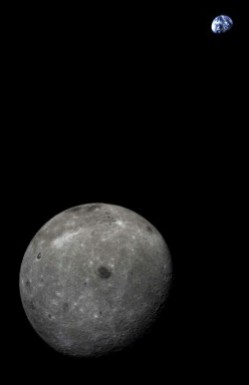
The Earth/Moon double planet, as seen by China’s Chang’e 5 probe

Earth/Moon as seen by Chang'e 5

China’s Chang’e 5 probe has taken a spectacular image of the Moon and Earth as it whips around the Moon on its circumlunar test flight.

Though China has released little additional information about the status of the mission, this image demonstrates that the vehicle is functioning well, sending back data, and that they are controlling its operation precisely and exactly as planned. The spacecraft is scheduled to return to Earth on November 1.

Meanwhile, China’s second lunar probe, Chang’e 2, now in solar orbit about 60 million miles from Earth, continues to operate four years after launch

0 comments
1 100 101 102 103 104 118