
Electric cars are wonderful — except no ones buying
What does this story really tell us? Electric cars are wonderful — except that the dealer hasn’t sold any.
What does this story really tell us? Electric cars are wonderful — except that the dealer hasn’t sold any.
Black gold! Three to four billion barrels of oil — 25 times more than previously predicted — are now thought to lie under certain geological formations in North Dakota and Montana.
Russian scientists are about to drill into Lake Vostok, a lake buried for the last 14 million years beneath the almost two and a half mile thick Antarctic icecap.
The next time someone begins ranting about how the money from “big oil” is used to attack the science of global warming, tell them to take a look at this post, which outlines in detail the more than $2 billion that the U.S. government plans to spend on climate change research in 2011 alone (too much of which is unfortunately used by partisans like James Hansen to try to prove the Earth is warming).
In a paper published today in Geophysical Research Letters of the American Geophysical Union, scientists describe how they have been able to produce remarkably detailed images of the ground buried almost a mile under the ice sheet of Greenland. These radar techniques are the same used in the past by spacecraft to image the hidden surface of Venus, only far more sophisticated.
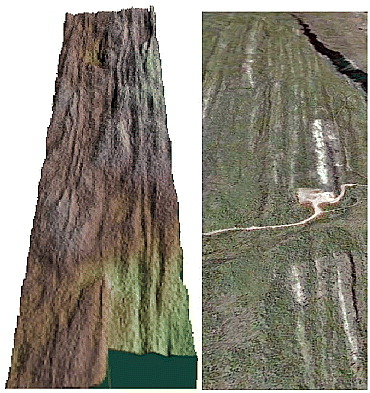
This image from the paper compares the radar image of the Greenland surface (on the left) to an photograph of a known surface feature in the Northwest Territories of Canada, produced thousands of years ago by the giant icesheets of the last Ice Age. Both are at the same scale, about a third of a mile across, and are looking at the surface at an oblique angle of about 45 degrees. With the radar-produced image on the left, sunlight is simulated as coming from the right, with the elevation increasing as the colors go from green (lowest) to yellow to brown to purple (highest).
The long grooves, generally 30 to 100 feet deep and extending sometimes several miles, are produced as the icesheet slides across the ground. In the radar image, however, these grooves are slowly being ground out now.
It is the resolution of this technique that is so exciting. That they can look through ice almost a mile thick and resolve objects that are only tens of feet across tells me that someday it will be possible for spacecraft to map the smallest features on the surface of Venus or Titan. More exciting, this suggests that the technology will one day exist to even map the unknown surface of gas giants like Jupiter or Saturn, and do it in breathtaking detail.
Yowza!
From Watts Up With That: Data from the Argos ocean floats says that the Earth’s climate, as measured by the heat content of the ocean, has been cooling since 2001, not warming as predicted by climate models. You can download the actual science paper, “The Energy Balance of Earth,” here.
A nation choking on endless laws. I like the subtitle for this article as well: “The rising dictatorship of the bureaucrats.”
Republicans kill House global warming committee.
Another whitewash? The University of Virginia is resisting releasing a variety of climate documents being requested under the state’s Freedom of Information Act (FOIA). Key quote:
In response to a previous FOIA request, U.Va. denied these records existed. However, during Cuccinelli’s pre-investigation under the Virginia Fraud Against Taxpayers Act (“FATA”), a 2007 law passed unanimously by Virginia’s legislature, which clearly covers the work of taxpayer-funded academics, U.Va. stunningly dropped this stance.
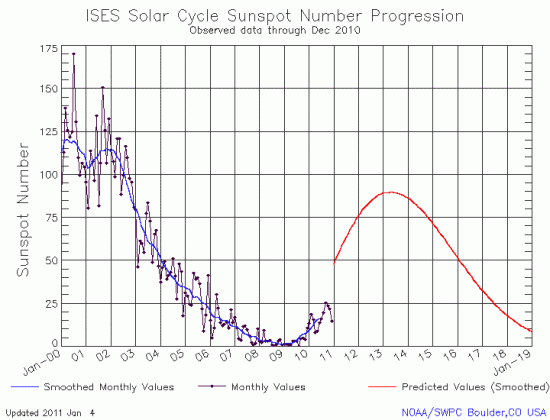
The monthly update of the Sun’s developing sunspot cycle was published tonight by NOAA’s Space Weather Prediction Center. You can see the newest graph below, which shows the slow rise in sunspots (blue/black lines) in comparison with the consensis prediction made by the solar science community in May 2009 (red line).
Not only does the Sun’s generally quiet trend continue, its activity took an additional plunge in December, dropping significantly from the previous month. This drop is probably due to the seven days of no sunspots that took place in mid-December.
All in all, we continue to head for the weakest maximum in two hundred years (see the graph on this page), which in the past meant very cold weather. Though scientists do not yet understand why the Sun does this or how these changes in solar activity influence the climate as much as they do, that this in now happening at a time when we have the technology to truly study it is an opportunity that must not be missed.
If anyone had any doubt that the global warming movement is undergoing a serious collapse, this so-called news article from Spiegal Online, entitled “Naked bodies and a new Messiah: Green groups are trying to sex up climate change,” probably lays that doubt to rest. Key quote:
Environmentalists and scientists are concerned about the massive drop in public interest in the topic over the last year. Now they are looking for new strategies to turn the tide. They’re searching for so-called “mind bombs” — highly emotional images that reduce a complex problem down to one core message.
Sadly, the article never asks the fundamental question: What do “mind bombs” have to do with facts, data, and proving your theories are correct in the real world?
The answer of course is obvious: Nothing.
» Read more