
Judy Garland – Old Man River
An evening pause: From the first episode of The Judy Garland Show, taped in June 1964 and aired December 1964.
Hat tip Doug Johnson.
An evening pause: From the first episode of The Judy Garland Show, taped in June 1964 and aired December 1964.
Hat tip Doug Johnson.
Both China and SpaceX successfully completed launches today.
First, China completed the first launch of its Long March 8A rocket, an upgraded and more powerful version of its Long March 8 rocket. The rocket lifted off from China’s coastal Wencheng spaceport, and put the second batch (number unrevealed) of one of China’s new mega internet constellations.
Along with the basic Long March-8 model and the booster-free tandem configuration, it forms the Long March 8 series of rockets, providing a payload capacity range of 3 tons, 5 tons, and 7 tons to SSO. This significantly enhances China’s satellite networking capabilities for low and medium Earth orbits.
These rockets and the coastal spaceport will also allow China to steadily reduce its reliance on its older family of rockets that use toxic hypergolic fuels and launch from within China.
Next SpaceX launched another 21 Starliink satellites, including 13 with direct-to-cell capabilities, its Falcon 9 rocket lifting off from Cape Canaveral in Florida.
The first stage completed its 18th flight, landing on a drone ship in the Atlantic.
The 2025 launch race:
19 SpaceX
7 China
1 Blue Origin
1 India
1 Japan
1 Russia
1 Rocket Lab
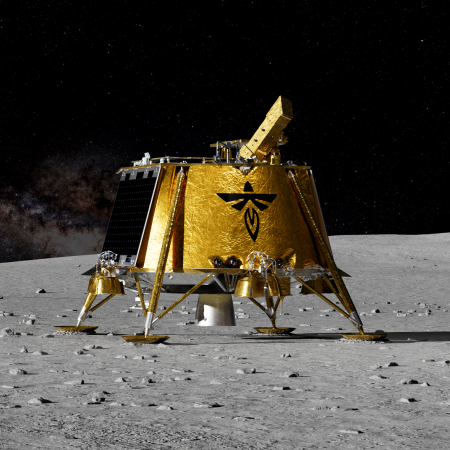
Artist rending of Blue Ghost on the Moon
Firefly’s Blue Ghost lunar lander has successfully completed the mid-course correction engine burn that has taken it out of Earth orbit and into a transfer orbit to the Moon.
After a successful Trans Lunar Injection burn on Saturday, Feb. 8, Firefly’s spacecraft carrying NASA science and tech to the Moon has departed Earth’s orbit and begun its four-day transit to the Moon’s orbit. Blue Ghost will then spend approximately 16 days in lunar orbit before beginning its descent operations. Since launching more than three weeks ago, Blue Ghost has performed dozens of health tests generating 13 gigabytes of data. All 10 NASA payloads onboard are currently healthy and ready for surface operations on the Moon.
I post the artist’s rendering of Blue Ghost to the right to contrast its design with Intuitive Machines’ Odysseus lunar lander that fell over when it landed last year. Note how much lower to the ground Blue Ghost is. This will certainly reduce the chances it will have the same problem as Odysseus, even if one leg breaks upon landing.
SpaceX today successfully launched 22 or 23 Starlink satellites (the reports vary), its Falcon 9 rocket lifting off from Vandenberg in California.
The first stage completed its 23rd flight, landing successfully on a drone ship in the Pacific. At present one other SpaceX booster has flown more, 25 times.
The 2025 launch race:
18 SpaceX
6 China
1 Blue Origin
1 India
1 Japan
1 Russia
1 Rocket Lab
An evening pause: Performed live 1979.
Hat tip Diane Zimmerman.

Click for NASA’s original image.
Link here. Athena is scheduled for launch on February 26, 2025 on a SpaceX Falcon 9 rocket. The article is mostly focused on describing the Gracie hopper, which will attempt to hop into the permanent shadows inside a nearby crater.
Though no announcement has ever been made, it appears the landing site for this lander has been changed. Previously it had been targeting a ridge adjacent to Shackleton Crater, at the south pole and shown on the map to the right. That location however required a launch in January. The delay to February seems to have shifted the landing site.
If all goes to plan, Athena will land on a plateau just 100 miles (160 kilometers) from the moon’s south pole. This region is thought to be rich in water ice, and IM-2 will prospect for the precious resource with the help of some ride-along robots, including a pioneering hopper nicknamed Gracie.
Though I cannot find any specific information on where this location is, I strongly suspect it is the site that Intuitive Machines’ lander, Nova-C (also dubbed Odysseus), attempted to reach last year.
The yellow boxes on the map indicate NASA’s candidate landing zones for its Artemis-3 manned mission.
The Germany government has now allocated $897,000 to a private consortium of four companies to help finance its promised but delayed an off-shore launch platform.
The North Sea launch platform is being developed by the German Offshore Spaceport Alliance (GOSA), a joint venture formed in December 2020 by Tractebel DOC Offshore, MediaMobil, OHB, and Harren Shipping Services. The platform will be constructed on the 170-metre-long Combi Dock I vessel and will accommodate launchers with a mass of between 36 and 52 tonnes. A 2020 feasibility study stated that the development and operation of the North Sea launch platform would cost between €22 and €30 million over six years.
The consortium had first announced the project in 2023, with the first launch of several suborbital test rockets in 2024. Since then little has been heard of this project, with those launches never occurring.
If built as promised, this platform would accommodate rockets as large as the Falcon Heavy. Its goal, besides offering the platform to all rocket companies, is apparently to give German rocket startups the option of a German spaceport so they don’t have to depend on other countries.
Even as the Falklands government is demanding its money back from OneWeb for not activating its service on time, it appears the public on those islands has buying and using Starlink terminals, even though it is presently illegal to use it there.
The high level of Starlink usage sparked a successful petition backed by 70% of the island’s population. This petition demanded both a reduction of the £5,400 FIG VSAT licence fee and formal approval for Starlink’s operation in the Falkland Islands.
In response, a Starlink Select Committee – comprising all of the island’s MLAs – convened from July to October 2024. The committee formally endorsed the petition’s demands, and the proposal was subsequently forwarded to the Falkland Islands Government (FIG) for implementation. However, the effective date for this approval has now been delayed until April.
Because Sure International holds an exclusive monopoly telecommunications licence, Starlink’s use in the islands is currently illegal. Nonetheless, this restriction has not prevented the widespread installation of hundreds of Starlink terminals, which remain unlicensed.
Sure International apparently provides internet service though traditional land lines. The cost difference compared to Starlink is considerable, with Starlink being far cheaper and providing much faster speeds. Meanwhile, OneWeb has failed to deliver and is losing this business. By April expect Starlink to be approved.
Hat tip to BtB’s stringer Jay.
Rocket Lab today successfully launched five more internet of things satellites for the French company Kinéis, bringing its planned 25 satellite constellation to 20 satellites.
Rocket Lab has the contract to launch the entire constellation, and this was the fourth of five launches in that deal.
The 2025 launch race:
17 SpaceX
6 China
1 Blue Origin
1 India
1 Japan
1 Russia
1 Rocket Lab
SpaceX today successfully placed 21 more Starlink satellites in orbit, its Falcon 9 rocket lifting off from Cape Canaveral in Florida.
The first stage completed its seventeenth flight, landing on a drone ship in the Atlantic.
The 2025 launch race:
17 SpaceX
6 China
1 Blue Origin
1 India
1 Japan
1 Russia
New details reported yesterday strongly suggest that the high altitude balloon company Space Perspective has been unable to find new investors and is on the verge of shutting.
In a February 5 email to stakeholders, Interim CEO Michael Savage provided the latest updates, shedding light on failed funding efforts, the company’s dire financial situation, and attempts to restructure its debt. The email also acknowledged the gravity of the challenges ahead, hinting at the possible closure of operations.
Savage’s email outlined efforts to secure funding, including meetings with investors Fortuna and Broadlight, both of whom ultimately declined to proceed. Savage explained that while there was initial interest, the company’s mounting debt and financial instability deterred further investment. “Both [investors] have expressed interest, but despite the current circumstances and since Nov./Dec. 2024, they feel that their LPs would not stomach the numbers,” Savage wrote.
The company has previously announced it was shifting operations out of the Cape Canaveral area to a location 90 miles north where costs were less as it searched for new investors. This new report suggests this move and the search have not worked and the company will soon go out of business.
ULA has decided to destack the Vulcan rocket it had planned as its first launch in 2025 (launching a military payload) and is now replacing it with one of its remaining Atlas-5 rockets to put the first batch of satellites for Amazon’s Kuiper internet constellation.
It appears the military is not ready to certify this launch after the second Vulcan launch in October 2024 experienced a problem with one of its strap-on boosters. The payload got to its proper orbit, but the loss of that booster’s nozzle appears to be an issue the military remains concerned about.
Rather than wait, ULA decided to switch to the Kuiper launch. The company wants to complete up to 20 launches in 2025, many of which are for Amazon using its last ten or so Atlas-5 rockets. When it can start commercial launches of Vulcan remains somewhat uncertain. The military has indicated it will make a final decision of certification in the spring, and has also said that first operational flight will follow soon after.