
Roxana Küwen – 5 balls hands and feet
An evening pause: Some unusual juggling.
Hat tip Phill Oltmann.
An evening pause: Some unusual juggling.
Hat tip Phill Oltmann.
An evening pause: Hat tip Ruth Beaty.
The Air Force is looking to buy commercially-made flying cars designed using drone technology.
The advantages of vertical landing and take-off are many. For example, they would not need runways that are targets and must be defended. They can take off and land practically anywhere. In the past however the cost and practicality of making an airplane do this has been a major obstacle.
Normally I would see an article like this in the military press as simply a lobbying effort by a government agency to garner a bigger budget for itself. That still might be the case, but this part of the Air Force’s proposal stood out:
Because a key aim of Agility Prime is to work with commercial industry, there are currently no plans to modify the design of the orbs for military use or arm them for strike missions. “We will not put any military unique requirements on them because the last thing you want to hear as a commercial backer of one of these companies is that the military is coming in and changing a vehicle away from a type that would have domestic use,” Roper said. “We want to create a supply chain in the U.S. that is dual commercial and military.”
In other words, the Air Force wants to buy these unmodified from commercial civilian companies, both to save money and speed utilization. They have issued the general specs for the two types of vehicles they want (one larger than the other) and are accepting bids from private companies for delivery.
If true and if the Air Force sticks to this policy (which is essentially the approach I advocated for NASA in my 2017 policy paper Capitalism in Space), they hope to have these vehicles flying operationally by 2023, and at a cost of only “a few hundred thousand dollars to a few million dollars per unit.”
An evening pause: Ah how I miss the taste of a real egg cream, using both real seltzer and Fox’s U-Bet syrup. Nothing beats it.
Hat tip Cotour.
Link here. Lots of good information, including details about the growing assembly line of new Raptor engines.
Meanwhile, labeled “27”, the engine – logically assumed to be Raptor SN27 – SpaceX has just installed on Starship SN5 is also of interest. On top of Musk’s recent confirmation that SpaceX is already building Raptor SN30 (probably SN31 or SN32, now), SN27’s assignment to Starship SN5 confirms that the company has managed to complete (and test) at least one next-generation engines every other week since the first full-scale engine shipped to McGregor, Texas in February 2019.
For a brand new engine as complex as Raptor, that’s an impressive production milestone. Per Musk, the end-goal is to produce at least one Raptor per day in the near term – a necessity given that each Starship and Super Heavy booster pair will require at least 37 engines. To feasibly build a fleet of tens – let alone hundreds or thousands – of Starships and boosters, one engine per day is arguably the bare minimum required just for early orbital launch attempts and initial operations.
They hope to start static fire tests, with prototype #5 by July 8th. If these go well they will likely follow soon thereafter with the first short vertical hop.
UPDATE: Mere seconds after I uploaded the post below, Rocket Lab announced that something had gone wrong late in the launch, resulting in the loss of all seven satellites.
This failure is the company’s second since their first test launch attempt. It will certainly prevent them from their goal this year of monthly launches.
The failure also changes the launch standings below. Rocket Lab is no longer among the leaders, and the U.S. leads China 16 to 14.
The original post:
—————————
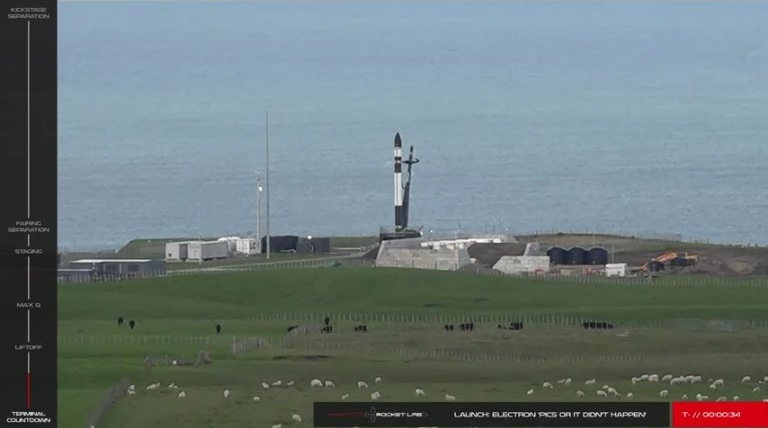
Capitalism in space: Rocket Lab today successfully completed the thirteenth launch of its Electron rocket, placing seven smallsats into orbit.
The picture above, captured from their live feed 34 seconds before launch, is most amusing because of the white sheep and black cattle grazing in the foreground.
This launch, three weeks after their previous launch, was their fastest turn-around so far. They made no attempt this time to recover the first stage, but noted that they plan to do so on their seventeenth launch, four launches from now.
The leaders in the 2020 launch race:
14 China
10 SpaceX
7 Russia
3 ULA
3 Rocket Lab
The U.S. now leads China 17 to 14 in the national rankings.
Capitalism in space: The Planetary Society’s satellite designed to test the use of a light sail in orbit, LightSail-2, has now begun an extended mission one year after launch.
It appears that they have successfully used the light sail to delay the decay of the satellite’s orbit, as well as change that orbit slightly. The extension will thus allow them to get a better and more exact understanding of the sail’s capabilities, information NASA will use in its own solar sail demonstration mission, NEA Scout, a cubesat that will use a solar sail to fly to an asteroid.
Capitalism in space? A partnership between the UK government and an Indian company operating in the UK has purchased the bankrupt satellite company OneWeb for $1 billion.
The decision for the U.K. government to purchase OneWeb came with few details about when satellite launches will resume and exactly what the OneWeb satellites will now be used for and even who will have access to them once launched.
The overall deal is worth $1 billion USD, with the U.K. government and Bharti Enterprises Ltd. (an Indian-based company with an operational arm in the U.K.) each committing $500 million USD to the acquisition deal.
The buy-out is expected to close by the end of the year and will represent a 90% overall stake in OneWeb, with the organization’s original investors maintaining a 10% share according to reports from Bloomberg News.
The Johnson government has indicated it wishes to use the OneWeb constellation, still incomplete, as some sort of navigational tool, like GPS. The problem is that the satellites were not designed for this, but for providing internet service.
The article provides a good overview of the questions raised by this government decision. It is hard to figure how this purchase makes sense for the UK government. The impact however on one of OneWeb’s launch providers, Russia, could be very negative. OneWeb was going use a lot of Soyuz rockets to get its satellites off the ground, and had become practically the only commercial customer Russia still has. It is unclear what will happen now with that contract deal.
An evening pause: Beautiful and haunting, but listen closely to these lyrics and you will hear our dark future singing.
Hat tip Lee Stevenson.
Arianespace announced yesterday that it has pushed back its first Vega rocket launch since the spring of 2019 (when the rocket failed) for seven more weeks, until August 17, 2020.
They had been trying to get the rocket off the ground this past week, but had been forced to scub several times because of high winds. They claim this long new delay is to wait until the weather improves, which really doesn’t make sense. Eric Berger at Ars Technica did some digging to find that other scheduling issues, including the odious lock down rules because of the Wuhan panic, were the really reason for the additional seven week delay. They have to recharge the batteries on the rocket, but don’t have time to do it before another launch is set to occur.
This process appears to involve customer representatives flying into French Guiana to perform this task, and there is a mandatory 14-day quarantine upon arrival in the non-European part of France that borders Brazil.
Finally, Arianespace also has a commercial satellite launch mission upcoming on its larger Ariane 5 rocket, and this VA253 flight has been scheduled for July 28. Because there is a minimum of a two-week turnaround time between launches at the spaceport in French Guiana, there was not time to reset the Vega rocket and its payloads before this mission.
With these rules and launch limitations, Arianespace is going to have increasing problems competing with the newer launch companies, all of whom are aiming, like SpaceX, to have almost instantaneous launch turn-arounds.
The Department of Defense yesterday withdrew the small contracts it had given to six small rocket companies on June 16 using funds allocated to help companies impacted by the Wuhan flu panic lock downs.
According to multiple industry sources, the selection of the six companies drew widespread criticism because it was unclear how these suppliers were selected over others. When contracts are awarded without an open competition, DoD by law has to file a “Justification & Approval” document explaining why an award was sole-sourced. No J&A documents were filed in this case.
This certainly appears fishy, as there are far more than six startups trying to capture market share in the smallsat launch market. Defense could now allow companies to competitively bid on this money, estimated to be about $115 million total, but it is unclear whether it will.
Capitalism in space: Blue Origin this week delivered its first BE-4 rocket engine to ULA, for use in ULA’s new Vulcan rocket.
This engine is still a test article and is not yet flight-worthy.
“The engine delivered is the first pathfinder engine to be mated with the Vulcan Centaur and will support ULA’s testing,” a Blue Origin spokesperson told SpaceNews. “We are planning on delivering the second engine in July.” A pathfinder is a development engine. Blue Origin has not said when a flight-qualified engine will be delivered.
…ULA set a 2021 target to fly its first Vulcan Centaur mission and needs two production-quality engines to build the launch vehicle for that mission. Flying Vulcan Centaur in 2021 is an imperative for ULA as it tries to win one of two contracts that the U.S. Space Force will award this summer to launch dozens of national security satellites between 2022 and 2027.
According to sources, frustration has been mounting at ULA as the company’s future is tied to the success of Vulcan Centaur and there is no room for error when it comes to the main engine.
I empathize with ULA’s frustration. The pace of development at Blue Origin has seemed incredibly slow in the past two years. They had begun static fire tests in 2018, and then — beginning with ULA’s decision to buy the BE-4 for Vulcan in May 2018 — for more than a year there was no news. It wasn’t until August 2019 that they announced completion of the first full power test. Even then, it took another whole year before they got to this point now, where they were willing to deliver a first test engine to ULA.
Building a new rocket engine is not simple, so these delays could be entirely reasonable. At the same time, the company’s overall pace in accomplishing anything has been glacial. For example, in the past three years it has repeatedly not delivered on its promises to start flying humans on its New Shepard suborbital capsule. Four months ago, in their most recent promise, they said they would need three more unmanned test flights of New Shepard before they’d put humans on it, and that all those flights (including the manned one) would occur this year. Yet nothing has happened since.
While I truly want Blue Origin to succeed, one must cast a cold eye on what is really happening. If they wish to really compete with SpaceX they have got to pick up their pace.
An evening pause: From the Carol Burnett Show.
Hat tip Phill Oltmann.
Capitalism in space: Firefly Aerospace yesterday found a very unusual and entertaining way to celebrate the 43rth birthday of Max Polykov, the investor who purchased the company during bankruptcy proceedings and then rehired everyone so that the company could come back from the dead.
They decided to use one of their rocket engines to light the candles on his birthday cake. I have embedded the video of this effort below the fold. It is very clear that everyone at Firefly is immensely and sincerely grateful to Polykov for saving their company, which right now is among the leaders in the race to be one of the new rocket companies to meet the needs of the burgeoning new satellite industry.
» Read more
Capitalism in space: Boeing last week successfully completed a Starliner parachute test designed to simulate the return of a capsule after a launch abort.
This is good news for the capsule and Boeing, but I am a bit puzzled why this test, to be followed by a second similar test, was done. These parachutes were supposedly tested thoroughly already, proven, and ready for use for manned missions. Part of that proof was an earlier launch abort test as well as Boeing’s unmanned orbital demo flight that failed to dock with ISS. Both returned to Earth safely using these parachutes. I wonder if during those latter flights they found issues with the parachutes that needed smoothing out by even more tests.
Either way, this success improves the chances that Starliner will finally fly manned early next year, giving the U.S. two different operational manned capsules for getting humans into space.
This article by Eric Berger at Ars Technica outlining the status of SpaceX’s fleet of reusable first stages contained this incredible fact:
On May 11, 2018, the company launched the first of its new “Block 5” version of its Falcon 9 rocket. This new version of the first stage incorporated all of the company’s previous performance upgrades to the Falcon 9 rocket while also maximizing its reuse. It worked—SpaceX has now flown two different Falcon 9 cores five times, and it may fly a first stage for the sixth time later this summer.
The success of the Block 5 rocket means that SpaceX has had to devote less time and resources to building Falcon 9 first stages. Since May 2018, it has launched 31 times on a Block 5 version of the Falcon 9 rocket—while using just 10 cores. Put another way, reuse has saved SpaceX the cost of 189 Merlin rocket engines, dozens of fuel tanks, and many complex avionics systems. [emphasis mine]
That is a lot of cost savings, which the company is not only using to cut its prices but also to reduce the cost of its Starlink launches. It appears SpaceX wants those launches, as much as possible, to use reused boosters in order to lower the overall cost of getting that internet constellation into orbit. This in turn will make it possible for them to charge less for the service, once they begin offering it.
Capitalism in space: SpaceX’s fifth Starship prototype #5 last night successfully completed a cryogenic test of its tanks, setting the stage for its first vertical test flight.
SpaceX’s Starship SN5 prototype performed a cryogenic proof test at the launch provider’s Boca Chica, Texas facility on Tuesday evening. The test marked a rapid recovery for SpaceX – managing to return to testing a month after the previous vehicle exploded on the pad.
The cryogenic proof is when the vehicle’s propellant tanks are filled with liquid nitrogen and pressurized to flight pressures. Then, hydraulic pistons (otherwise known as a thrust simulator) press against the base of the vehicle to mimic the force of a Raptor engine. The proof test will ensure that Starship SN5 is structurally sound ahead of testing with liquid oxygen and methane. Unlike oxygen and methane, nitrogen is inert and will not combust if something were to go wrong.
The article at the link gives a nice overview of the test program, and what is to come next.
An evening pause: Performed live in 2011.
Hat tip Diane Zimmerman.
Capitalism in space: SpaceX today successfully launched its first satellite for the Space Force, a GPS satellite.
It also successfully landed the first stage, which was on its first flight. This was also the 88th flight of the Falcon 9 since its inception in 2010, which now makes it the rocket with the most launches of any U.S. operational rocket, bypassing ULA’s Atlas 5, and doing it in about half the time.
The leaders in the 2020 launch race:
13 China
10 SpaceX
7 Russia
3 ULA
The U.S. now leads China 16 to 13 in the national rankings.
An evening pause: People tend to forget that great actors really are ordinary people.
Hat tip Tom Biggar.