
Faith Hill – This Kiss
An evening pause: A very nice performance. Hat tip Edward Thelen.
An evening pause: A very nice performance. Hat tip Edward Thelen.
Students at Rice University have built a chair and table expressly designed for use in a low gravity environment like the Moon or Mars.
The students interviewed astronauts to get an idea of what was needed, and did the design under NASA supervision. Their design is clever in that it can be packed easily, but I still wonder about the weight of transport. I don’t see the first explorers to Mars being able to afford bringing their furniture with them. I expect they will instead figure out ways to improvise chairs and tables from the materials on hand.
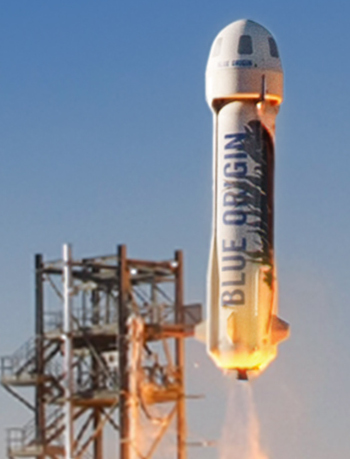
The competition heats up: Blue Origin completed on Wednesday its first test flight of its reusable suborbital spacecraft, New Shepard.
After reaching an altitude of 307,000 feet, or 58 miles, the capsule successfully separated from its first stage, what they call the propulsion module, and safely parachuted back to Earth. The first stage, designed to also be recoverable, was not recovered successfully. According to Jeff Bezos’s explanation, they “lost pressure in our hydraulic system” and that they were trying to land it vertically, like SpaceX’s Falcon 9 first stage.
The cropped image on the right of the full resolution image, gives us a close-up of the capsule and propulsion module. The small fins on the propulsion module suggest the capability for a vertical landing, but it is unclear from the image whether the module has legs, though other images and videos strongly suggest there are legs on this module.
The flight itself, getting above 50 miles, reached space according to most definitions. In fact, Blue Origin with this flight has accomplished what Virgin Galactic has been promising to do for more than a decade, a suborbital test flight of its spacecraft. Blue Origin’s flight was unmanned, but it demonstrated that their design works. They will of course have to re-fly the capsule as well as land that first stage successfully to prove the design’s re-usability, but this flight shows that they are off to a very good start. And their webpage clearly shows that they are almost ready to start selling tickets for suborbital flights.
The most significant success of this launch, however, is the performance of the BE-3 rocket engine. Blue Origin has convinced ULA to hire it to build the engines for its new Vulcan rocket. This success justifies that decision.
I have embedded their videos of the full flight below the fold.
» Read more
An evening pause: A remarkable performance, using juggling to play music. Stay with it, it only gets better.
Hat tip Danae.
An evening pause: One of the many classic scenes from the classic Hollywood masterpiece, Adam’s Rib (1949).
Another hat tip to Phil Berardelli, author of Phil’s Favorite 500: Loves of a Moviegoing Lifetime.
The competition heats up: SpaceX has successfully completed its fifth Falcon 9 launch of the year, putting a Turkmenistan’s first communications satellite into orbit.
This was the 18th consecutive successful launch for the Falcon 9, and the 13th in a row for its upgraded design. Not bad for a company that did not even exist a little more than a decade ago.
Having firmed up the May 20 launch date for the next X-37B mission, the Air Force has also revealed one of the experiments the reusable mini-shuttle will carry.
They will be testing in orbit an advanced ion engine. I suspect however that this is not the only experiment on board.
The competition heats up: The next commercial Falcon 9 launch is now set for tonight, Monday, less than two weeks after the last Falcon 9 launch.
The next two weeks will be especially busy for SpaceX, as they also have scheduled the first launch abort test of Dragon on May 5. The launch will also be the fifth for Falcon 9 this year, putting it in the lead as the busiest rocket in the world for 2015, ahead of the Russian Soyuz.
The heat of competition? In order to meet a government deadline to launch humans from their new spaceport at Vostochny, the Russians had planned, though now cancelled, a single manned launch there in 2019, using a new rocket.
Their cancelled plans had included two prior test flights of the rocket with Progress freighters.
If cargo missions were successful, the one brave crew would ride into orbit from the new spaceport, knowing that in case of a serious problem with the rocket, the descent module of the spacecraft would parachute into deep forest of the Russian Far East or somewhere in the Pacific.
After “satisfying” this political goal with a single crew, all manned Soyuz and cargo Progress missions would then revert back to Baikonur for a safe ascent trajectory. The Soyuz spacecraft would continue flying two missions annually from Baikonur, until the veteran spacecraft’s final launch in 2025. In 2021, Soyuz spacecraft missions originating from Baikonur would switch from Soyuz-FG to Soyuz-2-1a rocket.
The Russians have now decided, rather than rush this first flight on the new rocket, to hold to the slower schedule.
This story is important to the United States. I think we must definitely end our dependence on the Russians before they make the switch to the new rocket. Based on the levels of poor quality control and corruption seen recently in Russia, I have grave doubts the new rocket will fly reliably at first. It would be a mistake to buy its use to put Americans in space.
Link here.
Like the author, I remember every single one of these doomsday predictions. I also remember how every single one of these predictions was wildly wrong. Until these fear-mongers can reliably predict things, I see no reason to believe them.
His article however does provide one entertaining tidbit:
You know how old I am? I’m so positively ancient that I remember when one of Jimmy Carter’s big answers to the impending shortage of oil was to increase federal funding for research on how to extract oil from shale. It ended the way you would expect: it went nowhere. But some decades later, private oil companies did find a way to more economically extract oil from shale—and environmentalists promptly made it public enemy #1.
All true. And just one more example of how the government fails at something while private enterprise, fueled by the profit motive, finds a way to make that exact same thing happen.
Link here. It does appear that the hiring of Tory Bruno as ULA’s CEO was the major factor. He seems willing to push the company to take somewhat bigger chances with new technology than it has done previously.
An evening pause: This is truly a great performance, worth watching and listening to. I just wish it wasn’t so darkly lit.
Hat tip Danae.
