Russia confirms that a Proton rocket failed at launch two weeks ago because three of six sensors were installed upside down.

Russia confirms that a Proton rocket failed at launch two weeks ago because three of six sensors were installed upside down.

They are going to subject the personnel involved to lie detector tests in order to find out who did what. We should then expect them to prosecute those individuals. Unlike the U.S., they won’t simply fire them.

2 comments

SpaceX has renegotiated its lease with the city of McGregor, Texas, in order to begin testing the Falcon Heavy rocket.

The competition heats up: SpaceX has renegotiated its lease with the city of McGregor, Texas, in order to begin testing the Falcon Heavy rocket.

What I found stunning about this article is this quote:

The Falcon Heavy will have commercial, civil and national security applications, Ra said, adding that customers will pay $81 million to $135 million per launch, depending on the weight of the payload and the rocket’s destination. That is about twice the price of a Falcon 9 launch.

These prices for the Falcon Heavy are actually comparable or cheaper than that charged by most other rocket companies for geosynchronous launches. If SpaceX succeeds in doing this — launching Falcon Heavy at these prices — they will certainly open deep space to private enterprise. And even if their prices end up being twice this, those prices will still be anywhere from one fourth to less than a tenth of what it will cost NASA to launch its SLS rocket.

Which should make us all wonder: Why is anyone in Congress still voting to fund SLS?

5 comments

SpaceX has successfully completed a full duration test firing of 9 upgraded Merlin engines.

The competition heats up: SpaceX has successfully completed a full duration test firing of 9 upgraded Merlin engines.

The full mission duration firing of the next generation Falcon 9 booster was completed on Sunday. The booster’s nine Merlin 1D engines fired for approximately three minutes, simulating what the booster may experience in flight before stage separation.

With this success, I suspect they are finally ready to begin their commercial launches. The first is presently scheduled for September 5.

0 comments

Doing the Grand Canyon Right

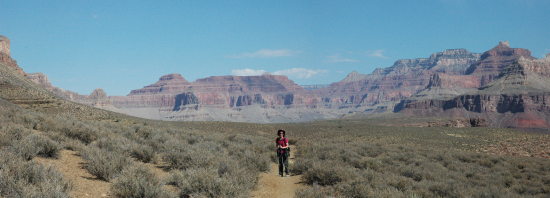
The Tonto Plateau

The one thing about the Grand Canyon that attracts hikers is its intimidating nature. People feel challenged by its large size and depth, and want to prove to themselves that they can do it.

The irony of this to me is that it is that intimidating nature that generally causes most people the most problems. People worry about the climb out. They worry about the heat. They worry about the lack of water. And they worry about vastness around them.

All of these things — the climb, the heat, the lack of water, and the vastness — must be dealt with. Each has caused the death of many visitors. Each could kill you if you are not prepared. In fact, one or all of these factors are probably the primary causes behind all of the approximately 300 rescues that occur each year at the Grand Canyon.

Yet, none of these factors is actually the biggest obstacle for most people trying to climb in and out of the Canyon. Instead, it is the worry about these things that causes people the most difficulties.
» Read more

6 comments

Orbital Sciences has issued an update on its Antares launch schedule, with the launch window now set for September 14-19.

The competition heats up: Orbital Sciences has issued an update on its Antares launch schedule, with the launch window for the Cygnus demonstration mission to ISS now set for September 14-19.

They announced this on July 10, but I am only now catching up. The launch could happen sooner, if there are delays to the launch of NASA’s LADEE moon probe. Right now the two launches are coordinated to have LADEE launch first.

0 comments

Sierra Nevada has completed its first tow tests of its Dream Chaser engineering test vehicle, now officially named “Eagle.”

The competition heats up: Sierra Nevada has completed its first tow tests of its Dream Chaser engineering test vehicle, now officially named “Eagle.”

These tests were merely to check out the craft’s landing systems, with it being pulled along the runway at 10 to 20 mph. Faster tests, followed by actual drop tests, are to follow.

The article has some great information about Dream Chaser itself.

0 comments
1 1,168 1,169 1,170 1,171 1,172 1,353