Visiting a nuclear missile silo

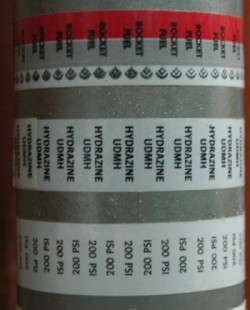
a fuel line for the Titan missile
A fuel line for the Titan missile.

Last week my oldest friend Lloyd and his wife Denise came to visit Diane and I here in Tucson. One of Lloyd’s requests was to visit the Tucson Missile Museum. This museum is built at the site of one of the now disabled missile silos built in the 1960s as a means for launching nuclear weapons against the Soviet Union. Fifty-four silos total had been built and operated, with eighteen of those silos scattered around the Tucson, Arizona area. When the U.S. signed a nuclear arms treaty with the Soviet Union in the 1980s these silos were then shut down and sold. Some became private residences. Others remain buried and abandoned.

One silo, however, was kept as intact as allowed by treaty and made into a museum in order to preserve this artifact of history. Because Diane and I happen to know Chuck Penson, the archivist at the museum, we were able to arrange an augmented tour of the facility. Below are some of my pictures as Chuck took us down into the deepest bowels of the silo.
» Read more

15 comments

Europe today inked a partnership deal with Russia for its two spacecraft ExoMars mission, planned to launch in 2016 and 2018.

Europe today inked a partnership deal with Russia for its two spacecraft ExoMars mission, planned to launch in 2016 and 2018.

Russia essentially replaces the United States, which backed out of the deal last year when the Obama administration eliminated the funding for most of NASA’s planetary program.

0 comments

The radiation from the Fukushima nuclear power plant failure in Japan has turned out to be less of a problem than predicted.

The radiation from the Fukushima nuclear power plant failure in Japan has turned out to be less of a problem than predicted.

[O]utside the immediate area of Fukushima, this is hardly a problem at all. Although the crippled nuclear reactors themselves still pose a danger, no one, including personnel who worked in the buildings, died from radiation exposure. Most experts agree that future health risks from the released radiation, notably radioactive iodine-131 and cesiums-134 and – 137, are extremely small and likely to be undetectable. Even considering the upper boundary of estimated effects, there is unlikely to be any detectable increase in cancers in Japan, Asia or the world except close to the facility, according to a World Health Organization report. There will almost certainly be no increase in birth defects or genetic abnormalities from radiation.

Even in the most contaminated areas, any increase in cancer risk will be small. For example, a male exposed at age 1 has his lifetime cancer risk increase from 43 percent to 44 percent. Those exposed at 10 or 20 face even smaller increases in risk — similar to what comes from having a whole-body computer tomography scan or living for 12 to 25 years in Denver amid background radiation in the Rocky Mountains.

The entire article is worth reading, as it outlines in detail the less than deadly consequences of both Fukushima and Chernobyl. This is the kind of information we should use to rationally decide whether we want to build more nuclear power planets.

4 comments
1 1,185 1,186 1,187 1,188 1,189 1,353