
Three astronauts safely returned to Earth today after a 125-day stay on ISS.
Three astronauts safely returned to Earth today after a 125-day stay on ISS.
Three astronauts safely returned to Earth today after a 125-day stay on ISS.
Dust devils and radiation in Gale Crater.
More on why that communications cable was cut at Russian mission control.
It appears that because of routine maintenance of other equipment, the company that controlled the cable was supposed to mark it so that the repair crew would leave it alone. That repair company is now claiming that the marking never happened.
SpaceX’s Grasshopper rocket has made its highest leap yet, almost 20 feet.
This is only a test vehicle for developing the engineering of a reusable rocket that can land vertically.
The Russians have repaired the severed cable that had cut off their communications with ISS and space.
The article notes that this failure was never a critical problem for ISS, pointing out that there was a back up communications route in the U.S., and that the astronauts on board are trained to work independent of the ground. Though both these points are true, what the article doesn’t mention is that much of the American half of ISS has been built to be run from the American mission control. It is not like Mir, which was designed to be as self-sufficient as possible. The result is that though a communications break in Russia is not really critical, a communications break in the U.S. might be.
The accidental cutting of a communications cable has cut off Russia’s mission control from ISS and many of its satellites.
They have rerouted communications to ISS through mission control in Houston, so the station has not been seriously effected by this accident.
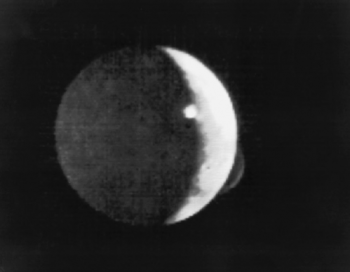
On March 8, 1979, as Voyager 1 was speeding away from Jupiter after its historic flyby of the gas giant three days earlier, it looked back at the planet and took some navigational images. Linda Morabito, one of the engineers in charge of using these navigational images to make sure the spacecraft was on its planned course, took one look at the image on the right, an overexposed image of the moon Io, and decided that it had captured something very unusual. On the limb of the moon was this strange shape that at first glance looked like another moon partly hidden behind Io. She and her fellow engineers immediately realized that this was not possible, and that the object was probably a plume coming up from the surface of Io. To their glee, they had taken the first image of an eruption of active volcano on another world!
Today, on the astro-ph preprint website, Morabito has published a minute-by-minute account of that discovery. It makes for fascinating reading, partly because the discovery was so exciting and unique, partly because it illustrated starkly the human nature of science research, and partly because of the amazing circumstances of that discovery. Only one week before, scientists has predicted active volcanism on Io in a paper published in the journal Science. To quote her abstract:
» Read more
Engineers have switched Mars Odyssey to its backup navigation equipment in order to save the failing primary system.
Got money to invest? SpaceOps is looking for funds to build its private spacecraft modeled after the American Gemini capsule.
The idea is a good one, as the Gemini capsule was quite capable. Getting almost $100 million from crowd-sourcing however is going to be very tough.
The orbital debris from the exploded upper stage of the failed Proton launch in August now totals over 100 pieces.
The competition heats up: China in 2013: another manned flight and an unmanned lunar landing.
The images don’t provide much information, and most of the article is empty speculation. Nonetheless, China is building something.