
NASA picks the Delta 4 Heavy to launch Orion into orbit on its first test flight

NASA has chosen the Delta 4 Heavy rocket to launch the Orion capsule into orbit for its first test flight in 2014.

So, tell me again why NASA needs to spend $18 to $62 billion for a new rocket, when it already can hire Lockheed Martin to do the same thing? Though the Delta 4 Heavy can only get about 28 tons into low Earth orbit, and only about 10 tons into geosynchronous orbit — far less than the planned heavy-lift Space Launch System rocket — Boeing Lockheed has a variety of proposed upgrades to Delta 4 Heavy that could bring these numbers way up. Building these upgrades would surely be far cheaper than starting from scratch to build SLS.

Corrected above as per comments below.
9 comments

NASA moves first flight test of Orion capsule up three years to 2014

NASA has moved the scheduled first flight test of the Orion capsule up three years to 2014.

This action, while good, was almost certainly triggered by the competition from the private space companies. The managers at NASA are finally realizing that if they don’t speed up deployment of their own spacecraft, they will certainly lose in the competition for government dollars. That they will have to use another rocket other than their heavy-lift vehicle for this launch, however, will not help that particular project’s lobbying effort.

Either way, I think this action is only further proof that the more competition we have, the quicker we will get into space. And the journey will cost less too, not only because it will take less time and therefore less money, but the competition between companies (or NASA) will force everyone — including NASA — to lower costs to show they can do it better.

2 comments

DARPA has launched a program to use airplanes as the launchpad for putting satellites in orbit

DARPA has launched a program to use airplanes as a launchpad for putting satellites in orbit.

The Pentagon’s research agency, the Defense Advanced Research Projects Agency (DARPA), also anticipates slashing small satellite payload costs from more than $30,000 per pound to less than $10,000 per pound β€” making such launches three times cheaper. . . . DARPA wants the program to demonstrate at least 12 launches of 100-pound payloads to low Earth orbit, with each launch costing about $1 million. Launches could start as soon as 2015, according to DARPA’s official announcement of the program on Nov. 4.

At first glance this appears to be good news for Orbital Sciences and its Pegasus rocket, the only commercial launch system that has successfully put satellites into orbit using a commercial L1011 airplane as its first stage. At the same time, however, it appears DARPA is pushing for new technology to lower costs below what Orbital charges, meaning the game is open to anyone.

1 comment

A breathtaking view of the Apollo 15 landing site

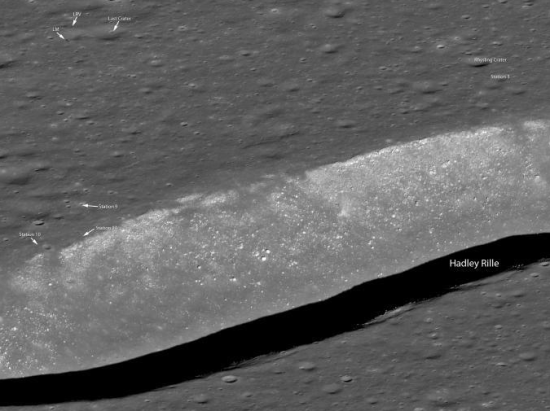
The Lunar Reconnaissance Orbiter team has released a wide angle side view image of the Apollo 15 landing site, showing the lunar module and the areas around Hadley Rille and the Apennine Mountain range that the astronauts explored using their lunar jeep. Below is a cropped close-up, showing the landing site near the top of the image with Hadley Rille near the bottom. Below the fold is a second image showing a wider view that includes the Apennine mountain slope that the astronauts drove their rover up.

Close up of Hadley Rille and Apollo 15 landing site

» Read more

0 comments

The first in orbit tests of Robonaut halted because the robot did not carry out its commands as expected.

HAL lives! The first in-orbit tests of Robonaut were halted today on ISS because the robot did not carry out its commands as expected.

NASA robot operator Phil Strawser said joint movements in the weightless space environment have proven to be different than those performed in normal gravity on Earth. Consequently, software used to operate the robot needs to be “fine-tuned,” he said.

0 comments
1 1,265 1,266 1,267 1,268 1,269 1,352