
NASA’s costs estimates too low for Congress’s heavy-lift rocket

Surprise, surprise! An independent analysis of NASA’s budget estimates to build Congress’s heavy-lift rocket, the program-formerly-called-Constellation, are untrustworthy and likely low.

“All three program estimates assume large, unsubstantiated, future cost efficiencies leading to the impression that they are optimistic,” the team said in its key findings. A risk assessment revealed the funding reserves projected for all three programs are insufficient, according to Booz Allen Hamilton. NASA has not disclosed its internal cost estimate for the Space Launch System. “Due to procurement of items still in development and large cost risks in the out years, NASA cannot have full confidence in the estimates for long-term planning,” the executive summary said.

This project is nothing more than Congressional pork. It will never get built. Sadly, it might waste a lot of money before it never gets built.
0 comments

Bigelow in negotiations to supply privately-built modules to ISS

Bigelow Aerospace is in negotiations with both NASA and Japan to supply ISS with privately-built modules

The module could be rented out as an ISS storage unit, making the station less dependent on frequent resupply flights, says Hiroshi Kikuchi of JAMSS. To show that the modules are capable of safe, crewed operation, Bigelow is also negotiating with NASA to attach one to a US-owned ISS module.

.

0 comments

Craters, craters, everywhere

Below the fold are two images released today, one from Dawn at Vesta and the other from Messenger at Mercury. What makes them interesting to me is that, though the surfaces of both Vesta and Mercury are crater-packed, there are definitely distinct differences between them that one can spot if you look closely, all highlighting the fundamentally different environments of both worlds.

First, the Vesta photograph. The image looks out past the asteroid’s horizon, showing clearly that this dwarf planet is not spherical, with the south pole depression that puzzles scientists just on the planet’s limb. The parallel long deep grooves that are associated with this depression can be seen on the right. Notice also that the inside walls of all the craters slope downward in a very shallow manner. This gives the impression that the impacts that formed these craters smashed into an almost beachlike sandy surface. Note too the that the center of some craters have what appear to be flat small “ponds,” a phenomenon seen by the spacecraft NEAR when it orbited the asteroid Eros. These ponds are not liquid, but are actually made up of fine-grained particles that settle in the hollows of the asteroid.
» Read more

1 comment

NASA announces awards for three technology demonstration space missions

NASA has announced three awards for technology demonstration space missions, all set to fly within four years. More details here.

The three missions are:

  • A solar sail demonstration mission, flying a sail 38 by 38 meter sail.
  • A demonstration of in-space laser/optical communications technologies.
  • The use of a high-precision atomic clock in space.

I especially like the solar sail mission because of its long range possibilities, though the other technologies would probably be put to practical use more quickly.

0 comments

The new commercial space companies question NASA contracting policies

The new commercial space companies are challenging NASA’s new contracting policy.

The article covers the conflict that I described in this post, whereby NASA is abandoning the more flexible contracting approach used for the commercial cargo contracts of SpaceX and Orbital Sciences and going instead with the contracting system it used for all past NASA subcontracts.

The article is errs badly when it calls the new contracting approach that NASA wants to use “non-traditional.” It is instead the way NASA has been doing things for decades, whereby the agency takes full control of everything and requires contractors to fill out so much paperwork that the costs double and triple.

0 comments

New images from Opportunity

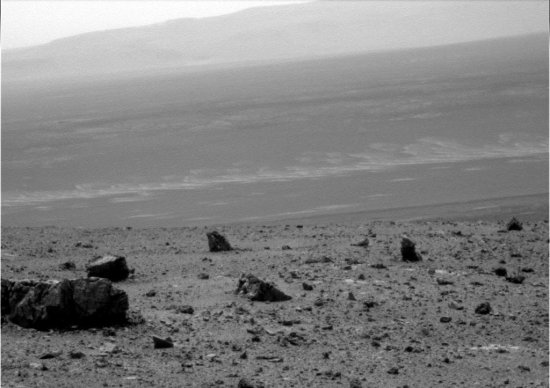
Opportunity begins exploring the rim of Endeavour Crater, taking a bunch of new images . I especially like this one, of which I’ve posted a cropped scaled-down version below. The image looks across the 13-mile-wide Endeavour Crater to its far rim on the horizon. Note the haze. Mars very clearly has an atmosphere, even though it is far thinner than Earth’s. In the foreground are scattered rocks, ejecta produced from the impact that formed a smaller nearby crater now named Opportunity Crater.

Endeavour Crater as seen by Opportunity

1 comment
1 1,282 1,283 1,284 1,285 1,286 1,352