
A Chinese launch failure today
Another rocket launch failure today, this time by the Chinese.
Another rocket launch failure today, this time by the Chinese.
The Titan Mare Explorer: A nautical mission to an alien sea.
If [NASA] green-lights the mission, the capsule will lift off in 2016. By 2023, TiME will be about 800 million miles away in Titan’s north-polar region, home to its biggest lakes and seas. The capsule will take photographs, collect meteorological data, measure depth, and analyze samples. TiME will have no means of propulsion once it is on Titan, so it will float, carried by breezes across the sea’s surface. Then, by the mid-2020s, it will enter a decade-long winter of darkness as the moon’s orbit takes it to the dark side of Saturn, away from the sun and communication. It won’t have a line of sight to Earth to beam back more data until 2035.
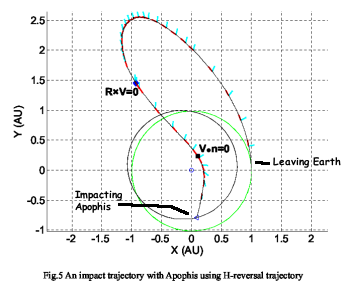
In a paper published today on the Los Alamos astro-ph preprint website, two Chinese scientists have proposed using a solar sail for deflecting any asteroid that happens to be aimed at the earth. The diagram to the right is their simulated mission to impact the asteroid Apophis, which will pass close to the earth in 2029 and — depending on whether that flyby puts it through a very small 600 meter-wide mathematical “keyhole” — could then return in 2036 on a collision course.
The idea is to use the sail to slow the spacecraft down enough so that it starts to fall towards the sun. The sail is then used to maneuver it into a retrograde orbit. When it impacts the asteroid the impact will therefore be similar to a head-on collision, thereby imputing the most energy in the least amount of time with the least amount of rocket fuel. In their Apophis simulation, a mission, weighing only 10 kilograms (about 22 pounds), launched around 2025, and hitting the asteroid in this manner in 2026, would deflect its flyby in 2029 enough to guarantee it will not fly through the “keyhole” and therefore eliminate any chance of it hitting the earth in 2036.
Obviously many questions must be answered before such a mission should fly.
» Read more
American manned space: dependent on the Russians in more ways than you think.
As commentators from around the country gnash their teeth at U.S. dependence upon Russia to move cargo and astronauts to the mostly U.S. built/funded International Space Station (ISS), they’ve missed the bigger boat: With one exception, all the commercial spaceflight offerings currently in the works have Soviet or Russian engines as a key part of the rockets involved.
Things are so good on Juno ten days after launch that mission controllers have canceled a rocket burn to adjust the spacecraft’s course.
Russians to display a new rocket and manned spacecraft design at an international air show in Russia today.
Saving a failed orbiting satellite with engineering.
An evening pause:
An evening pause: What every home should have.
Another anniversary: Thirty years ago today IBM introduced its first PC.
Here are some additional stories describing today’s test flight of the Hypersonic Test Vehicle.
I have several questions, and no answers: