China launches classified technology test satellite

According to China’s state-run press, it used its Long March 2C rocket to launch a satellite to test “internet technologies” today, lifting off from its interior Jiuquan spaceport in the northwest of China.

This is all that press told us. Nor did it say where the rocket’s first stage crashed in China, whether it used parachutes to control its descent, or whether it came down uncontrolled near habitable territories.

The leaders in the 2023 launch race:

45 SpaceX (with a planned Starlink launch tonight)
25 China
9 Russia
5 Rocket Lab

American private enterprise still leads China in launches 51 to 25, and the entire world combined 51 to 43, with SpaceX by itself leading the rest of the world, excluding American companies, 45 to 43.

1 comment

Puzzling crater on alien Mars

Puzzling crater on alien Mars
Click for original image.

Today’s cool image once again illustrates that the things that orbiters photograph on the Martian surface are not always what they seem at first glance. The picture to the right, cropped, reduced, and sharpened to post here, was taken on March 23, 2023 by the high resolution camera on Mars Reconnaissance Orbiter (MRO). It shows what the scientists label as “layering” in this small mile-wide crater.

That layering, seen on both the interior and exterior slopes of its circular rim, is what makes this crater puzzling. It suggests this crater was not formed by an impact, but by volcanism. The layers suggest repeated eruptive events. That the crater sits above the surround plain by about 100 feet strengthens this conclusion.

And yet, a look at the overview map below suggests this conclusion is premature.
» Read more

1 comment

SpaceX launches another 48 Starlink satellites

Using its Falcon 9 rocket, SpaceX today successfully launched another 48 Starlink satellites, lifting off from Vandenberg Space Force Base.

The first stage completed its twelfth flight, landing softly on a drone ship in the Pacific. The two fairing halves completed their fourth and seventh flights respectively.

The leaders in the 2023 launch race:

45 SpaceX
24 China
9 Russia
5 Rocket Lab

In successful launches, American private enterprise now leads China 51 to 24 in the national rankings, while SpaceX by itself leads the entire world combined, excluding American companies, 45 to 42.

8 comments

Taiwan wants and needs Starlink, but local law is blocking a deal

After three years of discussions, negotiations between Taiwan and SpaceX to provide Starlink to that nation broke off in 2022 because of a local Taiwanese law that requires local ownership of at least 51%.

SpaceX would not agree to these conditions, and ended the negotiations. In response, Taiwan has been struggling to get its own communications satellite into orbit, with limited success.

To address that vulnerability, the Taiwan Space Agency (TASA) intends to launch its first self-made low-Earth orbit communication satellite in 2026 and at least one more by 2028, Director General Wu Jong-shinn said. Taiwan also will have rockets capable of carrying payloads weighing over 100 kilograms, he added in an interview.

Since the country doesn’t yet have those rockets, this plan remains dependent on foreign launchers. Moreover, to be effective in low-orbit will require not two satellites but a constellation of 20 to 30. Taiwan is years from being to launch such a constellation.

It seems Taiwan is cutting off its nose to spite its face by not changing this ownership law. Its entire internet access is dependent on 14 undersea cables, and China has already demonstrated the ability to destroy these cables when it cut two in February. No foreign operation is going to give up its ownership to make a deal in Taiwan.

7 comments

Students complete first suborbital launch from new Nova Scotia spaceport

Students today completed the first suborbital launch from the new Nova Scotia spaceport being run by Maritime Launch Services.

The launch was completed by Arbalest Rocketry, a rocketry team from Ontario’s York University. It in turn is part of a nationwide Canadian student program called Launch Canada involving “over 1000 students nationwide from over 25 universities and colleges.”

Maritime hopes to offer both a launchpad and a rocket to satellite companies. It has deals with rocket startups in both the Ukraine and the United Kingdom, whereby satellite companies can come to Martitime and get full launch services.

1 comment

Large mass of granite unexpectedly detected on Moon

Using archival data from four lunar orbiters (two American and two Chinese), researchers have unexpectedly detected evidence suggesting the existence of a large 20-mile-wide mass of granite under a lunar volcanic caldera.

“We have discovered extra heat coming out of the ground at a location on the Moon believed to be a long dead volcano which last erupted over 3.5 billion years ago. It’s around 50km across, and the only solution that we can think of which produces that much heat is a large body of granite, a rock which forms when a magma body – the unerupted lava – below a volcano cools. Granite has high concentrations of radioactive elements like uranium and thorium compared to other rocks in the lunar crust, causing the heating we can sense at the lunar surface”.

Except for some small grains found in Apollo lunar samples, granite has not been found anywhere in the solar system except on Earth. This discovery, if confirmed, will strengthen the theory that the Moon was once part of the Earth and was created from the impact of a second large body.

11 comments

Update on preparations at Boca Chica for next Starship/Superheavy test launch

Link here. The article provides an excellent review of the extensive work SpaceX is doing, especially in repairing and upgrading the Superheavy launch facility.

Overall, SpaceX is moving fast, suggesting that Elon Musk’s prediction that it will be ready technically to launch in August quite believable. I remain doubtful that launch will happen in August, however, as I fully expect the FAA and the Biden administration will not issue a launch license on time, but will delay it.

8 comments

Swirls draining into a Martian crater

Swirls draining into a Martian crater
Click for original image.

Cool image time! The picture to the right, rotated, cropped, reduced, sharpened, and annotated to post here, was taken on April 8, 2023 by the high resolution camera on Mars Reconnaissance Orbiter (MRO).

The picture shows a terrain of swirls and terraced mesas. Because the shadows are deceptive, I have annotated the picture to show the actual drainage pattern of those swirls, suggesting that whatever material forms these swirls is not only draining about 200-250 feet down into the low point at the picture’s center, the swirls are also draining toward the small 1,000-foot-wide crater in the upper left. That crater however appears to lie on top of the swirls, which means it came after them.

What are the swirls made of?
» Read more

0 comments

Europe’s Ariane-5 rocket completes its last launch

The Ariane-5 rocket today successfully completed its final launch, lifting off from French Guiana and placing two communications satellites into orbit.

At the moment Europe has no capability of putting anything into orbit. Ariane-5 is retired. Ariane-6, its replacement, is far behind schedule will probably not make its first test flight until next year. The Vega-C rocket is grounded because of a launch failure in December 2022.

This was only the second launch for Europe in 2023, so the the leader board in the 2023 launch race remains the same:

44 SpaceX
24 China
9 Russia
5 Rocket Lab

In successful launches, American private enterprise still leads China 50 to 24 in the national rankings, while SpaceX by itself leads the entire world combined, excluding American companies, 44 to 42.

6 comments

Alien Mars

Alien Mars
Click for original image.

Today’s cool image illustrates again the alien geology of Mars, often disguised as geological features that at first glance seem familiar. The picture to the right, cropped and reduced to post here, was taken on April 9, 2023 by the high resolution camera on Mars Reconnaissance Orbiter (MRO). Its most distinct feature, the mile-wide double crater in the center bottom, at first appears typical of such craters found on the Moon and elsewhere, suggesting that the bolide that caused it broke in two as it cut through the Martian atmosphere.

This double crater however is not like lunar double craters, in that the shape of both craters is deformed, and the deformation is not quite the same in each. Moreover, the crater does not appear to have an upraised rim or to have thrown out any obvious ejecta. Instead, the two objects hit what looks like soft ground, such as when you drop a pebble into snow.

There’s more.
» Read more

0 comments

Curiosity’s most damaged wheel appears to be surviving the rough terrain on Mount Sharp

Curiosity's middle left wheel, from November 2022 to July 2023
For original images go here and here.

In today’s download of images from Curiosity was a set of pictures taken by its Mars Hand Lens Imager (MAHLI) of the rover’s wheels, as part of the science team’s routine inspection procedures after every 500 meters of travel.

The picture to the right shows what I think is the rover’s left middle wheel, its most heavily damaged, comparing what that wheel looks like now versus what it looked like in November 2022. At that time five of the wheel’s zig-zag grouser treads were broken, three of which are visible in both pictures. The numbers indicate identical wheel treads.

As you can see, after more than seven months of travel across some of the roughest and rockiest ground so far seen on Mars, no more grousers have broken in the new picture. The plus (“+”) signs indicate places where I think some additional metal between the grousers appears to have broken away, but even here the additional damage appears minimal.

Based on past wheel inspections, I expect more images will be taken in the next day or so. We shall see if those pictures indicate any further damage elsewhere. Based on this new picture, however, it appears that the care the science team takes in picking Curiosity’s route, as well as its software (designed to avoid the worst terrain), is continuing to preserve the wheels from further significant damage.

2 comments

South Korea: North Korean spy satellite of “no military utility”

Having completed its salvage operations to recover rocket and satellite remains from North Korea’s failed launch on May 31st, the South Korean military today revealed that the satellite had “no military utility as a reconnaissance satellite.”

As expected, it also provided few details to back up that claim:

The JCS [South Korea’s joint chiefs of staff] did not detail the findings through the allies’ analysis of the wreckage nor did it disclose any photos of the retrieved part of the satellite. Last month, a Seoul official struck a cautious note, insinuating that disclosing all the information the military gleaned from the salvage operation would rather benefit the North Korean military.

It is likely true that the North Korea satellite was of limited value, but it is also true that secrecy and disinformation works to the advantage of South Korea’s military. We therefore would be wise to remain skeptical about any of its claims, one way or the other.

1 comment

Instrument designed to detect lightning releases first data

Lightning over Europe
Lightning over Europe. Click for original movie.

The first data from the Lightning Imager launched in December 2022 on Europe’s Meteosat weather satellite has now been released, the images compiled into movies showing lightning activity across Europe, Africa, the Middle East and parts of South America.

While the animations are a first initial result from the Lightning Imager, the Meteosat Third Generation Imager is currently undergoing its commissioning phase during which the instruments are calibrated and the data is validated. Data from the Lightning Imager will be available for operational use in early-2024 at an increased sensitivity.

You can see all the movies here. The lightning is found almost exclusively over land. In fact, you can see the lightning in one storm vanish as the storm drifts out into the Mediterranean.

3 comments

Parker completes 16th orbit of the Sun

On June 22, 2023 the Parker Solar Probe completed its 16th close approach to the Sun, passing within 5.3 million miles of the solar surface while moving at 364,610 miles per hour.

The mission team at the Johns Hopkins Applied Physics Laboratory (APL) in Laurel, Maryland, noted the close approach was preceded by a small trajectory correction maneuver (TCM) on June 7 —​ the first course correction since March 2022. Mission Design and Navigation Manager​ Yanping Guo of APL said TCMs are performed periodically to ensure that the​ spacecraft remains on course, and the latest maneuver kept Parker on track to hit the “aim point” for the mission’s sixth Venus flyby on Aug. 21. ​

With each perihelion now, Parker sets new records of speed. No human spacecraft has ever flown so fast.

0 comments

A Martian volcanic ash field covering an ancient lava flow

A Martian volcanic ash field covering an ancient lava flow
Click for original image.

Cool image time! The picture to the right, rotated, cropped, reduced, and sharpened to post here, was taken on April 16, 2023 by the high resolution camera on Mars Reconnaissance Orbiter (MRO). It shows in the center an ancient tongue of lava flow that is surrounded by thick dust fields on the north and the south.

The arrow indicates the downhill grade. It also shows the direction of the prevailing winds, downhill to sculpt the volcanic ash into long streamers of parallel grooves, with obvious eddies forming around bits of older lava that still stick up through the ash. On the lava flow can also be seen one small volcano cone, on the picture’s right edge, suggesting that either during this flow or after it hardened magma bubbled up from below.

The location is fascinating, and in fact puts this picture into its much more spectacular context.
» Read more

0 comments

A spiral galaxy as seen by Hubble

A spiral galaxy as seen by Hubble
Click for original image.

Cool image time! The picture to the right, cropped, reduced, and sharpened to post here, was taken as part of a research project to use the Hubble Space Telescope to photograph galaxies where supernovae had recently occurred. From the caption:

UGC 11860 lies around 184 million light-years away in the constellation Pegasus, and its untroubled appearance can be deceiving; this galaxy recently played host to an almost unimaginably energetic stellar explosion.

A supernova explosion — the catastrophically violent end of a massive star’s life — was detected in UGC 11860 in 2014 by a robotic telescope dedicated to scouring the skies for transient astronomical phenomena; astronomical objects which are only visible for a short period of time. Two different teams of astronomers used Hubble’s Wide Field Camera 3 to search through the aftermath and unpick the lingering remnants of this vast cosmic explosion.

This Hubble image once again illustrates the vastness of the universe. Note that every single dot surrounding UGC 11860 in this picture is another far more distant galaxy. As much as UGC 11860 is in our local intergalactic neighborhood, it is still so distant that this field of view is small enough that it contains no stars.

2 comments

Another flying car gets FAA approval for flight testing

Aska-5 flying car
The Aska-5 flying car

The FAA has approved another flying car for flight testing, this time for a flying car designed to also be able to do vertical take-offs if necessary.

The Aska A5 … has four wheels and four seats. Like the Klein Vision [another flying car proposal], it can take off on a runway if there’s one available. Unlike the Klein Vision, it can also takeoff on a very short runway, or indeed no runway at all, thanks to an electric VTOL [vertical take-off and landing] system that folds out at the touch of a button. And unlike, say, the Xpeng AeroHT [a different flying car proposal], it’s capable of transitioning to efficient, winged cruise mode to expand its range.

The A5 will look fairly ridiculous driving down the road, all propellers and struts, a clog with a dishrack full of cutlery piled on top. But when the main rear wing and canard fold out, it all makes a lot more sense. There are six large propellers, four at the back, two at the front, and in VTOL operations these will lift the Aska off the ground and allow it to hover. For forward flight, the two inner rear propellers can tilt forward, allowing horizontal thrust in cruise mode with the rest of the props switched off and the car’s weight supported by its wings.

The proposed price tag for the Aska-5 is presently just under $800K, though it will be a while before you can buy one. The company says it is doing both driving and flight testing, but provided no images or data of it in the air. Thus, a lot of work remains before you could climb in, drive from your home to an airport and take off.

The company says it has $50 million in preorders. If so, at least 50 people think this might be the real deal.

10 comments

ISRO aborts first static fire test of prototype of a new upper stage rocket engine

According to India’s space agency ISRO, on July 1st engineers were forced to abort the first static fire test of prototype of a new upper stage rocket engine, planned to last 4.5 seconds but stopped after 1.9 seconds.

The test proceeded as predicted till 1.9 s validating the ignition and subsequent performance of PHTA [Power Head Test Article]. At 2.0 s, an unanticipated spike in the turbine pressure and subsequent loss of turbine-speed was observed. As a precautionary step, the test was terminated. Analysis under progress would offer further understanding before proceeding with further hot-tests for longer duration.

This was not a test of a real rocket engine, but an engineering test prototype, designed “to validate the integrated performance of the critical subsystems such as the gas generator, turbo pumps, pre-burner and control components.” That the test showed issues without exploding is actually very good news. Engineers still have the prototype to quickly figure out what went wrong and fix it.

0 comments

Ingenuity responds after 63 days of silence

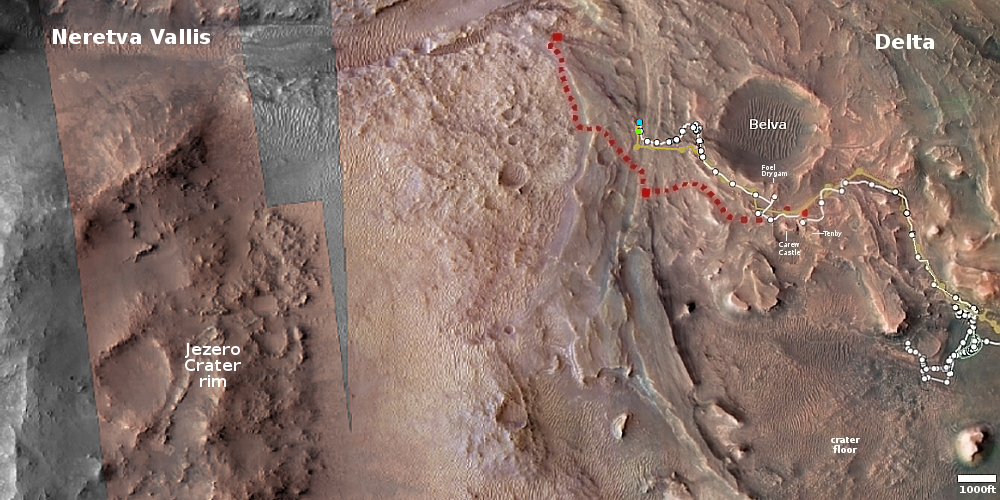
Overview map
Click for interactive map.

For the past two months the science and engineering teams for the Perseverance rover and the Ingenuity helicopter in Jezero Crater have been very silent as to the status of Ingenuity. On April 25, 2023 the Ingenuity team had posted their flight plan for the helicopter’s 52nd flight, with an expected flight date the next day.

Until today, however, no information about the results of that flight had been released. Except for one update in late May describing earlier issues with communications after flight 49, the science and engineering teams maintained radio silence about that 52nd flight in April.

Today’s update finally explained that silence:

The flight took place back on April 26, but mission controllers at NASA’s Jet Propulsion Laboratory in Southern California lost contact with the helicopter as it descended toward the surface for landing.

The Ingenuity team expected the communications dropout because a hill stood between the helicopter’s landing location and the Perseverance rover’s position, blocking communication between the two. The rover acts as a radio relay between the helicopter and mission controllers at JPL. In anticipation of this loss of communications, the Ingenuity team had already developed re-contact plans for when the rover would drive back within range. Contact was re-established June 28 when Perseverance crested the hill and could see Ingenuity again.

The flight plan for the 52nd flight in April had been to fly 1,191 feet to the west. Though the Ingenuity team has not yet released the actual flight details, I have indicated with the green line on the overview map above the estimated distance and direction planned. The green dot marks Ingenuity’s position before the flight, with the blue dot marking Perseverance’s present location. The red dotted line indicates the planned route for Perseverance.

11 comments
1 190 191 192 193 194 817