
Another carbon trading scheme is failing, this time in Alberta Canada
Another carbon trading scheme is failing, this time in Alberta Canada.
Another carbon trading scheme is failing, this time in Alberta Canada.
One scientist’s perspective on the new Climategate emails.
Long time readers will recall that in 2004 and 2005 (before Katrina), I led an interdisciplinary effort to review the literature on hurricanes and global warming. The effort resulted in a peer-reviewed article in the Bulletin of the American Meteorological Society. That paper, despite being peer-reviewed and standing the test of time (as we now know), was ignored by the relevant part of the IPCC 2007 that dealt with extreme events. Thanks to the newly released emails from UEA [University of East Anglia] (hacked, stolen, donated, or whatever) we can say with certainty why that paper was excluded from the IPCC 2007 report Chapter 3 which discussed hurricanes and climate change. Those various reviews associated with the release of the UEA emails that concluded that no papers were purposely kept out of the IPCC may want to revisit that particular conclusion.
Read the whole thing. It is worth it to get a real sense about how petty and political the IPCC process is. It has little to do with science, and everything to do with forcing a conclusion down everyone’s throat.
India pushes for a sharing of intellectual property rights at Durban climate talks.
If you ever had any doubts about the political goals behind the global warming movement, this headline and story should put those forever to rest. The advocates of climate change really don’t care about climate change. What they really want is to get their hands on other people’s success. Failing to get a deal that would limit the activities of the developed countries so that the developing countries would have an advantage in the free market, the effort is now aimed at attacking and even eliminating the property rights of private technology companies. What this has to do with climate change is beyond me.
That India is leading the way here is puzzling, however, as that country’s economic success in the past decade is solely due to its abandonment of communist ideals in favor of capitalism and the free market. You would think, with that experience, that India’s government would thus understand the importance of protecting property rights, not violating them.
Having failed to clean up its act after the release of the climategate emails two years ago, the field of climate science is about to turned upside down all over again. Today there was another release of hacked emails, written by the same collection of global warming scientists. Once again, these emails show that these scientists are anything but scientists. Instead, they seem far more interested in campaigning for a certain result, regardless of the science. A few quotes:
» Read more
A new batch of hacked climategate emails have been released. More info, including some examples from the emails, can be found here and here.
Update: A quick scan by me of these, hardly finished, reveals this one email from Phil Jones, demonstrating beyond doubt how much fraud is involved in climate science:
Basic problem is that all models are wrong – not got enough middle and low level clouds.
Stay tuned for more bombshells.
The press reports have been unanimous:
Unfortunately, if you read the actual IPCC panel summary report, you find that, though the majority of the press stories accurately describe the report’s worst scenarios and predictions, all of them downplay the most important point of the report, that the uncertainties are gigantic and that the influence of human activity on the increase or decrease of extreme weather for the next few decades will be inconsequential. To quote the report:
» Read more
We’re here to help you! Various environmental regulations or actions of the Obama administration have eliminated more than 2.6 million jobs.
Now we now why the Penn State investigation of global warming scientist Michael Mann was a whitewash: The Penn State president — fired over the child abuse scandal there — had a habit of squelching embarrassing investigations.
We’re here to help you: A federal agency has ruled that thousands of lakefront homes in Missouri must be removed, despite being built legally and having been in place for decades.
The global output of atmospheric carbon dioxide jumped in 2010 by the biggest amount on record, according to the U.S. Department of Energy.
In 2007 when the Intergovernmental Panel on Climate Change issued its last large report on global warming, it used different scenarios for carbon dioxide pollution and said the rate of warming would be based on the rate of pollution. Boden said the latest figures put global emissions higher than the worst case projections from the climate panel.
And yet, the global temperatures are not rising, as also predicted by those same IPCC models.
Though it has been very clear for the past few months that the sun has finally transitioned from solar minimum and begun its ramp up to solar maximum, that ramp up has also been very slow and wimpy.
On October 9, 2011 the scientists at Physikalisch- Meteorologisches Observatorium Davos (PMOD) posted an updated summary of the satellite data that has been carefully measuring the variation of the sun’s total solar irradiance since 1978. The graph below, which can be found here [pdf], brings that data up through the present. (I had posted the previous update about a year ago.)
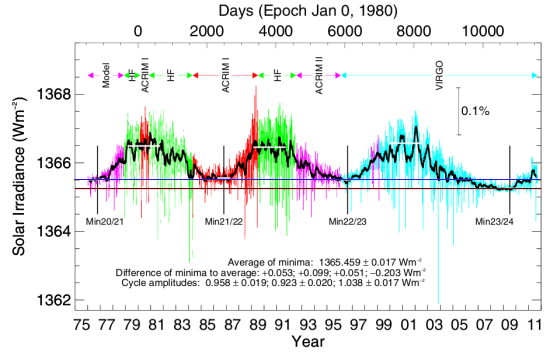
I have added a brown line to illustrate how deep the recently ended solar minimum was, compared to previous minimums. Note also that this most recent minimum would also be far below the minimum prior to 1975. I have also added a blue line to show that the sun has only very recently finally brightened enough to finally exceed the previous minimum. All told, the sun remained dimmer than the previous minimum for over five years!
» Read more