
New information on SpaceX’s rocket fairing recovery effort

Link here. In requesting permission to recover Dragon capsules in the Gulf of Mexico, SpaceX submitted a great deal of information to the FAA about its effort to recover and reuse the fairings of its Falcon 9 rocket. Doug Messier of Parabolic Arc has done a nice job of excerpting that information at the link.

For example, SpaceX is not only trying to recover the fairings, it is trying to recover the new fairing drogue chutes that it uses to slow the fairings down and then ejects before splashdown.

To me, however, one tidbit that stood out like a beacon and actually tells us more about SpaceX’s future anticipated launch rate was this quote:

From 2019-2024, SpaceX anticipates the frequency of launches involving fairing recovery to increase. In 2018, SpaceX anticipates approximately two recovery attempts, and from 2019-2024, SpaceX anticipates approximately three recovery attempts per month. Thus, for all seven years, SpaceX anticipates up to 480 drogue parachutes and 480 parafoils would land in the ocean.

This is further confirmation of SpaceX’s public prediction that it will soon be launching about 30 to 40 times per year. These numbers also equal the best yearly rates the entire United States launch industry ever achieved, and suggest that the entire launch industry in the next decade will be experiencing a significant boom, since aggressive competition usually causes an increase in business for all competitors.
2 comments

New method for scrubbing CO2 out of the air

Researchers have devised a new much more efficient technique for removing carbon dioxide from the smoke of power plants.

The memzyme meets the Department of Energy’s standards by capturing 90 percent of power plant carbon dioxide production at a relatively low cost of $40 per ton. Researchers term the membrane a “memzyme” because it acts like a filter but is near-saturated with an enzyme, carbonic anhydrase, developed by living cells over millions of years to help rid themselves of carbon dioxide efficiently and rapidly.

“To date, stripping carbon dioxide from smoke has been prohibitively expensive using the thick, solid, polymer membranes currently available,” says Jeff Brinker, a Sandia fellow, University of New Mexico regents’ professor and the paper’s lead author. “Our inexpensive method follows nature’s lead in our use of a water-based membrane only 18 nanometers thick that incorporates natural enzymes to capture 90 percent of carbon dioxide released. (A nanometer is about 1/700 of the diameter of a human hair.) This is almost 70 percent better than current commercial methods, and it’s done at a fraction of the cost.”

The article also notes at the end that this technology could also be adapted to scrubbing CO2 from spacecraft atmospheres.

Hat tip to reader MarcusZ1967.

15 comments

Private space raised nearly $1 billion the first quarter of 2018

Capitalism in space: A survey of the money raised in the first quarter of 2018 has found that commercial space has raised nearly $1 billion, all from non-government sources.

The April 10 report by Space Angels, a fund that invests in early-stage space companies, concluded that there was $975.8 million in non-government equity investment in space companies in the first quarter of 2018. That would put the industry on a pace for nearly $4 billion for the year, a figure similar to the estimate made by Space Angels for investment in the industry in 2017.

Just over half of that total for the first quarter, though, came from a single investment identified by Space Angels: a $500 million investment in SpaceX led by Fidelity Investments. That investment is intended “to drive development of their satellite communications network, Starlink,” the report stated.

It appears from the article that the bulk of the investment capital went, not to launch rocket projects, but to satellite proposals. Even so, those satellites will have to get launched, so investment in private rockets is sure to go up in the coming years.

1 comment

Another smallsat rocket company enters the fray

Capitalism in space: A new smallsat rocket company, EXOS Aerospace Systems & Technologies, has announced that it will do a test launch out of Spaceport America on May 5, the anniversary of Alan Shepard’s first suborbital flight, of a rocket it dubs SARGE.

The press release did not specifically say whether the test launch would be suborbital or not, though I strongly suspect so. Nor can I find any details about this rocket or the launch at the company’s website. The company sells itself as building reusable rockets, and the press release includes a video of a hover static fire test of one rocket. Other videos at the company’s website show short clips of other flights were an earlier rocket returned to Earth by parachute. They state that SARGE is an upgrade, so maybe they are going to use its engines to slow the landing.

Either way, the smallsat launch industry is getting very crowded. This company seems right now aimed at capturing the suborbital science and school portion of the market that is looking for cheap quick ways to get payloads up into space for very short periods at very low cost.

4 comments

NanoRacks outlines its private space station plans

Capitalism in space: NanoRacks, which already makes money launching private payloads to ISS, has revealed its plans for building its own private space station using converted Atlas 5 upper stages.

This project was previously called Ixion, but they have dropped that name, and will now call the first station Independence-1.

They have a contract with NASA for the initial development, and hope to convince the agency to pay them to next build a full-size test prototype. The video at the link to me was exceedingly unconvincing however. It shows a robot beginning the process of refurbishing a used upper stage while in orbit, and simplifies the process to an almost ludicrous degree. While I surely believe it can be done, it will not be simple. The difficulties should not be dismissed.

3 comments

Two investigations blame Northrop Grumman for Zuma failure

Two independent investigations have now placed the blame for the failure of the classified Zuma satellite to reach orbit on Northrop Grumman, not SpaceX.

Two independent investigations, made up of federal and industry officials, pointed to Northrop’s payload adapter as the cause of the satellite’s loss, the report said, citing people familiar with the probes. The payload adapter is a key part of deploying a satellite in orbit, connecting the satellite to the upper stage of a rocket.

…The investigations tentatively concluded that onboard sensors did not immediately communicate to ground systems that the satellite did not separate from the rocket, according to the Journal. Unbeknownst to officials at the time, the planned return of the rocket’s upper stage — a method of disposal to avoid adding space debris around the Earth — brought the satellite back down with it. By the time the satellite separated from the rocket it was too late, putting Zuma too low in orbit to save, according to the report.

I still have a nagging suspicion that Zuma actually did reach orbit, and this entire story that it never separated from the upper stage is all a disinformation campaign to help distract people from the satellite’s existence in orbit. At the same time, by this time I don’t put much faith in my own suspicions. These two reports appear to settle the matter.

6 comments

NASA expands first manned Starliner mission

NASA has modified its contract with Boeing to allow its first manned Starliner test mission to add an astronaut and extend the mission’s length so that it more resembles an operational flight to ISS.

NASA is considering adding a third crew member to the Starliner’s “Crew Flight Test” and could extend its trip to the International Space Station from two weeks up to six months, the length of a typical ISS expedition. The potential changes, outlined in a contract modification with Boeing, could help NASA maintain its presence on the International Space Station through 2019 and beyond.

NASA’s last purchased ride aboard a Russian Soyuz spacecraft, upon which the U.S. has relied for access to the ISS since the shuttle’s retirement in 2011, is scheduled to launch in the fall of 2019.
Boeing’s new Starliner spacesuit features lightweight fabric, slim gloves and sneaker-like boots. But Boeing’s Starliner and SpaceX’s Crew Dragon may not be certified to fly four-person crews until after that. “This contract modification provides NASA with additional schedule margin if needed,” said Bill Gerstenmaier, head of human spaceflight operations at NASA headquarters in Washington. “We appreciate Boeing’s willingness to evolve its flight to ensure we have continued access to space for our astronauts.”

Doing this makes some sense, but I wonder why NASA chose to do it with Boeing’s Starliner instead of SpaceX’s Dragon. Starliner has never flown in any form, while the manned Dragon is based on SpaceX’s well tested design.

I suspect NASA will soon modify its SpaceX contract as well. It makes sense. Once you put humans on board, you might as well give yourself the option to do a full mission.

14 comments

Ariane 5 launches two satellites

Europe’s Ariane 5 rocket today successfully placed two communications satellites in orbit, its first launch since January when the rocket placed two satellites in the wrong orbit.

Arianespace did launch a Soyuz rocket in the interim, but this launch signals the return to flight for Ariane 5.

The leaders in the 2018 launch standings:

10 China
7 SpaceX
4 Russia
3 Japan
3 ULA
3 Europe

0 comments

First SpaceshipTwo powered flight since accident

Capitalism in space? Virgin Galactic today successfully completed the first powered test flight of VSS Unity, the first such test flight since the flight accident that destroyed the first SpaceShipTwo and killed on pilot in October 2014.

VSS Unity was dropped from its WhiteKnightTwo mothership from about 50,000 feet (15,000 meters) over the mountains about 20 miles (32 kilometers) north of the Mojave Air and Space Port in California. Pilots David Mackay and Mark “Forger” Stucky fired Unity’s hybrid engine for 30 seconds, boosting the vehicle to a top speed of Mach 1.87 and a maximum altitude of 84,271 feet (25,686 m) before gliding back to the runway at the spaceport, Virgin Galactic representatives said.

During the descent, the crew deployed SpaceShipTwo’s feather system, which reconfigures the ship into a high-drag shuttlecock by moving its twin tail booms. The feather will be used to soften the vehicle’s re-entry into the Earth’s atmosphere during spaceflight.

They say that they hope to begin commercial flights later this year, but I remain exceedingly skeptical.

3 comments

Another space station hotel company enters the market

Capitalism in space: A new space station hotel start-up, Orion Span, hopes to launch their first module by 2021, and begin accommodating guests by 2022.

Aurora Station will accommodate four paying guests and two crewmembers; these latter personnel will likely be former astronauts, Bunger said. Most of the guests will probably be private space tourists, at least initially, but Orion Span will be available to a variety of customers, including government space agencies, he added.

And the space hotel will get bigger over time, if everything goes according to plan. As demand grows, Orion Span will launch additional modules to link up with the original core outpost, Bunger said. “Our long-term vision is to sell actual space in those new modules,” he said. “We’re calling that a space condo. So, either for living or subleasing, that’s the future vision here — to create a long-term, sustainable human habitation in LEO [low Earth orbit].”

This makes three companies vying to build the first private space stations, with Bigelow and Axiom Space already in the game.

3 comments

Revisiting Biosphere 2

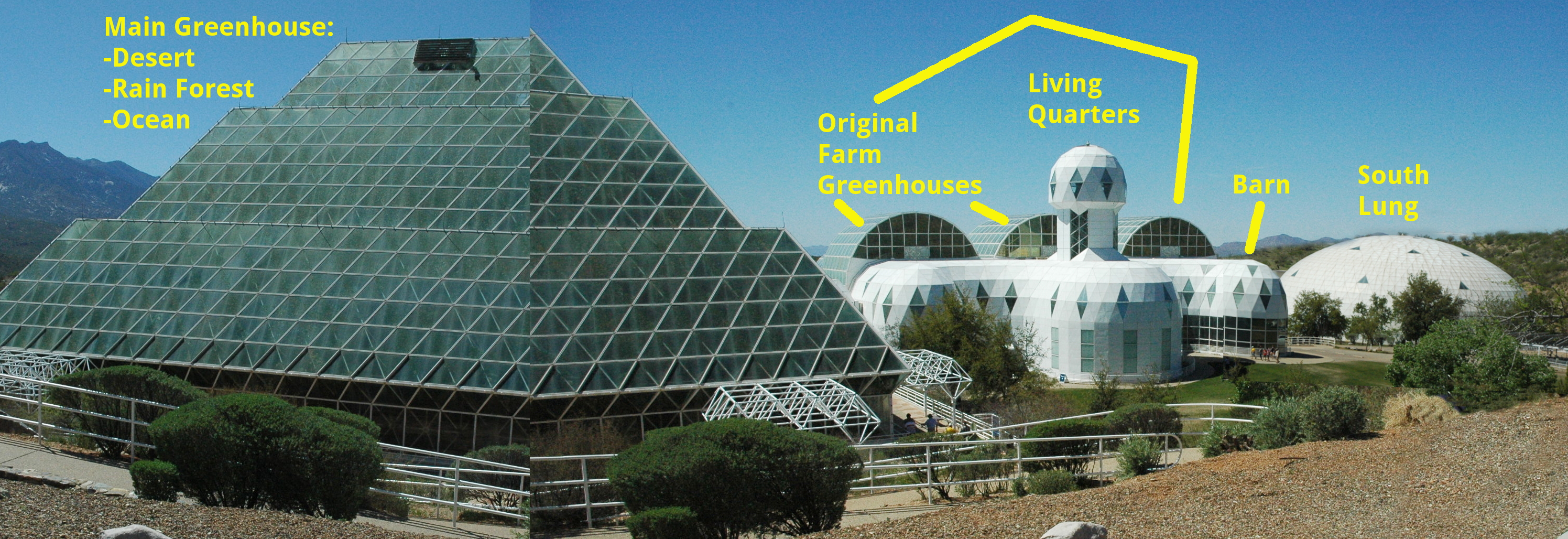
Biosphere 2

This week Diane and I have a friend visiting from back east. As locals generally do when guests visit, we used this visit as an excuse to go sightseeing at local attractions that we somehow never got the time to visit on our own.

So on Tuesday we drove north to take a tour of Biosphere 2, what has been called “a giant space-age ark in the middle of the desert.” The idea, as sold heavily to the public when it was built in the late 1980s and early 1990s, was that eight people would try to live in a closed system for two years, demonstrating the technology needed to both build colonies on other worlds as well as protect the environment here on Earth.

The system wasn’t really closed however (power came from outside), and during the first two year mission it seemed they were somewhat lax about keeping the system closed.

One Biospherian accidentally cut off the tip of her finger and left for medical care. When she returned, she carried in two duffle bags of supplies to the supposedly self-sustaining environment (which presumably would not have been feasible on, say, Mars).

There were also financial issues, as mentioned by our tour guide and confirmed by news stories. Its backer, Texas oil man Edward Bass, spent somewhere between $150 to $200 million. It seems however that the managers running Biosphere 2 didn’t keep good books, and when Bass asked for an accounting they couldn’t provide it. Instead, they attempted to sabotage the project’s second mission.
» Read more

8 comments
1 430 431 432 433 434 684