Thousands flee as Philippine volcano erupts
Thousands flee as Philippine volcano erupts.
Thousands flee as Philippine volcano erupts.
Thousands flee as Philippine volcano erupts.
The mysterious swarm of earthquakes in Arkansas keep coming, including a 4.3 quake today.
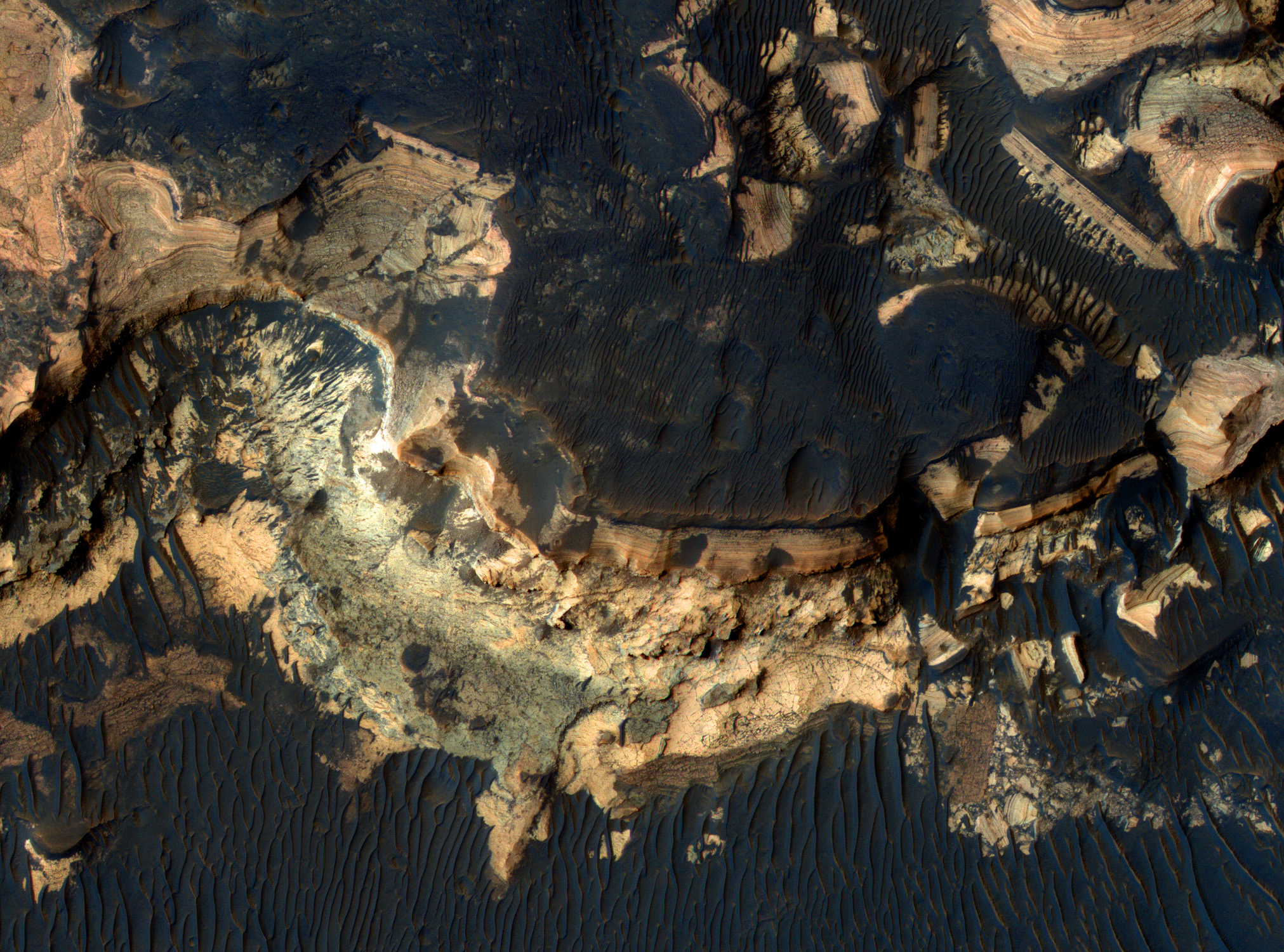
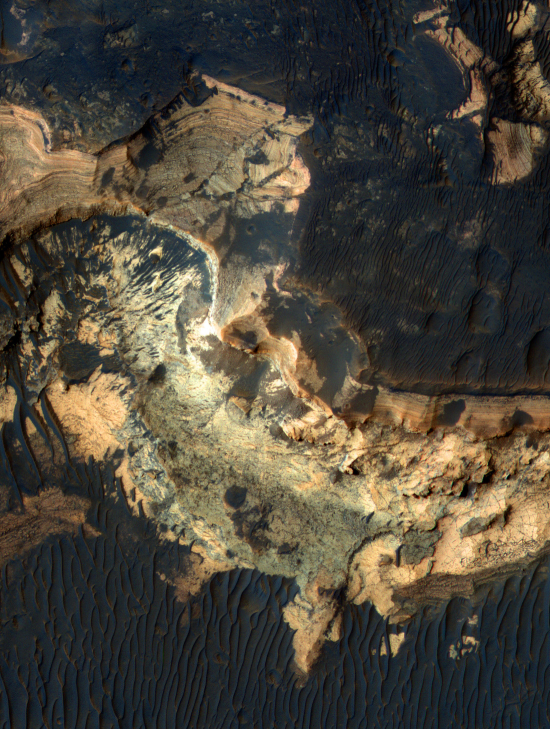
This week’s release of cool images from Mars Reconnaissance Orbiter included the color image below of a region on the floor of Holden Crater, one of the four possible landing sites for Curiosity, the Mars Science Laboratory planned for launch later this year. (If you want to see the entire image at higher resolution, you can download it here.)
Two things that immediately stand out about this image (other than this looks like an incredibly spectacular place to visit):
More news from Stardust: scientists have now identified what they think is the crater produced by Deep Impact’s impact in 2005. Key quote:
The images revealed a 150-metre-wide crater at the Deep Impact collision point that was not present in 2005. The crater is a subtle feature in the images, but it appears consistently in multiple views from the spacecraft. “So I feel very confident that we did find the [impact] site,” said mission member Peter Schultz of Brown University in Providence, Rhode Island, at a press briefing on Tuesday. The crater’s features are “subdued” rather than sharply defined, like those of craters made in hard materials like rock. “The message is: This surface of the comet where we hit is very weak,” said Schultz. The crater also has a small mound in its middle, indicating that some of the material thrown up by the impact was drawn by the comet’s gravity back down into the crater, he said: “In a way, it partly buried itself.”
Researchers have discovered a new set of deep-sea volcanic vents in the south Pacific, suggesting these vents are more common than previously believed. Key quote:
Using an underwater camera system, the researchers saw slender mineral spires about 10 feet tall, with hot water gushing from their peaks, and white mats of bacteria coating their sides. The vents are at a depth of 1,706 feet in a newly discovered seafloor crater close to the South Sandwich Islands, a remote group of islands about 310 miles southeast of South Georgia.
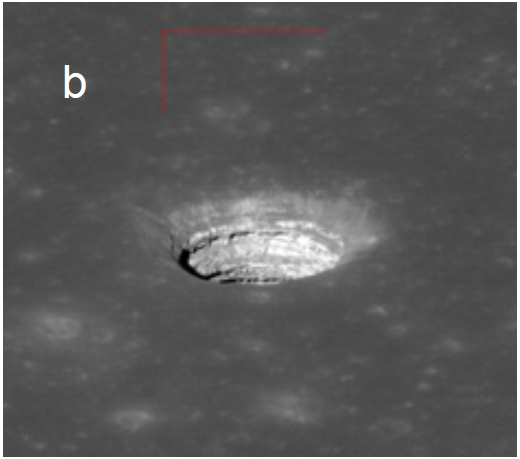
More images of lunar cave pits have been posted by the scientists of Lunar Reconnaissance Orbiter (LRO). They have also published their first paper [pdf] about these cave pits for the 2011 Lunar and Planetary Science Conference taking place in March. The paper summarizes, with images, what is know about the three pits on the Moon that have each been imaged a number of times at different angles and lighting situations.
The caldara of the erupting Japanese volcano Mount Shinmoe now appears to be filled to the brim. More photos here.
Wait ’til next year! The Russian effort to drill into Lake Vostok buried under the Antarctica icecap has fallen short by only a hundred feet, stopped by the end of summer.
Scientists have discovered significant seasonal changes to the northern martian sand dunes, including a number of large avalanches.
Japan’s Mount Shinmoe volcano erupted again today.
Government stupidity in action: FEMA considered then canceled (thank goodness) a proposal to spend more than a billion dollars on Meals-Ready-to-Eat on the very slim chance that the New Madrid fault in the midwest might produce a major earthquake sometime in the three years.
Unfortunately, they still haven’t canceled plans to buy 7 million emergency blankets and 550 million gallons of water in individual 1-liter plastic bottles.
Japan is on alert today after the biggest volcanic eruption in 50 years took place on the nation’s southernmost main island, Kyushu. The pictures at the link are truly incredible!
A fizzy ocean on Enceladus? Key quote:
[Scientists believe] that gasses dissolved in water deep below the surface [of Enceladus] form bubbles. Since the density of the resulting “sparkling water” is less than that of the ice, the liquid ascends quickly up through the ice to the surface. “Most of the water spreads out sideways and ‘warms’ a thin surface ice lid, which is about 300 feet thick,” explains Matson. “But some of it collects in subsurface chambers, builds up pressure, and then blasts out through small holes in the ground, like soda spewing out of that can you opened.”
The headline from this National Geographic story reads “Yellowstone Has Bulged as Magma Pocket Swells,” while the first sentence is designed to send chills up your spine:
Yellowstone National Park’s supervolcano just took a deep “breath,” causing miles of ground to rise dramatically, scientists report.
From here, the next few paragraphs go on to talk about the wild rise of the giant caldara under Yellowstone National Park in recent years, and how past eruptions there were were among the most powerful volcanic explosions ever to occur. Obviously, from this introduction, the thing is about to blow and we better run for cover!
This story is unfortunately typical for much of today’s modern media: find a story with a hint of disaster in it and play up that disaster as much as possible, regardless of the facts. For example, the opening of this article completely misreports the substance of the Yellowstone geology research. Back on December 4, I read the paper and headlined its results as follows: “Yellowstone caldara rise has slowed.” What the scientists had actually found was that after a period of significant growth beginning in 2004, the rise of Yellowstone’s giant volcanic caldara had slowed significantly since 2006, and since 2008 had actually subsided somewhat.
While the significant rise from 2004 to 2006 was then news, suggesting the worrisome possibility that an eruption was imminent, the story now, revealed by this scientific research, was how that rise has stopped, and why.
Now, if you spend the time to read the rest of the National Geographic article above, you will find that the reporter does dig a bit deeper, and notes these facts in better detail. The trouble is that a quick scan of the headline and opening paragraphs will instead leave you with an entirely incorrect impression of the facts.
That this kind of fear-mongering by modern reporters is not unusual, especially when it comes to climate research and extreme weather events, illustrates the vital importance of maintaining as skeptical an eye to what we read as possible. Don’t assume what you read is true. Read it as carefully as possible. Try to check its sources. And compare every article’s conclusions with other reports to see if you can get a feel for the truth, hidden behind the different reports.
And that, by the way, applies as much to what you read here at behindtheblack as anywhere else!
The touchdown that shook the Earth.
The Krakatau volcano in Indonesia has become active, forcing the evacuation of tens of thousands residents.
Black gold! Three to four billion barrels of oil — 25 times more than previously predicted — are now thought to lie under certain geological formations in North Dakota and Montana.
In a paper published today in Geophysical Research Letters of the American Geophysical Union, scientists describe how they have been able to produce remarkably detailed images of the ground buried almost a mile under the ice sheet of Greenland. These radar techniques are the same used in the past by spacecraft to image the hidden surface of Venus, only far more sophisticated.
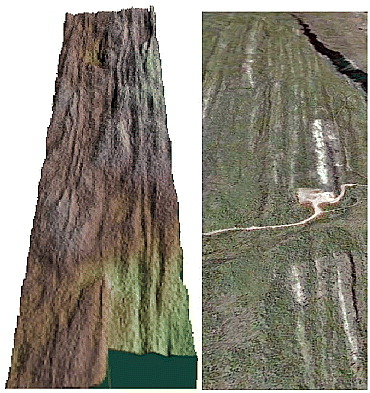
This image from the paper compares the radar image of the Greenland surface (on the left) to an photograph of a known surface feature in the Northwest Territories of Canada, produced thousands of years ago by the giant icesheets of the last Ice Age. Both are at the same scale, about a third of a mile across, and are looking at the surface at an oblique angle of about 45 degrees. With the radar-produced image on the left, sunlight is simulated as coming from the right, with the elevation increasing as the colors go from green (lowest) to yellow to brown to purple (highest).
The long grooves, generally 30 to 100 feet deep and extending sometimes several miles, are produced as the icesheet slides across the ground. In the radar image, however, these grooves are slowly being ground out now.
It is the resolution of this technique that is so exciting. That they can look through ice almost a mile thick and resolve objects that are only tens of feet across tells me that someday it will be possible for spacecraft to map the smallest features on the surface of Venus or Titan. More exciting, this suggests that the technology will one day exist to even map the unknown surface of gas giants like Jupiter or Saturn, and do it in breathtaking detail.
Yowza!
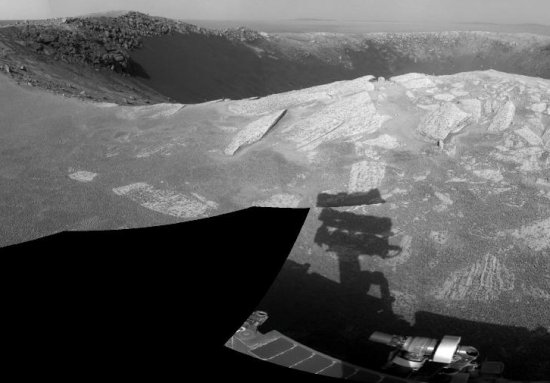
In its 14 mile multi-year trek to Endeavour Crater — now about half completed — the Mars rover Opportunity has stopped to take a short rest stop at a small crater.
The crater, dubbed “Santa Maria Crater” by the scientists who operater Opportunity, is about the size of a football field. What makes it especially interesting are the sharp rocks piled up on its rim, as they are probably debris ejected from the crater at impact. Since this material probably came from deep below the Martian surface, it is also likely to hold information about the Martian geological past, thereby making it a prime research site.
A scientist has made the first measurements of the strength at the Earth’s core of its magnetic field. What’s most fascinating is that he used the Moon and distant quasars to do it! First he used radio observations of the quasars to get very precise measurements of the Earth’s rotation axis and how the Moon was tugging at that axis and thus affecting its magnetic field. Then,
By calculating the effect of the moon on the spinning inner core, Buffett discovered that the precession makes the slightly out-of-round inner core generate shear waves in the liquid outer core. These waves of molten iron and nickel move within a tight cone only 30 to 40 meters thick, interacting with the magnetic field to produce an electric current that heats the liquid. This serves to damp the precession of the rotation axis. The damping causes the precession to lag behind the moon as it orbits the earth. A measurement of the lag allowed Buffett to calculate the magnitude of the damping and thus of the magnetic field inside the outer core.
Scientists have used data from Cassini to identify what they think are ice volcanoes on Titan. The two volcanoes, each about 3000 feet high, are located near the equator and appear to resemble the volcanoes on Earth, with a central crater on top of cone-like peak and finger-like flows coming down the sides from the crater. The lava here, however, is not molten rock, but water.
Why Arkansas? Since September 20, the small town of Guy, Arkansa, has experienced a swarm of 487 measurable earthquakes.
In a paper published today in Geophysical Research Letters of the American Geophysical Union, scientists note that the rise of giant volcanic caldara under Yellowstone National Park has slowed significantly since 2006 and since 2008 has actually subsided somewhat. Key quote from the paper:
Here we propose that as the caldera source continues inflating, the accumulated strain energy in the deformed crust could promote earthquakes with mechanisms such as hydrofracturing,, migration of magmatic fluids, and brittle fracturing of rocks. These events can subsequently depressurize the magmatic systems or release the accumulated strain energy, slowing the uplift or even influencing a change in motion to subsidence. In January 2010 the Yellowstone caldera experienced another large earthquake swarm at its northwestern boundary close to the location of the 1985 swarm. . . . In the following five months the caldera experienced the first overall subsidence since the inception of its uplift in 2004. This scenario is similar to that in 1985 where a reverse of caldera uplift to subsidence was temporally correlated with the largest observed Yellowstone earthquake swarm.
And damn, do I want to rappel into them!
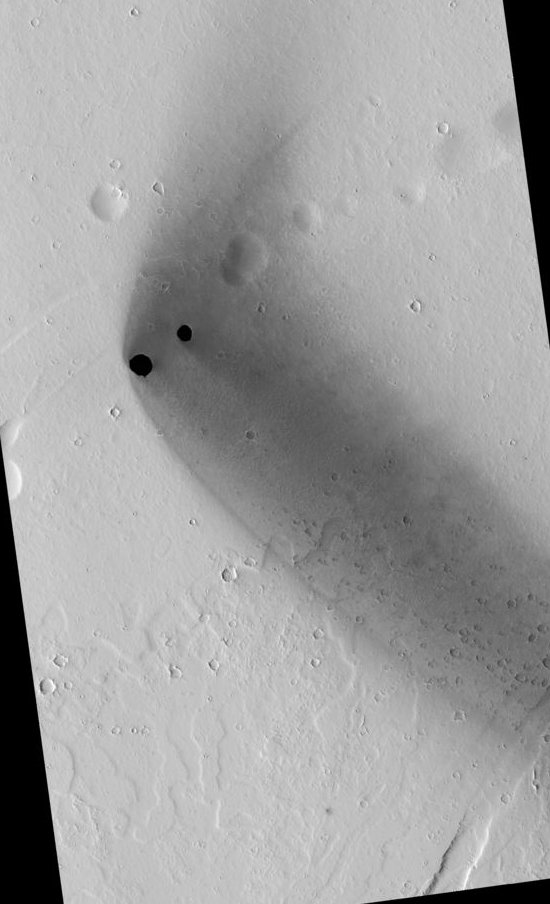
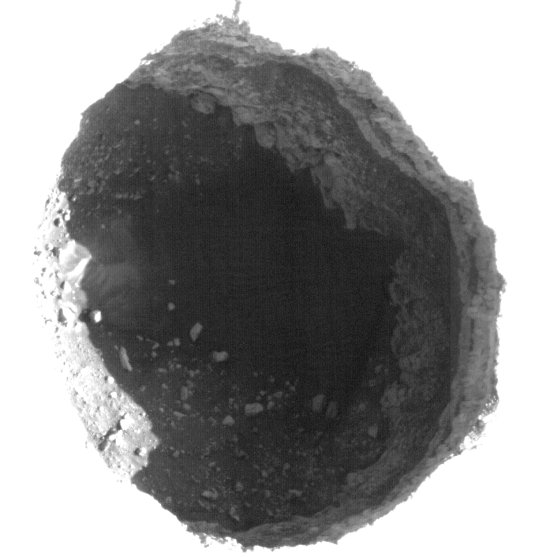
This week’s release of images from the HiRISE camera on Mars Reconnaissance Orbiter included these spectacular photos of two deep pits, approximately 180 and 310 meters in diameter and located aligned with a series of depressions that suggest additional passages at their base.
The first image shows the pits in the context of the surrounding terrain. From the caption:
These pits are aligned with what appears to be larger, degraded depressions. The wispy deposit may consist of dark material that has been either blown out of the pits or from some other source and scattered about by the local winds.
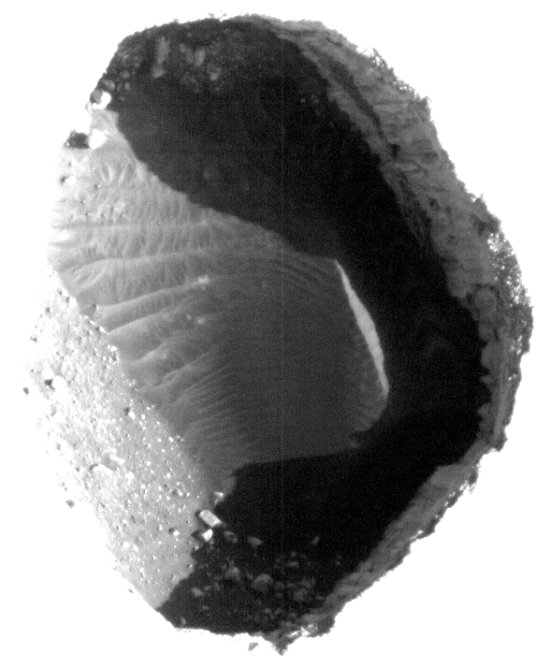
The next two images are heavily processed close-ups of each pit in order to bring out the detail within. From the caption:
The eastern most and smaller of the two pits contains boulders and sediment along its walls and brighter aeolian dune sediments on its floor. The larger, western most pit contains sediment and boulders with faint dune-like patterns visible on the deepest part of the floor. Both pits have steep eastern walls and more gently sloped western walls that transition gradually into the pit floor. Steep resistant ledges containing boulders that overhang and obscure the pit floors form the eastern walls.
The eruption of Mount Merapi continues to build, with the death toll now over 150 and over 200,000 people displaced from their homes. Heavens, it might even cause President Obama to cancel his visit to Indonesia.
More on the continuing eruption of Mount Merapi in Indonesia. Key quote:
The Volcano Mitigation and Geological Disaster Agency warned of worse in store as magma pushed towards the surface from depths of 6-8km, compared with a maximum 2km deep when the mountain previously erupted in 2006. “This is the scenario I dislike the most, because the deepest magma is pushing up now,” said the agency’s chief, Surono. “The eruptions haven’t stopped, the tremors are getting stronger and one big explosion could be the result. I’ve never seen it act like this. We don’t know what to expect.”
The worst volcanic eruption of Mount Merapi in Indonesia in a century has gotten worse.