Searching for surface changes caused by the biggest recorded Martian quake

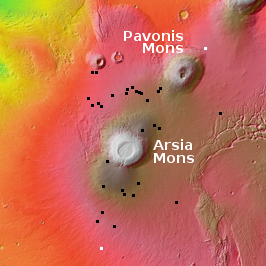
Location of May quake
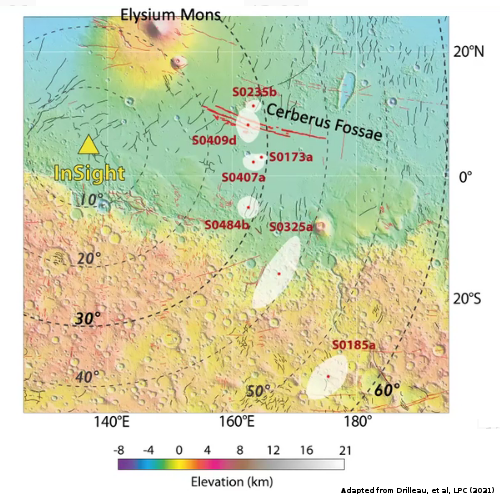
The white patches mark the locations on Mars of the largest quakes detected by InSight

On May 4, 2022, the seismometer on the InSight Mars lander detected a 4.7 magnitude earthquake on Mars, the largest ever detected.

The map to the right shows the approximate location of that quake by the white patch with the green dot. (You can read the paper describing this quake here [pdf].) This is also the same approximate location of a small five-mile-wide crater known to have many slope streaks on its interior walls.

Slope streaks are a uniquely Martian geological feature whose origin remains unknown. They resemble dark avalanche streaks flowing downhill, but make no changes in the topography, and lighten with time. They also occur randomly throughout the year. Two slightly different theories for their formation suggest that the streaks are triggered by the fall of dust particles, though neither is proven or even favored.

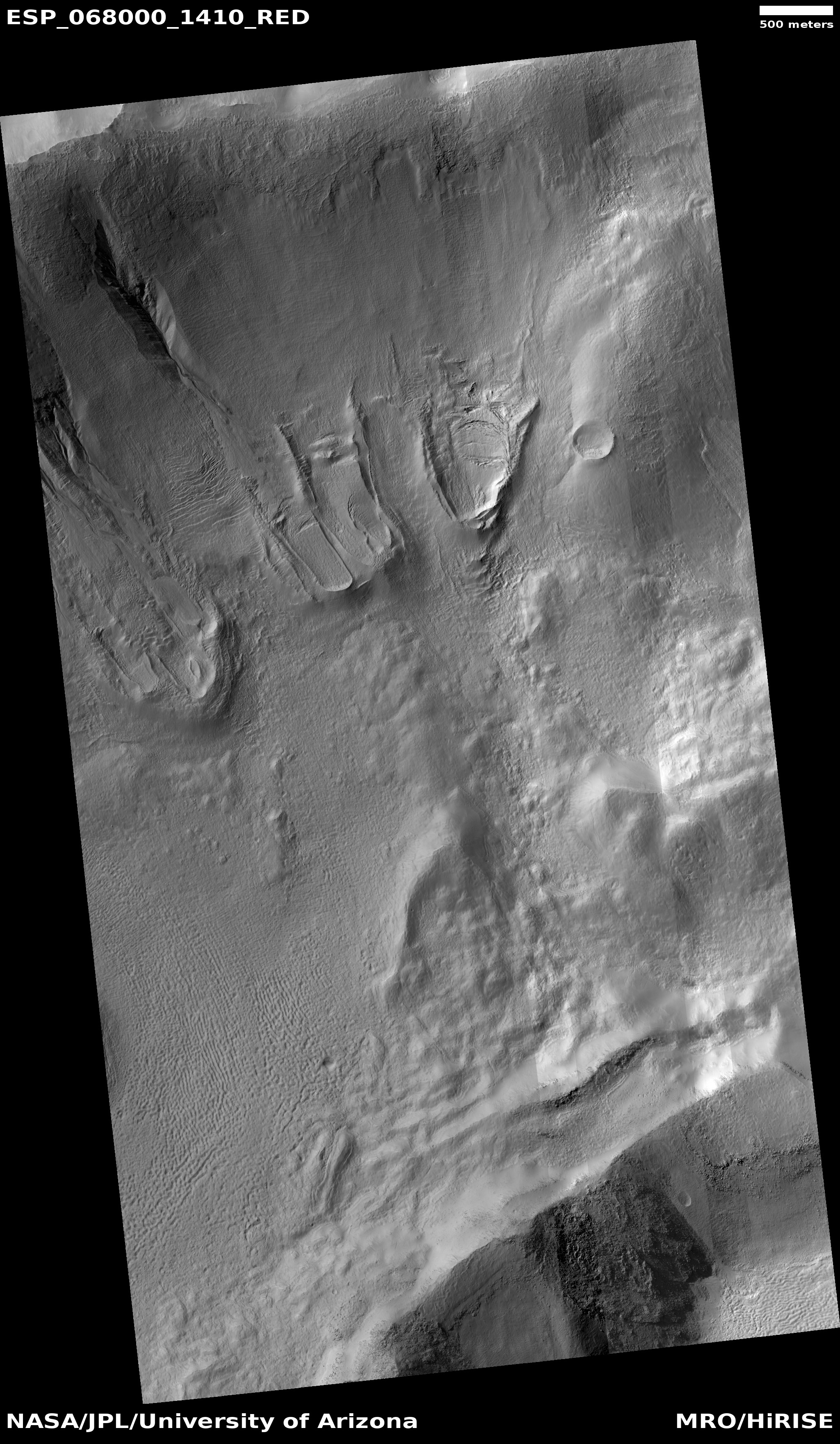
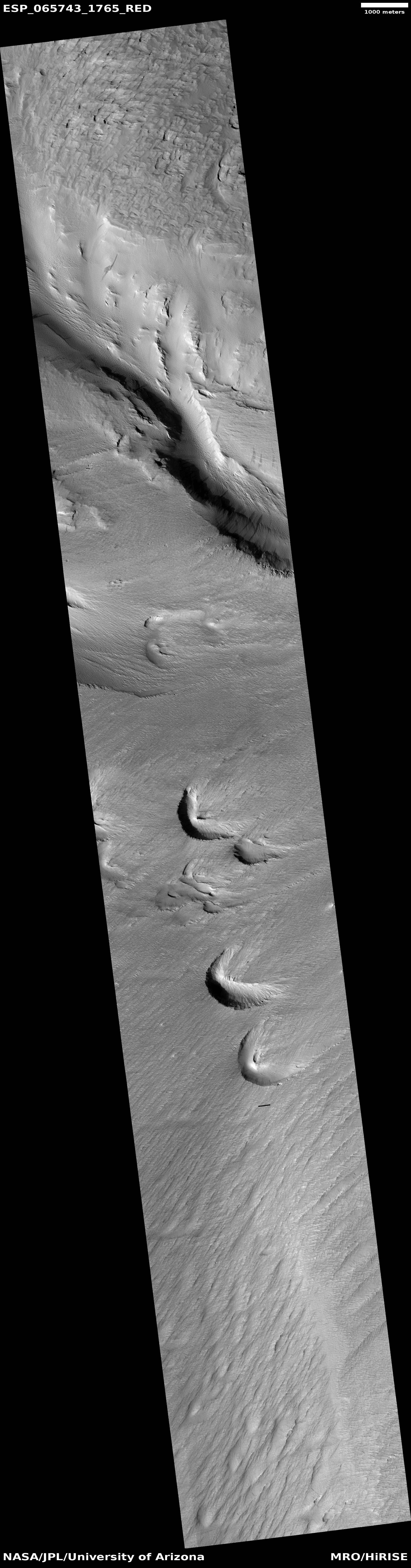
If either of these theories are true, then the 4.7 magnitude earthquake at this location should have caused the formation of more streaks. To find out, scientists have used the high resolution camera on Mars Reconnaissance Orbiter (MRO) to compare that crater both before and after the quake to see if any new streaks has appeared. Below is a side-by-side comparison of these images.
» Read more

1 comment

American camera snaps picture of shadowed floor of Shackleton crater

floor of Shackleton Crater
Click for original image.

Using ShadowCam, a NASA-funded camera designed to take high resolution images of the permanently shadowed regions on the Moon, scientists have snapped the first picture of shadowed floor of Shackleton crater.

That image, reduced to post here, is to the right. I have added some labels to clarify what we are seeing. The arrow points to a boulder track caused when the boulder rolled down the crater rim slope.

The camera will be used to image the moon’s permanently shadowed regions with a resolution of better than 6.6 feet (2 meters) per pixel

ShadowCam is one of six instruments on the South Korean lunar orbiter, Danuri, which is now in lunar orbit and beginning its science phase. This was therefore only a successful test image to make sure the camera was working as planned.

Though the area photographed was in shadow (otherwise it would have saturated ShadowCam’s sensitive camera), this first image appears to show no ice at the base of the crater. This simply could be that this part of the crater floor is not permanently shadowed, but gets illuminated enough to melt off any ice. Or it could be that no ice exists in these places. We need to wait and see.

3 comments

A collapse on Mars

A collapse on Mars
Click for full image.

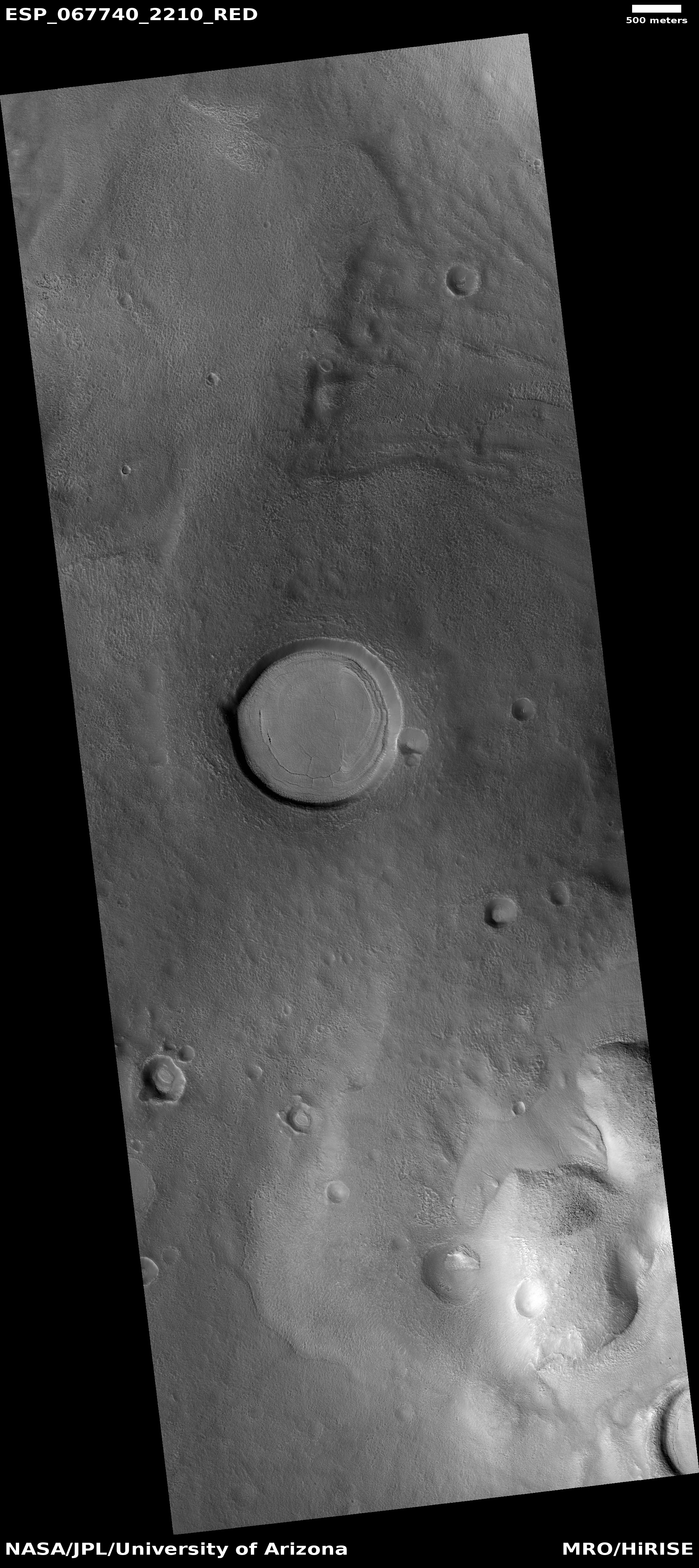
The photo to the right, cropped, reduced, and enhanced to post here, was taken on October 27, 2022 by the high resolution camera on Mars Reconnaissance Orbiter (MRO). The full photo was simply labeled as a “collapse feature”, and because it contained a few other sinks to the north beyond the top edge of this cropped picture, it is unclear if the scientists were referring to this sink in particular.

This sink is the most interesting however, because it really looks like something had sucked material out from below, causing the surface crust to fall downward, intact except for some cracks along the perimeter of the collapse.

The overview map below as always provides some context that might explain what we are seeing.
» Read more

0 comments

A new hotspot map of Io, based on Juno data

Hot spot map of Io
Click for original figure.

Scientists have compiled a new map of the many volcanic hotspots on the Jupiter moon Io, based on data obtained by Juno, including 23 spots previously undetected. From the paper’s abstract:

We mapped the hot spot distribution on Io’s surface by analyzing the images acquired by the JIRAM instrument onboard the Juno spacecraft. We identified 242 hot spots, including 23 not present in other catalogs. A large number of the new hot spots identified are in the polar regions, specifically in the northern hemisphere. The comparison between our work and the most recent and updated catalog reveals that JIRAM detected 82% of the most powerful hot spots previously identified and half of the intermediate-power hot spots, thus showing that these are still active. JIRAM detected 16 out of the 34 faint hot spots previously reported.

The map above is taken from figure 2 of the paper. The data, when compared to other earlier data, confirms that many of these hot spots are long-lived, and have been erupting now for decades.

1 comment

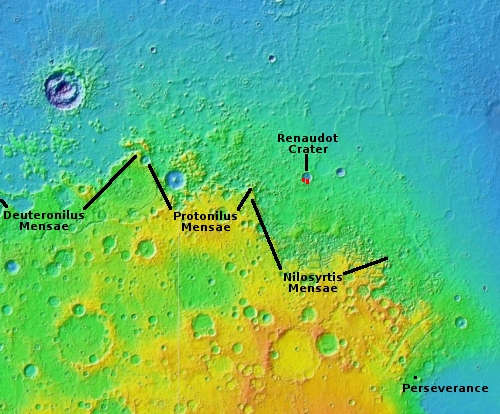
Ingenuity about to fly up onto the delta

Overview map
Click for interactive map.

The engineering team that operates the helicopter Ingenuity on Mars announced today that the next flight, #39, will go about 456 feet and travel to the northeast.

The green dot on the map to the right shows Ingenuity’s present location. The yellow lines indicate the territory within which this flight will head. If successful it will be the first time the helicopter has left the floor of Jezero Crater, and moved uphill onto the delta that flowed into that crater sometime in the far past.

The blue dot marks Perseverance’s present location. The dotted red line indicates its eventual planned route on that delta.

The engineers state that their flight goal is to “flight test new software”. This new software is supposed to allow Ingenuity to fly over rougher terrain. On the 38th flight, it proved its worth by not only flying over an area of rippled sand dunes, it landed between two.

This next flight, scheduled for sometime today, will be even more challenging, because the helicopter will have to fly upward above higher terrain.

0 comments

Defrosting Martian Dunes

Defrosting Martian dunes
Click for full image.

Cool image time! The photo to the right, cropped, reduced, and sharpened to post here, was a captioned image on January 6, 2023 from the science team of the high resolution camera on Mars Reconnaissance Orbiter (MRO). From the caption by Alfred McEwen of the Lunar & Planetary Laboratory in Arizona:

In the late winter when first illuminated, the carbon dioxide frost at high latitudes will begin to sublimate. Over sand dunes, the defrosting spots and mass wasting on steep slopes produce striking patterns. This scene is especially artistic given the shapes of the dunes as well as the defrosting patterns.

» Read more

5 comments

The dry and dusty equatorial regions of Mars

The dry cratered highlands of Mars
Click for full image.

Cool image time! The photo to the right, rotated, cropped, and reduced to post here, was taken on October 2, 2022 by the high resolution camera on Mars Reconnaissance Orbiter (MRO). It shows a cluster of craters filled with ripple dunes.

The color strip tells us something [pdf] about the surface materials here. The reddish-orange in the craters is thought to be dust. The greenish terrain above the craters is likely coarse rock or bedrock, covered with a veneer of dust.

There is no ice here, just dust that over time has become trapped in the craters and cannot escape. And though there is also dust on the surrounding terrain, there is not that much. The craters themselves are likely very ancient, based on their shape and the eroded condition of their rims.

» Read more

1 comment

Drainage out of a Martian crater

Drainage out of a Martian crater
Click for full image.

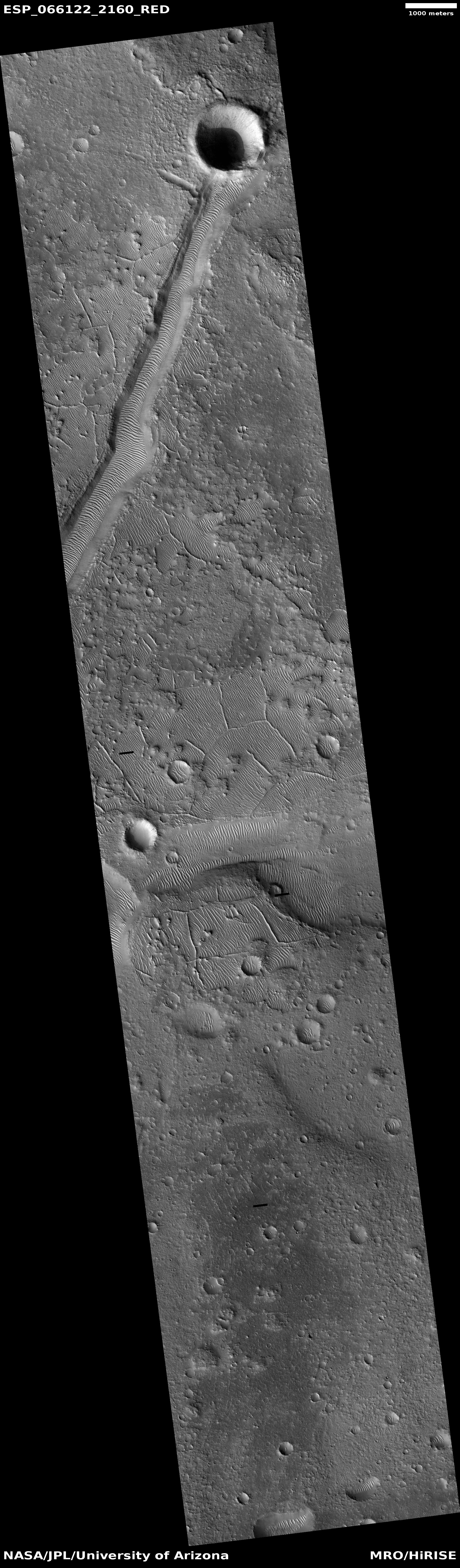
Today’s cool image to the right, rotated, cropped, reduced, and sharpened to post here, not only gives us another example of a Martian geological feature that is unique to Mars and whose origins are not yet understood, it also shows what appears to have once been a lake-filled crater that over time drained out to the east through a gap.

This picture was taken on October 14, 2022 by the high resolution camera on Mars Reconnaissance Orbiter (MRO). The inexplicable geology is called brain terrain, and it fills the floor of the crater on the picture’s left side. The rim shows a gap, from which a meandering channel continues downhill to the east. The lake inside the crater might not have been liquid water, but ice. The channel might not have been formed by flowing water, but by a glacial flow downhill.

What makes this glacial evidence especially interesting is that it is located in a very different part of the Martian mid-latitudes.
» Read more

1 comment

China releases first update on status of Yutu-2 since September

Yutu-2's travel path through December 2022
Click for full image. The red flag marks the landing site.

China today released its first update since September on the status of its Yutu-2 rover on the far side of the Moon. The map on the right shows the rover’s travels through December 2022.

As of today the rover has traveled 4,774 feet total, and about 450 feet since September. The goal, as stated in April 2021, was to “move northwest toward the basalt distribution area located about 1.2 km away.” At the time the rover was only averaging about 100 feet travel per lunar day. According to these numbers, it picked up the pace in the past year, though it is unclear whether it has reached that goal.

1 comment

The soft icy Martian northern lowland plains

The soft icy Martian northern lowland plains
Click for full image.

In a cool image post last week, I noted that the near surface “ice sheets in the northern lowland plains are never … smooth, even if well protected.” The picture to the right, cropped, reduced, and sharpened to post here, provides an excellent example. It was taken on November 2, 2022 by the high resolution camera on Mars Reconnaissance Orbiter (MRO).

It is winter, and the sunlight is coming from the southwest, only 27 degrees above the horizon. The mound on the left is soft, while the depression on the upper right appears to have sand dune ripples sitting on top of a flat glacial mound. This depression may be an eroded crater (no upraised rim) or it could be a sink caused by the sublimation of the near surface ice.

Everywhere else the flat plains are stippled with small knobs.

The overview map below provides more context.
» Read more

0 comments

Largest volcanic eruption in years detected on Io

Using instruments on a ground-based telescope, one scientist based at the Planetary Science Institute (PSI) in Arizona has detected the largest volcanic eruption in years on the Jupiter moon Io.

PSI Senior Scientist [Jeff] Morgenthaler has been using IoIO, located near Benson, Arizona to monitor volcanic activity on Io, since 2017. The observations show some sort of outburst nearly every year, but the largest yet was seen in the fall of 2022. Io is the innermost of Jupiter’s four large moons and is the most volcanic body in the Solar System thanks to the tidal stresses it feels from Jupiter and two of its other large satellites, Europa and Ganymede.

IoIO uses a coronagraphic technique which dims the light coming from Jupiter to enable imaging of faint gases near the very bright planet. A brightening of two of these gases, sodium and ionized sulfur, began between July and September 2022 and lasted until December 2022. The ionized sulfur, which forms a donut-like structure that encircles Jupiter and is called the Io plasma torus, was curiously not nearly as bright in this outburst as previously seen. β€œThis could be telling us something about the composition of the volcanic activity that produced the outburst or it could be telling us that the torus is more efficient at ridding itself of material when more material is thrown into it,” Morgenthaler said.

The material released by this eruption could impact Juno during future close approaches of Jupiter.

0 comments

A spray of Martian hollows

A spray of Martian sinks
Click for full image.

Cool image time! The photo to the right, rotated, cropped, reduced, and sharpened to post here, was taken on October 12. 2022 by the high resolution camera on Mars Reconnaissance Orbiter (MRO). Dubbed simply as a a “terrain sample” by the science team, the picture was not taken as part of any specific research project, but instead to fill a gap in the orbiter’s shooting schedule so as to maintain the camera’s proper temperature. When MRO’s science team does this, they try to pick something in the area below that might be interesting. Sometimes they succeed, but often the features in the picture are nondescript.

The white line delineates the rim of a faint and very eroded small crater. Are the depressions that are mostly concentrated just to its south and east sinks or past impact craters? I haven’t the faintest idea. The overview map below helps to answer this question, but only partly.
» Read more

1 comment
1 58 59 60 61 62 157