
Tag: ipcc
IPCC in trouble again over using Greenpeace employee for energy report
The IPCC is in trouble again for using a Greenpeace activist to help write one of its recent energy reports.
Where’s the warming?
Global greenhouse gas emissions have risen even faster during the past decade than predicted by the United Nations Intergovernmental Panel on Climate Change (IPCC) and other international agencies. According to alarmist groups, this proves global warming is much worse than previously feared. The increase in emissions “should shock even the most jaded negotiators” at international climate talks currently taking place in Bonn, Germany, the UK Guardian reports. But there’s only one problem with this storyline; global temperatures have not increased at all during the past decade.
The evidence is powerful, straightforward, and damning. NASA satellite instruments precisely measuring global temperatures show absolutely no warming during the past the past 10 years. This is the case for the Northern Hemisphere mid-latitudes, including the United States. This is the case for the Arctic, where the signs of human-caused global warming are supposed to be first and most powerfully felt. This is the case forglobal sea surface temperatures, which alarmists claim should be sucking up much of the predicted human-induced warming. This is the case for the planet as a whole.
If atmospheric carbon dioxide emissions are the sole or primary driver of global temperatures, then where is all the global warming? We’re talking 10 years of higher-than-expected increases in greenhouse gases, yet 10 years of absolutely no warming. That’s 10 years of nada, nunca, nein, zero, and zilch. [emphasis mine]
IPCC announces reforms for next report
The IPCC announced this week it has established new procedures in an effort to avoid the problems that occurred with the last report.
I remain very skeptical of these reforms, as well as anything this UN organization publishes. Consider this quote for example:
On the issue of citing non-peer-reviewed literature, such as reports from nongovernmental organizations and climate activists, the new procedures say that IPCC report authors can include such documents “as long as they are scientifically and technically valid. [emphasis mine]
How convenient. Decide that something written by Greenpeace is “scientifically and technically valid” and you can use it as evidence.
The science remains uncertain
Two papers published this week by the American Geophysical Union once again indicate that the science of climate change remains exceedingly uncertain. More significantly, the models that try to predict the future of the Earth’s climate continue to appear unreliable, with such large margins of error that it is at this time foolish to make any policy based on their predictions.
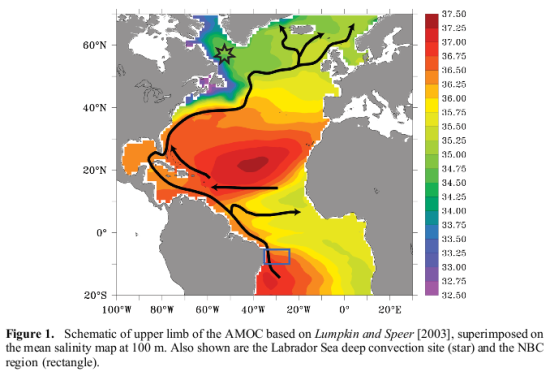
The first paper took a close look at the deep water currents in the Atlantic to see if it could track changes to what the authors’ call the Atlantic meridional overturning circulation (AMOC), more generally referred to as the Atlantic conveyor belt. This conveyor belt begins with the sinking of salty dense water in the northeast Atlantic off of Europe and Africa. The deep water current then travels south and into the Indian and Pacific Oceans where it comes to the surface only to flow back to the Atlantic, traveling north along the coast of North America as the Gulf Stream, bringing with it the warm temperatures that make Europe’s climate much warmer than its latitude would normally suggest.
According to most global warming models, higher temperatures should cause the glaciers in the Arctic and Greenland to melt, thereby pouring an increased amount of fresh water into the North Atlantic. This infusion of fresh water is then expected to lower the salinity and density of the Atlantic water, thus preventing it from sinking and thus acting to slow the conveyor belt, and possibly even causing it to shut down. The consequence would be no more Gulf Stream to warm the climate of Europe.
In other words: Disaster! Death! Destruction! All caused by global warming!
Unfortunately for these global warming models, the paper above found no trend at all. The conveyor belt is not slowing, as predicted. To quote the paper’s abstract:
» Read more
Federal funding for IPCC back in budget
The pigs win: Funding for the IPCC restored to budget in 2011 budget deal.
House cuts off funds to IPCC
Listen to the squealing: Scientists criticize the House vote to cut off funds to the IPCC. Key quote:
Without the federal support, [Stanford ecologist Chris Field] said, “We’d have no ability to organize meetings, we’d have no ability to coordinate chapters.”
In other words, no more jaunts to Cancun in the midst of winter. What a shame!
Considering the insincere effort of the IPCC and its scientists to correct its numerous errors, as well as their admitted political agenda, it seems completely appropriate to stop funding it with U.S. tax dollars. If these environmentalists want to issue a report, they should pay for it themselves.
Kyoto Protocol is dead, long live the climate fund
It appears the climate meeting in Cancun has ended without much success. Unable to get an renewal of the Kyoto Protocol, which expires in 2012, the diplomats instead agreed to create a $100 billion “Green Climate Fund” that is mostly funded by the First World nations but is mostly distributed by the Third World. See the notes at 10:45 am on this blog and at 12:20 am on this blog. Key quote:
[The fund] will have 25 members of developing countries on its board, compared to only 15 for developed countries. This gives developing countries a much stronger role. The World Bank is a trustee.
The real question is whether the new Congress in the U.S. will appropriate any money at all to this scam.
Obama climate cash pledge in doubt
The Obama administration’s $30 billion cash pledge at last year’s climate summit is in doubt.
Not only do I think this is good, I continue to wonder how any administration (not just Obama’s) can make such a pledge in the first place, considering the fact that under our Constitution all such allocations must first be approved by Congress.
Cancun blog
Want to follow the Cancun climate summit come to an end, for good or ill, on this its final day? Check out this blog.
“Gore effect” strikes Cancun Climate Conference 3 days in a row
“Gore effect” strikes Cancun Climate Conference 3 days in a row.
Climate models used by IPCC fail to predict past climate patterns
A recent paper published in Hydrological Sciences Journal states that climate models used by IPCC cannot even predict known past climate patterns. Key quote:
It is claimed that GCMs [General Climate Models] provide credible quantitative estimates of future climate change, particularly at continental scales and above. Examining the local performance of the models at 55 points, we found that local projections do not correlate well with observed measurements. Furthermore, we found that the correlation at a large spatial scale, i.e. the contiguous USA, is worse than at the local scale. However, we think that the most important question is not whether GCMs can produce credible estimates of future climate, but whether climate is at all predictable in deterministic terms.
‘No climate talks in future if Cancun fails’
Cool news! India said Wednesday that future climate negotiations would be unlikely if the Kyoto protocol is not extended in some manner this week at the climate summit in Cancun.
Wikileaks and the IPCC
Wikileaks and the IPCC. Key quote:
What really strikes us is the fact that all this Copenhagen/Cancun stuff has nothing to do with the Climate, or saving the World. It’s about political positioning, money, and plain old fascism cult promotion.
More here.
Cancún climate talks in danger of collapse over Kyoto continuation
To me, this is good news: The Cancún climate summit is in danger of collapse. Key quote:
The UN climate talks in Cancún were in danger of collapse last night after many Latin American countries said that they would leave if a crucial negotiating document, due to be released tomorrow, did not continue to commit rich countries to emissions cuts under the Kyoto Protocol. . . . The potential crisis was provoked by Japan stating earlier this week that it would not sign up to a second period of the Kyoto Protocol. Other countries, including Russia, Canada and Australia are thought to agree but have yet to say publicly that they will not make further pledges.
Scientists pinpoint where Venus’s sulphuric acid clouds come from
Apropos of the desire of IPCC chief Rajendra Pachauri to re-engineer the climate to battle global warming, including spraying “sulphate particles high in the atmosphere to scatter the sun’s rays back into space,” planetary scientists have pinpointed the source of Venus’s sulphuric acid clouds, and from this believe that the IPCC scheme might backfire badly, doing more harm than good.
The IPCC and the UN is planning to re-engineer the Earth to save it
What could go wrong? Railroad engineer and head of the IPCC Rajendra Pachauri announced at the Cancun climate summit today that he has decided that the threat of global warming is so great that the IPCC is going to recommend in its next report (AR5) that actions be taken to re-engineer the climate. Key quote:
“The AR5 has been expanded and will in future focus on subjects like clouds and aerosols, geo-engineering and sustainability issues,” [Pachauri] said.
Later this year IPCC “expert groups” will meet in Peru to discuss geo-engineering. Options include putting mirrors in space to reflect sunlight or covering Greenland in a massive blanket so it does not melt. Sprinkling iron filings in the ocean “fertilises” algae so that it sucks up CO2 and “seeding clouds” means that less sunlight can get in. Other options include artificial “trees” that suck carbon dioxide out of the air, painting roofs white to reflect sunlight and man-made volcanoes that spray sulphate particles high in the atmosphere to scatter the sun’s rays back into space.
IPCC meeting ends with few changes or reforms
You call this reform? At the just completed annual meeting of the IPCC in South Korea, the panel refused to remove its controversial chairman, Rajendra Pachauri, while recommending a few minor reforms in how the panel writes its reports. This quote indicates just how unserious the IPCC is about reform:
In the past, he said, IPCC reports sometimes projected the likelihood of potential climate-change effects, such as melting glaciers, without enough evidence. “There were some weaknesses in the application,” said [Chris Field, a U.S. scientist and a leader of the panel’s 2014 report].
IPCC fail
Meltdown of the climate ‘consensus’. Key quote:
What does the best evidence now tell us? That man-made global warming is a mere hypothesis that has been inflated by both exaggeration and downright malfeasance, fueled by the awarding of fat grants and salaries to any scientist who’ll produce the “right” results. The warming “scientific” community, the Climategate emails reveal, is a tight clique of like-minded scientists and bureaucrats who give each other jobs, publish each other’s papers — and conspire to shut out any point of view that threatens to derail their gravy train.
Another climategate whitewash?
Another climategate whitewash? The Netherlands Environmental Assessment Agency has reviewed the 2007 UN IPCC report and decided that, though the report did have some really embarrassing errors (including some new ones uncovered by the review), the IPCC’s conclusion — that global warming is happening and that it is caused by humans — must still be correct.