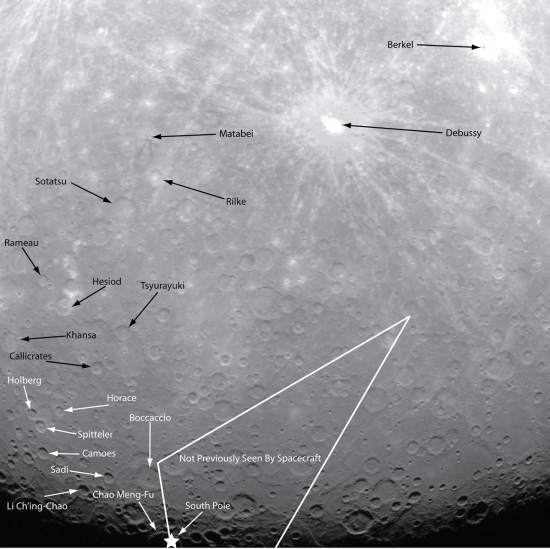
Data from Messenger now shows that as Mercury cooled it shrunk far more than earlier data had indicated.

Data from Messenger now shows that as Mercury cooled it shrunk far more than earlier data had indicated.

A new census of these ridges, called lobate scarps, has found more of them, with steeper faces, than ever before. The discovery suggests that Mercury shrank by far more than the previous estimate of 2-3 kilometres, says Paul Byrne, a planetary scientist at the Carnegie Institution for Science in Washington DC. He presented the results today at a meeting of the American Geophysical Union in San Francisco, California.

The finding helps explain how Mercury’s huge metallic core cooled off over time. It may also finally reconcile theoretical scientists, who had predicted a lot of shrinkage, with observers who had not found evidence of that — until now. “We are resolving a four-decades-old conflict here,” Byrne told the meeting.
0 comments

Mercury, in full color.

Mercury, in full color.

Scientists working with NASA’s Messenger probe have produced a global color map of the surface of Mercury, closest planet to the Sun. Thousands of sets of images were enhanced then stitched together in a mosaic to create a detailed image covering the entire planet.

0 comments

Messenger has found new and “compelling” evidence that there is water ice locked in the permanently shadowed craters of Mercury.

Messenger has found new and “compelling” evidence that there is water ice locked in the permanently shadowed craters of Mercury.

On Monday I had spoken to one of the project scientists for this discovery, David Lawrence, in connection with an article I am doing for Astronomy on the evidence of water on the Moon. I knew the Mercury announcement was coming, and asked him for some details. Based on what he told me, it struck me that the evidence for water on Mercury is actually more conclusive than the evidence for the Moon. (In fact, inconclusive nature of the lunar data is the point of my Astronomy article, based on previous posts here and here on Behind The Black.

The more intriguing aspect of this discovery on Mercury, however, is the unknown dark material that covers and protects some of this water ice. That some scientists believe it might even be organic material deposited there by comets and asteroids is most interesting.

0 comments

After one year in orbit around Mercury, Messenger’s scientists have concluded that Mercury is not only dense but odd.

After one year in orbit around Mercury, Messenger’s scientists have concluded that Mercury is not only dense but odd.

The [proposed gravity] model, when combined with topography data and measurements of the planet’s spin, reveals that as much as 85% of Mercury’s radius is taken up by its dense iron core — an upward revision. “We knew Mercury had a large core,” says [Maria Zuber of MIT]. “Now we think it’s even larger.” What’s more, to compensate for a crust that’s enriched in sulphur and depleted in iron, the team has proposed a solid shell of iron sulphide that sits between the core and the mantle. While the shell satisfies the gravity constraints, it also makes it more difficult for a lot of convection to occur in the thin mantle that overrides it — which presents problems for those that invoke convection as a driver of the observed tectonic and volcanic features at the surface. “There isn’t a whole lot of mantle to be doing this lifting up,” says Zuber.

0 comments

A summary of Messenger’s first six months in orbit around Mercury

A summary of Messenger’s first six months in orbit around Mercury.

Though packed with lots of results, this strikes me as the most interesting discovery so far:

Orbital data reveal that Mercury’s magnetic field is offset far to the north of the planet’s center, by nearly 20% of Mercury’s radius. Relative to the planet’s size, this offset is much more than in any other planet, and accounting for it will pose a challenge to theoretical explanations of the field. . . . This finding has several implications for other aspects of Mercury, says Anderson, who co-authored several of the presentations in the MESSENGER session. “This means that the magnetic field in the southern hemisphere should be a lot weaker than it is in the north. At the north geographic pole, the magnetic field should be about 3.5 times stronger than it is at the south geographic pole.

0 comments

The strange hollows on the mountain tops of Mercury

hollows on Mercury

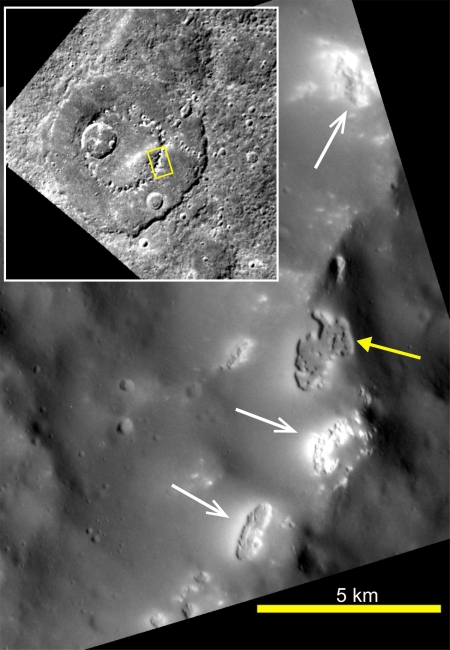
Another spectacular planetary science image, this time from Messenger orbiting Mercury. This close-up image of the hollows of Mercury only illustrates their mystery. The insert shows the context of the close-up image. These irregular sinks are here found on the mountain top ridge of an inner crater rim. Also, some but not all of the hollows have bright interiors.

Scientists have proposed that some form of impact melt process caused these hollows. At impact, the ground literally rippled like water when you toss a stone into a pool. Here, however, the molten ripples quickly froze, creating the inner and outer crater rim rings. To my untrained eye, the hollows look like collapse features where the surface hardened first, then collapsed when the molten inner material drained away as it became solid.

Why some hollows are bright, however, is not yet understood.

0 comments

Craters, craters, everywhere

Below the fold are two images released today, one from Dawn at Vesta and the other from Messenger at Mercury. What makes them interesting to me is that, though the surfaces of both Vesta and Mercury are crater-packed, there are definitely distinct differences between them that one can spot if you look closely, all highlighting the fundamentally different environments of both worlds.

First, the Vesta photograph. The image looks out past the asteroid’s horizon, showing clearly that this dwarf planet is not spherical, with the south pole depression that puzzles scientists just on the planet’s limb. The parallel long deep grooves that are associated with this depression can be seen on the right. Notice also that the inside walls of all the craters slope downward in a very shallow manner. This gives the impression that the impacts that formed these craters smashed into an almost beachlike sandy surface. Note too the that the center of some craters have what appear to be flat small “ponds,” a phenomenon seen by the spacecraft NEAR when it orbited the asteroid Eros. These ponds are not liquid, but are actually made up of fine-grained particles that settle in the hollows of the asteroid.
» Read more

1 comment

In color from Mercury

The Messenger spacecraft has now been in orbit around Mercury since the end of March, almost four months. During that time the probe has sent back many fascinating images, showcasing a hot, alien planet whose surface was formed by impacts, volcanic activity, and some processes that no one as yet understands.

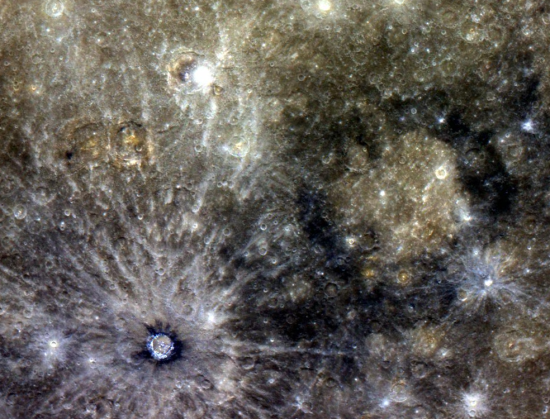
Most of the released images, however, have been in black and white, which at first glance makes one think that Mercury is not unlike the Moon. This week the Messenger team released a color image, demonstrated clearly how false this assumption is. The image below shows two very different craters, a dark-haloed crater named Basho at the bottom left of the image, and a very bright crater, Kalidasa crater, near the top left. On the right of the image is a dark haloed Tolstoj basin. For an uncropped full resolution version go here.

color image from Mercury
» Read more

1 comment
1 2 3