
Yutu reveals a complex lunar geology

The uncertainty of science: The Chinese lunar rover Yutu has uncovered a much more complicated geology history than previously predicted at its landing site on the moon.

Those data paint a detailed portrait of the Chang’e 3 landing site, which sits just 165 feet (50 m) away from a 1,475-foot-wide (450 m) crater known as C1. C1 was gouged out by a cosmic impact that occurred sometime between 80 million and 27 million years ago, the study authors said.

Yutu studied the ground it rolled over, characterized the craters it cruised past and investigated an oddly coarse-textured rock dubbed Loong, which measures about 13 feet long by 5 feet high (4 by 1.5 m). Overall, the rover’s observations suggest that the composition of its landing site is quite different from that of the places visited by NASA’s Apollo missions and the Soviet Union’s Luna program.

The rover found 9 distinct layers, suggesting numerous and different past events that layered the surface.
0 comments

Yutu lives!

Despite an engineering failure that has prevented it from roving after only a few days on the Moon, the Chinese lunar rover Yutu continues to reawaken after each long lunar night, surviving now far longer than its planned three month lifespan.

Since the rover arrived in late 2013, it has now functioned in the hostile lunar environment for more than a year. This, along with other successful long missions, suggests that Chinese space engineering has matured to a point that it has the ability to achieve some significant long term goals.

0 comments

Earth’s other moon

Link here.

What you might not know is that the moon is not the Earth’s only natural satellite. As recently as 1997, we discovered that another body, 3753 Cruithne, is what’s called a quasi-orbital satellite of Earth. This simply means that Cruithne doesn’t loop around the Earth in a nice ellipse in the same way as the moon, or indeed the artificial satellites we loft into orbit. Instead, Cruithne scuttles around the inner solar system in what’s called a “horseshoe” orbit.

2 comments

X-Prize contestants team-up to create head-to-head lunar race

The competition heats up: Two Google Lunar X-Prize contestants have teamed up to use the same rocket to get to the Moon together, where they will literally race head to head to see who travels the 500 meter distance first to win the prize.

At a press conference in Tokyo on Monday, the leaders of two Lunar X PRIZE teams—Astrobotic and HAKUTO—announced a plan in which the two teams’ robotic rovers will travel to the moon together and touch down on the lunar surface at the same time. They will then race each other to cover the 500 meters required to win the first place prize of $20 million.

John Thornton, head of Pittsburgh-based Astrobotic (a Carnegie Mellon University spin-off), said in a call with reporters that the partnership with HAKUTO (a spin-off from Tokyo University) represented the first step in realizing his team’s goal of turning robotic moon missions into a viable business. That mission won’t stop with this single partnership. He said the team was in talks with more than half of the other 16 GLXP competitors to carry their rovers to the moon, too, in exchange for sharing the cost of getting there and splitting prize money.

If this happens as they propose, we could be watching as many as ten rovers line up for the race.

3 comments

South Korea unveils its own lunar rover

The competition heats up: South Korea has revealed its preliminary design for a lunar rover, set to launch in 2020 on a Korean-built rocket.

The article does not indicate whether this project has actually been approved or is merely being touted by Korea Institute of Science and Technology, which made the announcement. The cost to build it is estimated to be more than $7 billion, which seems quite exorbitant and over-priced.

Update: I had misread the conversion in the article from U.S. to Korean currency and thought the proposed cost for this mission was way more than it really is, which is about $7 million, a much more reasonable number. Thanks to Edward for the correction.

2 comments

Private company offers to fly packages to Moon

Fly me to the moon! A company building a small lunar rover as part of the Google Lunar X-prize competition is now offering, for a small fee, to include private packages with its lander.

Astrobotic Technology on Thursday (Dec. 11) announced the launch of its new “MoonMail” program, which offers to send heirloom rings, family photos, locks of hair and other small personal items on the company’s first private moon mission set to launch in the next few years. With prices based on the item’s size, MoonMail rates start at $460 for a half-inch wide by 0.125-inch tall (1.27 by 0.3 centimeter) capsule and increase to $25,800 for a one by two-inch (2.54 by 5.08 cm) payload. “You can think of the pricing for it to be very similar to ‘it fits, it ships’ at the post office,” John Thornton, Astrobotic CEO, told collectSPACE.com in a call with reporters. “It is essentially a flat-rate box.”

They hope to launch on a Falcon 9. More interestingly, they want to land and explore one of the Moon’s skylight caves.

The first Griffin is slated to launch on a SpaceX Falcon 9 rocket and land at Lacus Mortis, or the “Lake of Death,” a plain of basaltic lava flows in the northeastern part of the moon as viewed from Earth. “There is a unique feature there called a ‘skylight,'” stated Thornton, adding that only about 300 of these sinkhole-like entrances into subsurface caves have been discovered on the moon. “What’s very unique about the skylight at Lacus Mortis is that its walls have collapsed creating a ramp into the cave. … Caves on the surface of the moon could be our natural shelter,” Thornton explained. “So our first mission goes to one of these caves where we hopefully think someday we could settle on the moon. We think it’s a fantastic location to place MoonMail, which ultimately will be a time capsule of our generation for future moon explorers.”

1 comment

Chinese spacecraft reaches L2

The service module for China’s test lunar probe, that circled the Moon before returning to Earth, has reached L2 as planned.

As of Friday, the service module had been flying for 28 days, and was 421,000 kilometers away from Earth and 63,000 km from the moon. All experiments are going well. The service module was separated from the return capsule of China’s test lunar orbiter, which returned to Earth on Nov. 1 after circling the moon in its eight-day mission launched on Oct. 24.

…After two orbital transfers, the service module re-entered the elliptical orbit with an apogee of 540,000 km and a perigee of 600 km. During the flight, the service module again performed orbital transfer actions twice, and flew along the pre-set Earth-moon transfer orbit. On Nov. 23, it reached the perilune and with the lunar gravity it was able to undertake the orbit maneuver to fly to the L2 point.

This is brilliant management. They not only test return-to-Earth capability, they practice flying a robot ship in deep space, doing complex orbital maneuvers. In addition, depending on the equipment on the service module, they get a cheap unmanned probe for observing the near lunar environment.

0 comments

Kickstarter campaign to fund lunar probe

The competition heats up: A private consortium of scientists and entrepreneurs is planning to fund its unmanned lunar lander with a Kickstarter campaign followed by private sales..

The mission is raising initial development funding through Kickstarter, the crowdfunding platform. Following the initial public phase the remaining funding requirements will be met through sales of ‘digital memory boxes’ in which donors can have their biographies recorded and taken to the Moon. These will also include a strand of hair so that their DNA can exist in space. The team has claimed that around one per cent of the global population who can afford a memory box will buy one. Also included in the time capsule will be record of life on Earth. The archive will include a record of human history and civilisation to date alongside a species database showing the biodiversity of animals and plants.

This is essentially a UK project, backed by the government but with little funding. They hope to launch in 2024, with two missions planned, the first to drill into the lunar soil and the second to bring back samples.

0 comments

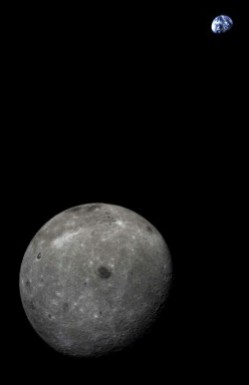
The Earth/Moon double planet, as seen by China’s Chang’e 5 probe

Earth/Moon as seen by Chang'e 5

China’s Chang’e 5 probe has taken a spectacular image of the Moon and Earth as it whips around the Moon on its circumlunar test flight.

Though China has released little additional information about the status of the mission, this image demonstrates that the vehicle is functioning well, sending back data, and that they are controlling its operation precisely and exactly as planned. The spacecraft is scheduled to return to Earth on November 1.

Meanwhile, China’s second lunar probe, Chang’e 2, now in solar orbit about 60 million miles from Earth, continues to operate four years after launch

0 comments
1 73 74 75 76 77 94