A comet picture taken by Philae on the way down
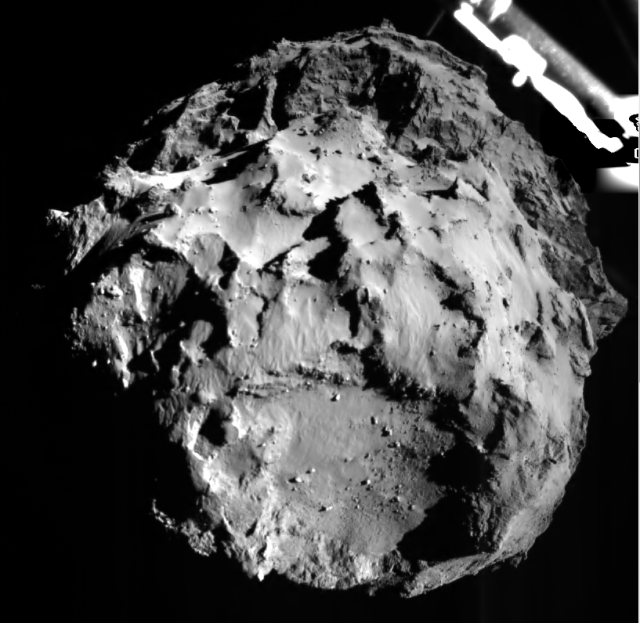
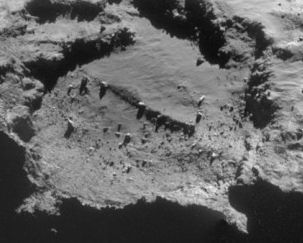
Comet 67P/C-G as seen by Philae during its descent

I am not sure if the actual landing site is visible in this image. I don’t think so as nothing seems to match what was on the earlier close-up. Moreover, the Rosetta website does not say.

No images on the surface have yet been released. There are also issues that could prevent a full success.

However, while the lander has touched down on the comet using its harpoons, scientists said that it had not yet deployed its anchors which meant that it was not completely attached to the surface. The surface was much softer than they expected, so there were some concerns that it was not securely fixed on the comet โ€“ although from a software point of view things seemed to be fine. Engineers will attempt to fire the anchors again soon in order to keep Philae attached to the surface of the comet.
3 comments

Philae has landed successfully!

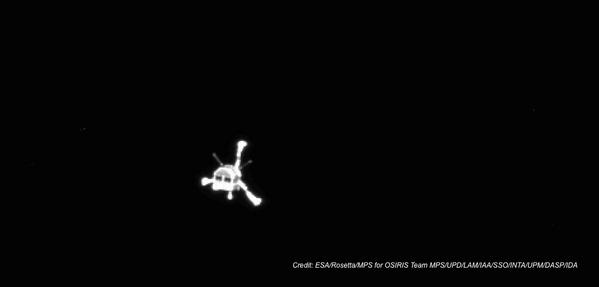
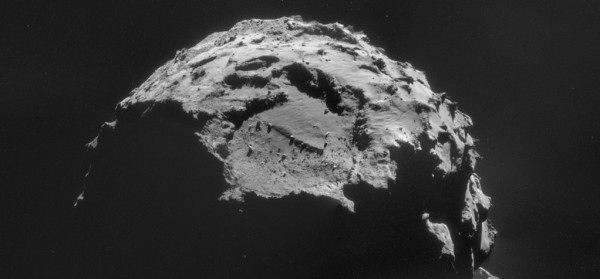
Philae has landed successfully on Comet 67P/C-G.

Philae is on the surface, its harpoons have fired and the landing gear has been moved inside, and Philae is in contact. It’s incredible! Massive smiles on everyone’s faces. The room went mad. Twice — when we first had the hint, and then when Stephan Ulamec and Andrea Accomazzo confirmed it. Unbelievable.

More information and data will be coming in a few hours. Stay tuned.

3 comments

Philae is go for separation, despite problem

Engineers have given a go for the separation of the Philae lander from Rosetta, despite the failure of a thruster to operate.

During checks on the landerโ€™s health, it was discovered that the active descent system, which provides a thrust upwards to avoid rebound at the moment of touchdown, cannot be activated.

At touchdown, landing gear will absorb the forces of the landing while ice screws in each of the probeโ€™s feet and a harpoon system will lock Philae to the surface. At the same time, the thruster on top of the lander is supposed to push it down to counteract the impulse of the harpoon imparted in the opposite direction. โ€œThe cold gas thruster on top of the lander does not appear to be working so we will have to rely fully on the harpoons at touchdown,โ€says Stephan Ulamec, Philae Lander Manager at the DLR German Aerospace Center. โ€œWeโ€™ll need some luck not to land on a boulder or a steep slope.โ€

Update: Separation has occurred and signal reacquired from Philae. We wait for landing.

0 comments

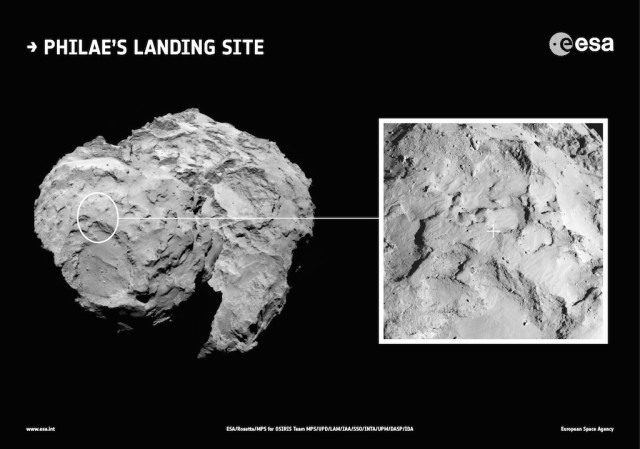
Close-up image of Philae’s landing site


Agilkia landing site for Philae

Inset of landing site

In the preparation to Wednesday’s landing of Philae on Comet 67P/C-G, Rosetta’s science team has released a great image of the landing site, shown above. To the right is a higher resolution inset of the site itself, with the smallest object visible about 8.5 feet across.

Looking at this inset, there are some obvious worries that we all should be aware of prior to the landing attempt. Though the Agilkia landing site is generally more smooth than most of the comet’s surface, it still has significant hazards. The lower part is strewn with boulders and rocks, many of which are quite large. Any one of these could do serious harm to Philae should it land on them.

Even more interesting is the upper part of the landing site. Though very smooth, the image suggests to me that this is a very thick pile of softly packed material. Philae might land there and quickly sink below the surface, where its cameras will be able to see nothing.

Nonetheless, the science team has also released this outline of Philae’s science timeline after landing. The lander will also be taking images of both Rosetta and the comet during its descent, so even if the landing is a failure we will still get some worthwhile data.

1 comment

The November 12 timeline of events for Philae’s landing on a comet

ESA has released a detailed timeline of events on November 11-12, when Rosetta’s Philae lander will be released and land on Comet 67P/C-G. They have also released a much more readable summary of the most critical events, describing what will be happening.

For Americans, these events will be occurring from around 3 pm (Eastern) November 11, when the process begins, to 12 pm (Eastern) November 12, when Philae will send back the first signals after landing. Much of the most critical events will take place in the wee hours of the morning.

Meanwhile, one of Rosetta’s instruments has confirmed the presence of water vapor and carbon dioxide in the jets seen near the comet’s narrow neck.

0 comments

Rosetta gets in position to release Phalae

Rosetta has successfully maneuvered into position prior to releasing Philae on November 12 for landing on Comet 67P/C-G.

The thruster burn took place starting at 02:09:55 UTC (03:09:55 CET), ran for 90 seconds and, based on an initial analysis of spacecraft radiometric data, delivered a delta-v โ€“ change in speed โ€“ of 9.3 cm/sec, as confirmed by the Rosetta Flight Dynamics team. It was the second and final of two โ€˜deterministicโ€™ (i.e. direction and thrust are prepared in advance) manoeuvres that moved Rosetta onto the planned lander delivery orbit, now at a height of about 30 km, which will be maintained right up until the pre-delivery manoeuvre at two hours before separation at 08:35 UTC (09:35 CET) on the morning of 12 November.

…[T]he next planned orbit-changing manoeuvres will occur on the 12th at (a) 2 hours before separation and (b) about 40 minutes after, in between which Philae will be released. The pre-delivery manoeuvre will shift Rosetta’s trajectory so that the orbiter would be on a path so as to pass over the comet at a distance of 5 km, while the separation will occur at 08:35 UTC on board the spacecraft about 22 km (the confirmation signal will arrive on Earth at 09:03 UTC).

Since Philae is a passive lander, firing no thrusters but simply being thrown gently at the comet by Rosetta, the last two burns are crucial. The first literally puts Rosetta on the same collision course as Philae so that when the lander is released it is on a course to hit the comet. The second takes Rosetta out of that collision course, since no one wants it to hit the comet also.

0 comments

Comet 67P/C-G at 2 feet per pixel

New images from Rosetta, now about 6 miles from the surface of Comet 67P/C-G, show details as small as 2 feet across.

Go to the link to see some images. If you were hiking there, these images would see you.

In related news, the Rosetta team is asking the public to help name the landing site for its Philae lander.

As the location of the first soft landing of a human-made object on a comet, the site, currently identified as Site J, deserves a meaningful and memorable name that captures the significance of the occasion. The rules are simple: any name can be proposed, but it must not be the name of a person. The name must be accompanied by a short description (up to 200 words) explaining why this would make the ideal name for such an historic location. A jury comprising members of the Philae Steering Committee will select the best name from the entries, and the winning proposer will be invited to follow the landing in person from ESAโ€™s mission control centre in Darmstadt, Germany on 12 November.

2 comments

Philae’s landing site chosen

Philae's primary landing site

The Rosetta science team has chosen the primary landing site on Comet 67P/C-G for its Philae probe.

Site J is on the โ€˜headโ€™ of the comet, an irregular shaped world that is just over 4 km across at its widest point. The decision to select Site J as the primary site was unanimous. The backup, Site C, is located on the โ€˜bodyโ€™ of the comet. The 100 kg lander is planned to reach the surface on 11 November, where it will perform indepth measurements to characterise the nucleus in situ, in a totally unprecedented way.

This site is, located in the outside center of the nucleus’s smaller lobe, was picked unanimously because it appears to be the easiest to reach while also providing good science.

The descent to the comet is passive and it is only possible to predict that the landing point will place within a โ€˜landing ellipseโ€™ typically a few hundred metres in size.

A one square kilometre area was assessed for each candidate site. At Site J, the majority of slopes are less than 30ยบ relative to the local vertical, reducing the chances of Philae toppling over during touchdown. Site J also appears to have relatively few boulders, and receives sufficient daily illumination to recharge Philae and continue science operations on the surface beyond the initial battery-powered phase.

Provisional assessment of the trajectory to Site J found that the descent time of Philae to the surface would be about seven hours, a length that does not compromise the on-comet observations by using up too much of the battery during the descent.

I have put a close-up of the landing site below the fold.
» Read more

0 comments

Philae’s mission at Comet 67P/C-G

With the decision to pick a landing site for their Philae lander coming up this weekend, the Rosetta science team today released a press announcement describing in detail the lander’s mission.

The details are fascinating. Not only will Philae take images from the surface as well as get data of the surface and its surrounding environment, the probe will also literally pound the surface to measure its temperature as well as get seismic readings.

The MUPUS hammer is released and embeds itself into the ground so that it can measure the temperature at various depths in the subsurface. The acoustic signals of the vibrations of the hammer action will be detected by acoustic sensors in the feet of SESAME/CASSE and will be used to measure the mechanical properties of the nucleus.

If all goes well, they hope that Philae will remain operational on the surface through March.

2 comments

Rosetta’s comet landing sites

67P/C-G landing sites

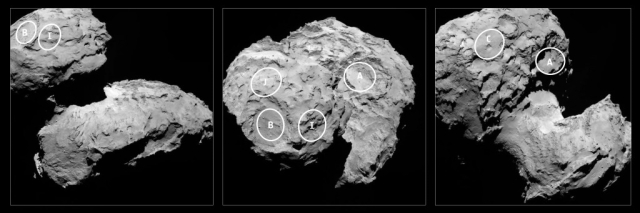
The Rosetta science team has narrowed the choices for Philae landing sites on Comet 67P/C-G to five, three on the smaller lobe and two on the larger lobe.

The smaller lobe sites, being on the outside surface of the lobe, don’t provide as good a view of the rest of the comet, while the larger lobe sites are on its inside surface, looking down at the neck and the smaller lobe. In addition, the terrain for the larger lobe sites looks to me more interesting.

Being on the inside surface, however, the larger lobe sites are going to be more difficult to land on.

0 comments

Picking a comet landing site

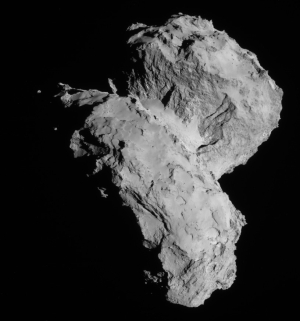
67P/C-G on August 22, 2014
Comet 67P/C-G as seen on August 22, 2014
from 40 miles. Click on image for full resolution.

Engineers have begun the landing site selection for Rosetta’s Philae lander.

This week, up to ten possible sites are being laid on the table for a first round of dedicated discussions and for the LCC and the SONC to carry out a technical analysis on each site, ready to be presented at the weekend meeting. Participants of the LSSG will then review the results from the technical analysis and discuss the scientific merits of the candidate sites. By the end of the weekend meeting, as many as five sites could be selected for further detailed investigation.

They will announce the five finalist sites on Monday.

1 comment

The German-built comet lander Philae has been successfully reactivated on Rosetta.

The German-built comet lander Philae has been successfully reactivated on Rosetta.

Philae will be ejected from the Rosetta mothership in November to latch itself onto the comet’s icy surface with harpoons and screws. The lander has its own suite of science instrumentation to take the first-ever photos and measurements from a comet’s surface. Engineers plan a four-week commissioning phase for Philae to check on its health and activate the lander’s 10 instruments.

0 comments
1 2 3