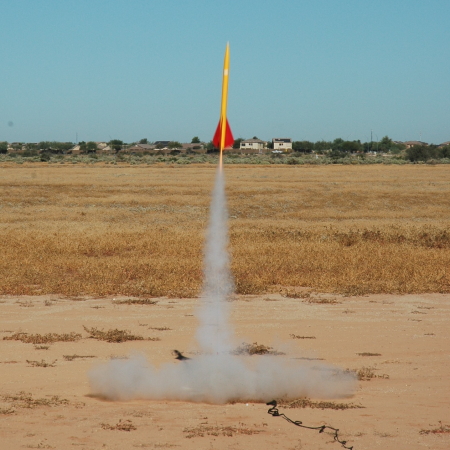
Rocket Lab’s payload on its first suborbital test launch of its Electron rocket

Until today it was unclear whether the successful first suborbital launch of Rocket Lab’s Electron rocket on June 17, 2023 carried a payload. Now we know it did:

The launch took place at NASA’s Wallops Flight Facility in Virginia and demonstrated the Multi-Service Advanced Capability Hypersonic Test Bed, or MACH-TB, program’s first suborbital flight of a hypersonic payload.

MACH-TB is led by the Pentagon’s Test Resource Management Center and the Naval Surface Warfare Center’s Crane Division. The team selected Leidos as the program’s prime integrator last September, and California-based space company Rocket Lab is one of 12 subcontractors supporting the effort.

It appears the Pentagon program that funded MACH-TB is a different program — from a different Pentagon office — from the one that is funding the next suborbital hypersonic test using Electron. Nor is this unusual for the military. The duplication of these Pentagon programs, with multiple bureaucracies, says a lot more about the utter waste and incompetence and corruption in DC than it does about hypersonic suborbital testing.

For Rocket Lab however this duplication is great news, as it provides the company at least two different customers for its suborbital rocket.

2 comments

FAA finally reduces airspace restrictions for some launches out of Cape Canaveral

On June 15, 2023 FAA announced that it has at last reduced the airspace restrictions for some launches out of Cape Canaveral, thus allowing more launches while reducing the disruption to commercial airline traffic.

The move is part of broader efforts to address the conflicts between launches and commercial aviation, particularly in Florida’s congested airspace. In April, the FAA released a set of factors when considering whether to allow a launch to proceed or ask the launch company to identify alternative windows for the launch.

Among those factors are the timing of the launch, particularly relative to holidays or other special events that cause increases in air traffic, and the duration of the launch window. “The FAA encourages commercial space operations to take place during nighttime hours (to the extent practicable) when other flight operations tend to be reduced,” the guidelines state.

I say “at last” because SpaceX have been pushing for this reduction for years. It knows its rockets will fly very reliably, and even if a rare failure forces their destruction, the territory threatened is much smaller than what was once considered necessary in the past. It just took years to get the federal bureaucracy to recognize these facts.

3 comments

Russia gets a launch contract!

In what has become a very rare event, Russia’s state-run press today announced that Roscosmos has won a launch contract for its Soyuz-2 rocket from the United Arab Emirates (UAE).

“On June 27th at 3:34 p.m. UAE time [2:34 Moscow time], [UAE’s] MBR Space Centre will launch its maiden mission, PHI-Demo, from Russia’s Vostochny Cosmodrome using the Soyuz-2 rocket as part of the Payload Hosting Initiative,” the media office said in a statement.

The statement says that the initiative, jointly led by MBRSC [UAE’s space agency] and the United Nations Office for Outer Space Affairs (UNOOSA), is aimed at providing space access and hastening the sustainable progression of novel space technologies.

The satellite will be a secondary payload on the launch of a Russian weather satellite.

It seems this UN office wants to help the Russians, and is working to encourage other nations to use its rockets to get into space. Because of Russia’s invasion of the Ukraine, it has lost all of its international launch business. UNOOSA is apparently working to recover Russia some of that business.

The UAE meanwhile appears to be trying to light the candle from both ends, working extensively with NASA and American private companies while also attempting to partner with Russia and China.

0 comments

Fake pushback: Texas passes law banning DEI at the state universities

Failure Theater!

Failure theater: This week Texas’ Republican governor Greg Abbott signed a new law that formally abolished all diversity, equity, and inclusion offices at the state’s public universities and schools.

“An institution of higher education may not establish or maintain a diversity, equity, and inclusion office or hire or assign an employee of the institution, or contract with a third party, to perform the duties of a diversity, equity, and inclusion office,” states the legislation, Senate Bill 17, which takes effect at the start of the spring semester of the 2023-24 academic year.

Exceptions spelled out include “academic course instruction,” “research or creative works by an institution of higher education’s students or faculty,” and activities by student groups.

The new law also bans “ideological oaths,” or DEI statements, for hiring and enrollment. [emphasis mine]

Hooray! The unicorns have come out and the world is now good and pure. All racist teaching at Texas universities will now forever cease!

Bah. This law was first proposed in May. At that time I wrote the following:
» Read more

18 comments

China launches classified experimental satellite

Using its Long March 6 rocket, China today launched what its state-run press called a “new experimental Earth-observation satellite,” lifting off its Taiyuan interior spaceport.

No word on whether the rocket’s first stage crashed near habitable areas, or whether it used parachutes to control its descent.

The leaders in the 2023 launch race:

41 SpaceX
24 China
8 Russia
5 Rocket Lab

American private enterprise still leads China in successful launches 46 to 24 in the national rankings, and the entire world combined 46 to 40, with SpaceX by itself still leading the rest of the world, excluding other American companies, 41 to 40.

0 comments

Pushback: Judge blocks race-based program of Biden administration

Modern segregation
Modern Democratic Party segregation

“Segregation today, segregation tomorrow, segregation forever!” On June 5, 2023 federal Judge Mark Pittman of the Northern District of Texas ruled [pdf] that a race-based development agency, dubbed the Minority Business Development Agency (MBDA) and created under Biden administration, was patently illegal under both the U.S. Constitution and numerous civil rights laws, and must cease awarding grants based on race.

The ruling was in response to a lawsuit [pdf] filed for three individuals by the Wisconsin Institute for Law & Liberty (WILL), one of whom, Christian Bruckner, was specifically told by the local office of MBDA “…that it could not help him because of his race.” The lawsuit notes that:
» Read more

9 comments

NASA official in charge of its manned program denigrates the idea of fixed-price contracts

Jim Free, apparently hostile to commercial space despite running the NASA manned program dependent on it
Jim Free, apparently hostile to commercial space despite
running the NASA manned program dependent on it

Eric Berger on June 16, 2023 wrote up a careful analysis of comments made by NASA official Jim Free, who is in charge of its Artemis manned program, when he appeared on June 7, 2023 before the Aeronautics and Space Engineering Board and Space Studies Board in Washington, DC.

During that appearance, in which Free provided an update on the program’s status, including admitting that the manned lunar landing will not happen in 2025 but in 2026 — something that everyone in the space industry has known for years but NASA had been denying — Berger then noted this further comment by Free:

Oddly, Free also questioned the value of the contract mechanism that NASA used to hire SpaceX and its Starship lander. “The fact is, if they’re not flying on the time they’ve said, it does us no good to have a firm, fixed-price contract other than we’re not paying more,” he said.

Free did this after trying to place the entire blame for the launch delay on SpaceX, made worse by the regulatory delays being imposed on it by the FAA.

Berger than proceeded to outline in great detail why fixed-price contracts work far better than cost-plus contracts — also known widely in the space industry and detailed myself in Capitalism in Space. To sum up, cost-plus contracts produce very little but cost gobs of money, while fixed-price contracts save money while guaranteeing results. He then asked, “What’s going on here?” and answered it as follows:
» Read more

16 comments

Rocket Lab completes first suborbital test launch of its Electron rocket

As part of its contract for providing the Defense Department with a testbed for hypersonic testing, Rocket Lab on June 17, 2023 successfully completed the first suborbital test launch of its Electron rocket.

The HASTE suborbital launch vehicle is derived from the Company’s Electron rocket but has a modified Kick Stage for hypersonic payload deployment, a larger payload capacity of up to 700 kg / 1,540 lbs, and options for tailored fairings to accommodate larger payloads, including air-breathing, ballistic re-entry, boost-glide, and space-based applications payloads. By leveraging the heritage of Rocket Lab’s low-cost Electron – the world’s most frequently launched commercial small launch vehicle – HASTE offers true commercial testing capability at a fraction of the cost of current full-scale tests.

Because of its military nature, Rocket Lab’s press release was generally terse in providing details. Sources in the industry tell me that this launch was designed to prove out the required suborbital capabilities of Electron prior to the first hypersonic test flight. When that flight takes place, it will carry a hypersonic test vehicle built by another company, Hypersonix.

Rocket Lab with this launch demonstrated again the smart flexibility of the company. It only announced this suborbital concept for Electron in April. Only two months later it has test flown it. It is now ready to fly an actual hypersonic test flight, and waits only for the test vehicle to be provided by Hypersonix. The speed of this program leap-frogged Stratolaunch, which is also offering its Roc airplane and Talon hypersonic test vehicle to the military but started its project in late 2020 and is still not ready for flight.

1 comment

PLD’s first suborbital test launch aborted just prior to launch

According to company officials, the first suborbital test launch of PLD Miura-1 rocket was aborted today just prior to launch because some of the umbilical fuel and power lines failed to disconnect as planned.

The launch was from PLD’s launch site in Spain. No word when the company will try again. Before it can build its orbital Miura-5 rocket it needs the test data from this suborbital launch.

0 comments

ESA transfers its Artemis-2 Orion service module to NASA

The European Space Agency (ESA) yesterday officially handed over to NASA its second completed Orion service module, to be used in 2024 on the first manned Artemis mission, dubbed Artemis-2, that will carry four astronauts on a mission around the Moon.

The European Service Module-2 will power the Orion spacecraft on the Artemis II mission that will see NASA astronauts commander Reid Wiseman, pilot Victor Glover, and mission specialists Christina Koch with Canadian Space Agency astronaut Jeremy Hansen complete flyby of the Moon and return to Earth.

The crew will fly Orion to 8889 km beyond the Moon before completing a lunar flyby and returning to Earth. The mission will take a minimum of eight days and will collect valuable flight test data, in the first time for over 50 years that humans have voyaged to our natural satellite.

The odds of this launching in 2024 are relatively slim. It will also be the first time NASA will be flying Orion’s environmental systems (the systems that keep the astronauts alive). We all hope those system work perfectly this first time, since people will be on board.

0 comments

Axiom delays launch of first space station module to ’26

Buried in a Space.com article today about Axiom was the important revelation that the company has now officially delayed the launch of its first space station module that will be attached to ISS from 2024 to 2026, with the rest of its follow-up modules delayed as well.

In January 2020, Axiom won NASA’s contract to construct the first commercially manufactured module for the ISS. “Our first module is going to be in 2026,” David Zuniga, senior director of in-space solutions at Axiom, told Space.com. This is an update to the company’s previously stated target of 2024.

Axiom’s first station component will attach to the forward port of the ISS’ Harmony module and serve as the springboard for the remaining pieces of the company’s planned space station architecture. Axiom is planning to attach a second module in 2027 and a third module a year later. Finally, a thermal power module, scheduled for sometime before 2030, will allow Axiom’s space station to detach from the ISS and become a free-flying, commercially run low Earth orbit (LEO) destination.

This schedule puts Axiom at some risk. ISS is likely going to be retired in 2030. Axiom has to therefore be able to detach its space station before that happens. It seems however with this new schedule that it might not be ready. And if it can’t, it will then need to arrange some deal with NASA and ISS’s international partners to either take over operations of ISS temporarily or convince these nations to operate it a little longer.

8 comments

A private Russian rocket?

According to two short stories in the Russian state-run press (here and here), a private Russian company, dubbed SR Space, is developing a private orbital rocket, and has already completed two launches of a test rocket, though neither launch reached suborbital space.

It is now assembling its first suborbital rocket intended to reach space.

As the SR Space press office specified for TASS, the new sub-orbital rocket is set for its launch at the end of the year. “The launch is scheduled for the end of the current year to deliver a signal transmitter payload,” the press office said. The transmitter’s signal sent to Earth is expected to be received by drones engineered by the company. “This is necessary to test interaction with remotely piloted aircraft systems and the technology of their remote control and flight control of a swarm in automatic mode,” it explained.

This will be the first launch of a private sub-orbital rocket in Russia to an altitude of over 100 km (the altitude where outer space begins). The carrier rocket will measure 5.17 meters in length and 0.45 meters in diameter and weigh 253 kg.

SR Space appears to be the same kind of pseudo-company that China allows. It has obtained private funding, and is operating with some independence hoping to win contracts from the Russian government in order to earn a profit. At the same time, it without doubt does nothing without that government’s permission and approval, and can be taken over at any time by that government, as happened to Russia’s last commercial rocket company S7 that wanted to use the Sea Launch ocean platform to fly commercial launches.

0 comments
1 192 193 194 195 196 838