
Russia is now claiming that a U.S. military radar might have disabled Phobos-Grunt.

Looking for scapegoats: Russia is now investigating whether a U.S. military radar signal might have disabled Phobos-Grunt.

The state news agency RIA Novosti quoted Yury Koptev, former head of the Russian space agency Roscosmos, as saying investigators will conduct tests to check if a U.S. radar emissions could have impacted the Phobos-Ground space probe, which became stuck in Earth’s obit for two months before crashing down. “The results of the experiment will allow us to prove or dismiss the possibility of the radar’s impact,” said Koptev, who is heading the government commission charged with investigating causes of the probe’s failure.

The current Roscosmos head, Vladimir Popovkin, previously said the craft’s malfunction could have been caused by foreign interference. Deputy Prime Minister Dmitry Rogozin acknowledged U.S. radar interference as a possible cause but said it was too early to make any conclusions. “This version has the right to exist,” Rogozin said Tuesday. “There is evidence indicating that frequent disruptions in the operation of our space technologies occur in that part of the flight path that is not visible to Roscosmos and is beyond its control.”

Though this might be technically possible, it is incredibly unlikely. For Russian politicians to focus on this issue indicates serious problems in both their space engineering community and their political culture.
0 comments

Phobos-Grunt due to crash to Earth anytime in the next ten hours

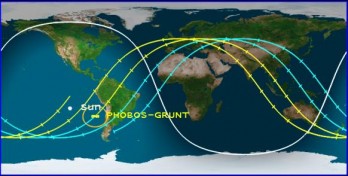
path of Phobos-Grunt's reentry

Updated and bumped. An updated prediction from Aerospace now calls for Phobos-Grunt to come down sometime between 9 and 3 pm (Eastern). This puts the U.S. now out of danger, though Europe, South America, Africa, Australia, and the southern half of Asia all remain in the spacecraft’s path.

Watch your heads! Phobos-Grunt is due to crash to Earth anytime in the next ten hours. And unfortunately, this new prediction has it flying over both North America and much of Europe and Africa during that time period.

0 comments

Phobos-Grunt’s reentry this weekend

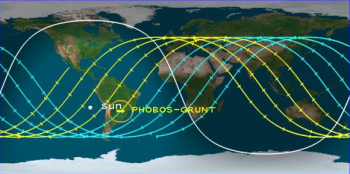
path of Phobos-Grunt's reentry

Watch your head this weekend: The re-entry of Phobos-Grunt has been refined, and is expected to come down sometime between 5 pm (Eastern), Saturday January 14 and 9 am (Eastern), Monday January 16.

As you can see by the image on the right, there is as yet no way to predict where it will land, though it appears that — except for the tip of Florida — North America is in the clear. The blue lines show its orbital path during the first half of this window, while the yellow lines show its path during the window’s second half.

0 comments

Phobos-Grunt is now expected to fall to Earth sometime around January 16

It’s official: Phobos-Grunt is now expected to fall to Earth sometime around January 16.

Meanwhile, the head of the Russian space agency is looking for a scapegoat for his country’s recent space failures.

Roskosmos chief Vladimir Popovkin told the Izvestia daily he could not understand why several launches went awry at precisely the moment the spacecraft were travelling through areas invisible to Russian radar. “It is unclear why our setbacks often occur when the vessels are travelling through what for Russia is the ‘dark’ side of the Earth — in areas where we do not see the craft and do not receive its telemetry readings,” he said. “I do not want to blame anyone, but today there are some very powerful countermeasures that can be used against spacecraft whose use we cannot exclude,” Popovkin told the daily.

With leadership like this, Russia might soon join the U.S. as a country unable to get astronauts into space.

0 comments
1 117 118 119 120 121 133