
Scientists detect the five chemicals that make up DNA/RNA inside Ryugu samples
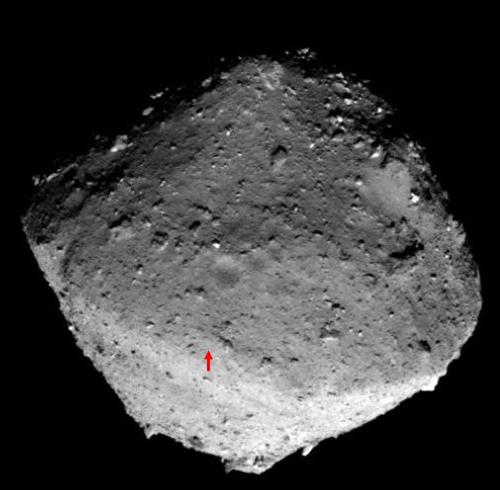
Ryugu's northern hemisphere
Ryugu as seen by Hayabusa-2 shortly before it grabbed
samples from the surface. Arrow indicates planned touchdown
site.

Scientists studying the samples brought back from the asteroid Ryugu by Japan’s probe Hayabusa-2 have found therein a full set of the five fundamental chemicals that make up either DNA or RNA: adenine, guanine, cytosine, thymine and uracil. From the paper’s [pdf] abstract:

Organic molecules delivered from extraterrestrial materials may have played a key role in supplying building blocks for life on Earth. Here we report all five canonical nucleobases—purines (adenine and guanine) and pyrimidines (cytosine, thymine and uracil)—in samples returned from the C-type asteroid (162173) Ryugu by JAXA’s Hayabusa2 mission and compare the results with data from similar extraterrestrial material.

Ryugu samples contain nearly equal amounts of purines and pyrimidines, whereas Murchison is enriched in purines and Bennu and Orgueil in pyrimidines. Samples from Ryugu, Bennu and Orgueil, which have a similar mineralogy and elemental composition, show purine-to-pyrimidine ratios negatively correlating with ammonia.

These observations indicate that the nucleobases in these samples may have formed via a shared pathway depending on the physicochemical environment of the respective parent bodies. The detection of diverse nucleobases in asteroid and meteorite materials demonstrates their widespread presence throughout the Solar System and reinforces the hypothesis that carbonaceous asteroids contributed to the prebiotic chemical inventory of early Earth.

In other words, the data from these samples suggests that the formation of life on Earth was greatly aided by the deposition of these carbon molecules from asteroids onto the Earth.

At the same time, some caution must be exercised. At present we only have samples from three asteroids, one of which (Orgueil) was obtained shortly after it crashed on Earth. It will take a much larger census of many in-space asteroids to confirm this hypothesis.
5 comments

Scientists link near Earth asteroids Bennu and Ryugu to much larger main belt asteroid

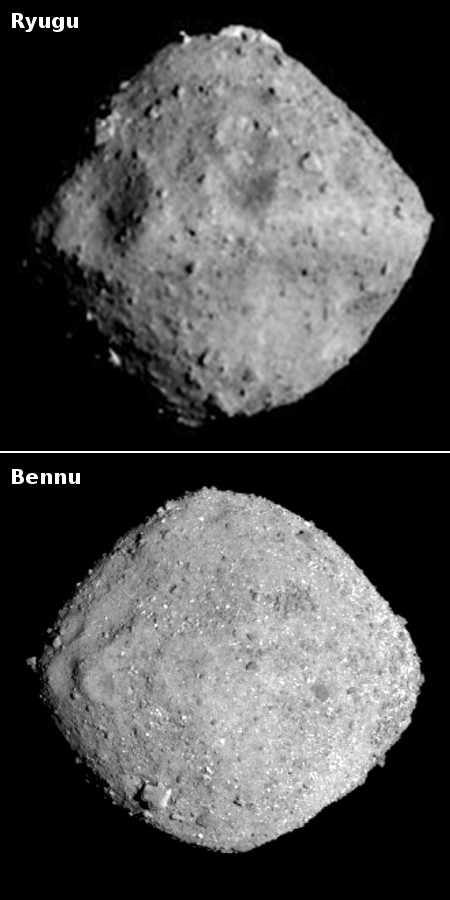
Ryugu and Bennu

Scientists comparing the spectroscopy of samples returned from the near Earth asteroids Bennu and Ryugu have found they closely resemble the much larger main belt asteroid Polana, suggesting all three formed at the same time and place.

You can read the paper here [pdf] From the press release:

The study compared spectroscopy data from Polana with spacecraft and laboratory data from Bennu and Ryugu samples, discovering similarities in their near-infrared spectrum sufficient to support the theory that they originate from the same parent asteroid. “Very early in the formation of the solar system, we believe large asteroids collided and broke into pieces to form an ‘asteroid family’ with Polana as the largest remaining body,” said SwRI’s Dr. Anicia Arredondo, lead author of the study. “Theories suggest that remnants of that collision not only created Polana, but also Bennu and Ryugu as well.”

While the similarities are great, the paper notes there are differences, possibly from “space weathering, particle size, surface texture, or different compositions.” The scientists believe the differences were caused by the asteroids’ different environments, with the 33-mile-wide and much older Polana in the asteroid belt beyond Mars, and Ryugu and Bennu, both less than a mile wide, orbiting the Sun inside Mars.

It is also possible the asteroids have little to do with each other, and the similar spectroscopy only informs us of some of the more common components of the early solar system.

0 comments

Scientists discover unexpected mineral in Ryugu asteroid sample

Scientists analyzing the samples brought back from the rubble pile asteroid Ryugu by Japan’s Hayabusa-2 spacecraft have now discovered an unexpected mineral, dubbed djerfisherite, that the formation theories of the asteroid say should not be there.

“Djerfisherite is a mineral that typically forms in very reduced environments, like those found in enstatite chondrites, and has never been reported in CI chondrites or other Ryugu grains,” says first and corresponding author Masaaki Miyahara, associate professor at the Graduate School of Advanced Science and Engineering, Hiroshima University. “Its occurrence is like finding a tropical seed in Arctic ice—indicating either an unexpected local environment or long-distance transport in the early solar system.”

At present the scientists propose two hypotheses for explaining the mineral. Either it came from another asteroid as Ryugu was congealing, or it formed in Ryugu when conditions raised its temperature above 350 degrees Celsius. The researchers now favor the latter theory, even though the generally accepted histories of Ryugu’s formation never included such conditions.

2 comments

Japan’s Hayabusa-2 asteroid probe in safe mode

Japan’s Hayabusa-2 asteroid probe, which had successfully dropped off samples from the rubble-pile asteroid Ryugu in 2020 and then was sent on a long journey to visit two more asteroids, has suffered an unknown anomaly and shifted into safe mode to protect its instruments.

Communications between Earth and the spacecraft were stable, however, and teams were investigating the situation and its impact on the extended mission, a machine translation of the post read. JAXA has yet to provide a new update since posting about the anomaly.

If engineers can identify the problem and bring the spacecraft back into full operations, the hope is that it will fly past another asteroid in 2026 on its way to a third in 2031, where it will remain for a period of time doing more detailed observations.

0 comments

Samples from the asteroid Bennu reshape entirely our understanding of the solar system’s early make-up

Nightingale landing site on Bennu
The sample site on Bennu, with OSIRIS-REx
superimposed for scale. Click for full image.

First, I hope my readers will notice that — unlike NASA and the entire press — I make no mention in my headline above of the discovery of a “mix of life’s ingredients” or “the key building blocks of life” from the samples brought back by the probe OSIRIS-REx from the asteroid Bennu.

This is the game NASA does all the time, to hint at the discovery of life when this is not the real discovery. NASA does it because it knows that if you hint at such a discovery, the press will go crazy and give you lots of press.

The real news from the two papers published this week, available here and here, however, is more fundamental. Before the samples from Bennu and Ryugu (brought back by the Japanese probe Hayabusa-2) had arrived, our understanding of the make-up and chemistry of the early solar system was very incomplete and badly biased. The only asteroid samples we had of carbonaceous chondrite asteroids, the most primitive and fragile carbon-rich asteroids in the solar system, had came from meteorites that had survived the journey through the Earth’s atmosphere. Thus, the only material that survived was robust enough to do so. The more fragile molecules however were always destroyed and thus missing from meteorites, even though it was very clear from spectroscopy of these asteroids in the solar system that such molecules did exist, and likely formed the majority of these asteroids’ make-up.

Thus, though carbonaceous chondrite asteroids represent the early solar system, our understanding of them was warped and very incomplete. The whole point of both missions to Bennu and Ryugu was to fill in this data, to get a more complete census of the real make-up of the early solar system.

The two papers published this week have given us that. That’s their real discovery.
» Read more

3 comments

Scientists: most asteroids come from a limited number of earlier break-ups

According to three different recently published papers (available here, here, and here), the majority of all meteorites hitting the Earth likely came from a limited number of specific past break-ups of larger asteroids.

New studies show that 70% of the 70,000 meteorites that have been found on Earth have come from 3 recent collisions in the main asteroid belt which sits between the orbits of Mars and Jupiter. The collisions occurred 5.8, 7.5 and 40 million years ago, according to the studies. They correspond to 3 young asteroid “families” known as Karin, Koronis and Massalia. These families formed from the destruction of asteroids at least 30km across.

The 70% number comes from data in the last two papers above, while the first paper claims it is more like 80% of all asteroids. The Massalia family is the most dominate, with it estimated to be the source 37% of all meteorites as well as a major impact half a billion years ago.

The first study also found that both Ryugu and Bennu came from the same event and are part of another family of asteroids called Polana.

0 comments

Scientists try to model what would happen if Ryugu hit Earth

Ryugu's northen hemisphere
Ryugu’s northen hemisphere. The arrow marks the spot Hayabusa-2
gathered samples

Scientists, using the data and rock samples gathered by the Japanese probe Hayabusa-2, have attempted to predict what what would happen if the rubble-pile asteroid Ryugu hit the Earth.

Without diversion intervention, Tanaka explained, if the Ryugu asteroid was heading to Earth and entered the planet’s atmosphere at an angle of 45 degrees and at a speed of around 38,000 miles per hour (17 kilometers per second), the rubble pile asteroid would break up at an altitude of around 25 to 21 miles (40 to 35 km) over the surface of the planet.

This would result in an “airburst” similar to that seen over Russia in February 2013 when the Chelyabinsk meteor erupted at an altitude of around 19 miles (30 kilometers) over Earth. The result of the Chelyabinsk blast was a bright flash of light and an atmospheric blast equivalent to the detonation of 400–500 kilotons of TNT. This is as much as 33 times the energy released by the atomic bomb that devastated Hiroshima at the end of the Second World War.

The Chelyabinsk meteor caused about 1,500 injuries, mostly from people injured by glass thrown out by breaking windows when it suddenly and unexpectedly exploded during re-entry. With Ryugu this would not be a surprise, so these injuries could be reduced, though not eliminated. The damage and injuries from pieces that survived the breakup and hit the ground remains unknown because scientists don’t know how much of the asteroid would survive the break up.

Ryugu of course poses no threat, because it is not on a collision course with Earth. Whether an asteroid like Ryugu could be diverted however remains unknown, since any such diversion must not cause the asteroid to break apart as well.

7 comments

Samples from Ryugu found to contain uracil, one of the four nucleobases in RNA

Japanese researchers analyzing the samples returned by Hayabusa-2 from the rubble-pile asteroid Ryugu have identified the molecule uracil, one of the four nucleobases that form the molecule RNA.

Hayabusa 2 collected 5.4 grams from two spots on Ryugu and delivered them to Earth on December 6, 2020. Early studies showed the samples contained many organic compounds. That led Oba’s group to analyze two 10-milligram samples using the same sensitive technique they had used earlier on meteorites. The technique can detect nucleic acid bases at levels down to parts per trillion in small samples.

Now, they report in Nature Communications that uracil is present at a level of parts per billion in both Ryugu samples. While this concentration is different than they’d previously found in meteorites, Oba says that might be because the parent bodies of the meteorites and of Ryugu underwent different levels of aqueous alteration and other processes. They also detected niacin (vitamin B3) as well as other organic molecules, but they didn’t find any other nucleobases.

RNA is formed from four nucleobases, uracil, adenine, cytosine, and guanine. To form DNA, the fundamental building block of life, uracil is replaced by thymine.

This data reinforces other data that suggests the formation of these essential molecules for life is relatively common and easy, at least in our solar system.

0 comments

Many carbon-based molecules identified in Ryugu samples

Researchers in Japan, Europe, and the U.S. have now identified many carbon-based molecules in the Ryugu samples brought back to Earth by Japan’s Hayabusa-2 asteroid probe. From their paper, published in Science yesterday:

We identified numerous organic molecules in the Ryugu samples. Mass spectroscopy detected hundreds of thousands of ion signals, which we assigned to ~20,000 elementary compositions consisting of carbon, hydrogen, nitrogen, oxygen, and/or sulfur. Fifteen amino acids, including glycine, alanine, and α-aminobutyric acid, were identified. These were present as racemic mixtures (equal right- and left-handed abundances), consistent with an abiotic origin. Aliphatic amines (such as methylamine) and carboxylic acids (such as acetic acid) were also detected, likely retained on Ryugu as organic salts.

The presence of aromatic hydrocarbons, including alkylbenzenes, fluoranthene, and pyrene, implies hydrothermal processing on Ryugu’s parent body and/or presolar synthesis in the interstellar medium. Nitrogen-containing heterocyclic compounds were identified as their alkylated homologs, which could have been synthesized from simple aldehydes and ammonia. In situ analysis of a grain surface showed heterogeneous spatial distribution of alkylated homologs of nitrogen- and/or oxygen-containing compounds.

The large number of carbon-based molecules is not unlike data from similar carbonaceous chondrite meteorites, though the differences appear to suggest Ryugu experienced chemical processes in connection with water during its lifetime.

Note for clarity: Organic molecules are not life. This is a term scientists use for any carbon-based molecule.

1 comment

Samples from Ryugu prove the truly delicate and long-lived nature of the rubble-pile asteroid

Two new studies of samples brought back from the rubble-pile asteroid Ryugu by the Japanese probe Hayabusa-2 have found that the asteroid not only was never heated above 86 degrees Fahrenheit, it also contained dust grains older than the solar system itself.

The evidence from the first study, completed by Japanese scientists, suggested that:

  • 1.Asteroid Ryugu accreted some components that originated in the outer Solar System and contained abundant water and organics. The asteroid then traveled to the inner Solar System.
  • 2.Organics associated with coarse-grained phyllosilicates may serve as one of the potential sources of water and organics to the Earth.

The second study, using samples provided to American scientists, found two tiny dust grains that must have come from the material that existed before the formation of our solar system.

The team detected all the previously known types of presolar grains—including one surprise, a silicate that is easily destroyed by chemical processing that is expected to have occurred on the asteroid’s parent body. It was found in a less-chemically-altered fragment that likely shielded it from such activity.

This is not the first discovery of presolar grains, but their delicate existence in Ryugu confirms the conclusions of the first study, that Ryugu had to have formed in the outer solar system and then migrated inward over eons.

The second study also reviewed the make-up of the sample and concluded that Ryugu appears to most closely match the family of carbonaceous Ivuna-type (CI) chondrites, thought to be among the most primitive asteroids known, of which very few have been studied because of they rarely survive the journey through the Earth’s atmosphere.

1 comment

Amino acids found in asteroid samples brought back from Ryugu

Japanese scientists revealed this week that they have detected more than 20 types of amino acids in the asteroid samples brought back from Ryugu by the probe Hayabusa-2.

Kensei Kobayashi, professor emeritus of astrobiology at Yokohama National University, said the unprecedented discovery of multiple types of amino acids on an extraterrestrial body could even hint at the existence of life outside of Earth. “Proving amino acids exist in the subsurface of asteroids increases the likelihood that the compounds arrived on Earth from space,” he said.

It also means amino acids can likely be found on other planets and natural satellites, hinting that “life could have been born in more places in the universe than previously thought,” Kobayashi added.

Let me emphasize that this is not a discovery of life on Ryugu, only chemistry that is found in life on Earth. Such chemistry however can be found outside of life as well. What this detection suggests however that it is relatively common to produce such complex chemistry in hostile space environments, which increases greatly the possibility of life everywhere in the universe.

0 comments

Japanese scientists complete inventory of Ryugu asteroid samples

In a press conference yesterday the Japanese space agency JAXA announced that scientists have completed their inventory of the samples brought back from the asteroid Ryugu by the Hayabusa-2 spacecraft, and are now ready to begin distributing those samples to scientists around the world for more detailed research.

JAXA has cataloged the soil samples brought back by Hayabusa 2 last December, by size, color and shape. From now, 269 researchers from 14 countries, including Japan and the United States, will conduct an in-depth analysis of the soil’s structures and components over the course of about a year.

As expected, the inventory found the samples had a large amount of hydrogen, oxygen, and carbon atoms. Even before Hayabusa-2’s arrival, Ryugu had been catalogued as a “hydrated” asteroid, which means it was thought to contain a lot of hydrogen and oxygen, the basic elements of water. The inventory has now confirmed this.

1 comment
1 2 3 9