
The new Milky Way
This is a wonderful article, outlining (with video!) the present state of knowledge about the past, present, and future of our home galaxy.
This is a wonderful article, outlining (with video!) the present state of knowledge about the past, present, and future of our home galaxy.
The head of Russia’s manned program said today that the first yearlong mission on ISS will begin in March 2015.
This appears to be another case of the Russians trying to use the media to pressure NASA into agreeing to the mission. I hope it works.
Diederik Stapel, the psychologist who had fabricated his results in numerous published papers and has since resigned, is now under investigation by Dutch prosecutors.
Twenty-five of Stapel’s papers have now been retracted.
The scientist famous for identifying drowning polar bears in the Arctic has been reprimanded for leaking emails and following “inappropriate” procurement procedures at his job at the Department of Interior.
The investigation also criticized the scientist, Charles Monnett, for fudging his data in reporting the death of the polar bears, a report that the global warming movement used extensively to falsely prove that global warming was causing the destruction of the polar bear population.
The Nature story above tries to make light of Monnett’s misconduct, especially in connection with his polar bear report as well as his work in awarding contracts. The report itself [pdf] is far more harsh.
In connection with Monnett’s contract work, it appears he actually helped one contractor write his proposal, then sat on the board that awarded the contract to that contractor.
» Read more
The weather in Gale Crater on Mars: warmer than expected.
James Hansen’s Goddard Institute of Space Studies has once again been caught changing its past climate temperature data without explanation.
Surprise of surprise, the change had the effect of making the long-term temperature record support conclusions of faster warming. The biggest changes were mostly pre-1963 temperatures; they were generally adjusted down. That would make the warming trend steeper, since post-1963 temperatures were adjusted slightly upward, on average. Generally, the older the data, the more adjustment.
Hat tip to reader jwing who alerted me to this story. As I commented to him, this “also is old news, to my mind, even though this is a new discovery of corruption. This kind of fraud has now been on-going for the past decade, with no signs of any effort to fix it. Worse, the climate science field even denies that it has a problem. Thus, I don’t trust anything they tell me. I check everything twice, and then have doubts besides. Which is why I remain entirely skeptical of any claims these climate scientists make.”
And in this case, the climate scientist in question is James Hansen.
It appears that Curiosity is traveling across an ancient streambed on Mars.
“From the size of gravels it carried, we can interpret the water was moving about 3 feet per second, with a depth somewhere between ankle and hip deep,” said Curiosity science co-investigator William Dietrich of the University of California, Berkeley. “Plenty of papers have been written about channels on Mars with many different hypotheses about the flows in them. This is the first time we’re actually seeing water-transported gravel on Mars. This is a transition from speculation about the size of streambed material to direct observation of it.”
This discovery also confirms the wisdom of Gale Crater as a target. Satellite data and images had suggested the crater had once been water filled. Now this suggestion appears confirmed.
The sharpest ever ground-based image of Pluto and its moon Charon.
It is a great image of Pluto, but not quite as good as Hubble’s best, proving once again the value of either getting up above the atmosphere with a telescope, or even better, going there.
The Martian weather, as recorded by the Curiosity weather station.
The prosecutor in the Italian trial of seven earthquake experts has requested four year jail sentences for their failure to properly warn the public in advance about the April 2009 L’Aquila earthquake.
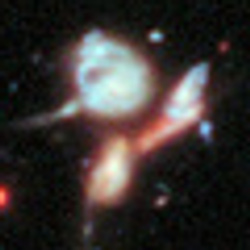
The Hubble Space Telescope has taken its deepest image yet.
This long exposure picture of a tiny patch of sky in the constellation Fornax spotted about 5,500 galaxies from the very beginning of the universe. Take a close look, because you will see that these early galaxies are often strange looking. I have cropped out one just example to the left to give you an idea.