
New data from Antarctica suggests that the south pole icecap is not warming, as predicted by climate models.

New data from Antarctica suggests that the south pole icecap is not melting, as predicted by climate models.

It turns out that past studies, which were based on computer models without any direct data for comparison or guidance, overestimate the water temperatures and extent of melting beneath the Fimbul Ice Shelf. This has led to the misconception, Hattermann said, that the ice shelf is losing mass at a faster rate than it is gaining mass, leading to an overall loss of mass. The model results were in contrast to the available data from satellite observations, which are supported by the new measurements.

The teamโ€™s results show that water temperatures are far lower than computer models predicted, which means that the Fimbul Ice Shelf is melting at a slower rate. Perhaps indicating that the shelf is neither losing nor gaining mass at the moment because ice buildup from snowfall has kept up with the rate of mass loss, Hattermann said.

In other words, the climate models were wrong. When actual data was obtained, first by satellites and now from the water under the ice shelf itself, the new data found that the ice shelf is stable, not melting as predicted.
2 comments

Two exoplanets in a tight orbital dance.

Two exoplanets in a tight orbital dance.

“These are the closest two planets to one another that have ever been found,” Agol said. “The bigger planet is pushing the smaller planet around more, so the smaller planet was harder to find.”

Orbiting a star in the Cygnus constellation referred to as Kepler-36a, the planets are designated Kepler-36b and Kepler-36c. Planet b is a rocky planet like Earth, though 4.5 times more massive and with a radius 1.5 times greater. Kepler-36c, which could be either gaseous like Jupiter or watery, is 8.1 times more massive than Earth and has a radius 3.7 times greater.

But wait, there’s more!

The fact that the two planets are so close to each other and exhibit specific orbital patterns allowed the scientists to make fairly precise estimates of each planet’s characteristics, based on their gravitational effects on each other and the resulting variations in the orbits. To date, this is the best-characterized system with small planets, the researchers said.

They believe the smaller planet is 30 percent iron, less than 1 percent atmospheric hydrogen and helium and probably no more than 15 percent water. The larger planet, on the other hand, likely has a rocky core surrounded by a substantial amount of atmospheric hydrogen and helium.

2 comments

According to this article, the water-ice discovered at Shackleton Crater is insufficient for human settlement.

The uncertainty of science: According to this article, the water-ice discovery announced yesterday at Shackleton Crater is insufficient for human settlement.

The latest LRO data indicate “that water is not there … in a way that would facilitate human exploration,” says planetary scientist Maria Zuber, who led the team analyzing the data.

If the signatures the team saw in the soils on the crater floor do indicate water, how much water might there be? Roughly 100 gallons โ€“ enough to fill two or three residential rain barrels โ€“ spread over a surface of about 133 square miles. Leave the swim-suit at home. “This is not like Mars,” says Dr. Zuber, a professor at the Massachusetts Institute of Technology in Cambridge, in an interview. On the red planet, explorers would find thick layers of icy soil in many locations just by turning over a shovelful or two of topsoil. [emphasis mine]

This story seems to answer my question about Zuber’s participation in the water in Shackleton paper as well as the previous paper saying there is much less water on the Moon than previously believed. It also raises questions about the journalism work of many of the other stories published in the past few days, which heavily touted the possibility of water in Shackleton.

I intend to dig into this story a bit more. Stay tuned.

6 comments

New data from Lunar Reconnaissance Orbiter suggests that ice may make up as much as 22 percent of the surface material in Shackleton Crater, located on the moon’s south pole. The uncertainty of science: New data from Lunar Reconnaissance Orbiter suggests that ice may make up as much as 22 percent of the surface material in Shackleton Crater, located on the moon’s south pole.

The uncertainty of science: New data from Lunar Reconnaissance Orbiter suggests that ice may make up as much as 22 percent of the surface material in Shackleton Crater.

What I find most interesting about this result is that the team leader of this paper, Maria Zuber, was also one of the co-authors of the paper I wrote about two days ago that said there was no water in Shackleton Crater.

2 comments

The pork of Obamacare

The Patient Centered Outcomes Research Institute (PCORI), created by Obamacare, announced its first round of grants today, part of a funding program of fifty โ€œpilot projectsโ€ totaling $30 million.

It didn’t take much research for me to conclude that, while some of this work might be useful, most of it sounds like bureaucratic claptrap. For example, consider the description Nature gives for these three grants:
» Read more

4 comments

The Moon: a desert after all?

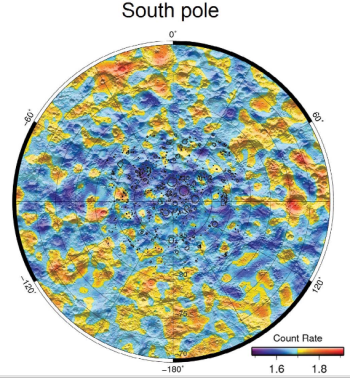
LEND data of lunar south pole

The uncertainty of science: A new science paper, published Saturday in the Journal of Geophysical Research – Planets,, has found that there is much less water ice trapped in the permanently shadowed craters of the lunar poles than previously thought. From the abstract:

This means that all [permanently shadowed regions], except those in Shoemaker, Cabeus and Rozhdestvensky U craters, do not contain any significant amount of hydrogen in comparison with sunlit areas around them at the same latitude.

And from the paper’s conclusion:

[E]ven now the data is enough for definite conclusion that [permanently shadowed regions] at both poles are not reservoirs of large deposits of water ice.

» Read more

6 comments

Scientists have concluded that a 460 foot diameter asteroid only has a 1 percent chance of hitting the Earth in 2040.

O goody: Scientists have concluded that a 460 foot diameter asteroid only has a 1 percent chance of hitting the Earth in 2040.

Observations to date indicate there is a slight chance that AG5 could impact Earth in 2040. Attendees expressed confidence that in the next four years, analysis of space and ground-based observations will show the likelihood of 2011 AG5 missing Earth to be greater than 99 percent.

It appears that they won’t really be able to pin down the impact odds for 2040 until 2023, when the asteroid passes the Earth at a distance of 1.1 million miles.

0 comments
1 589 590 591 592 593 729