
Have researchers found Leonardo da Vinci’s lost “The Battle of Anghiari” fresco, hidden for the past six centuries behind a wall?

Have researchers found Leonardo da Vinca’s lost “The Battle of Anghiari” fresco, hidden for the past six centuries behind a wall?

The painting, considered a masterpiece by contemporaries, had never been finished by da Vinci because he had used an experimental technique to paint it, and that technique had failed. Thus, the painting was painted over fifty years later. The only reason we have a good idea of what the painting looked like is that several artists were so impressed by it that they produced copies while it was still visible.

The research suggests the painting was not painted over, but that a false wall was built in front of it. If so, this would be truly exciting discovery. The painting would probably not be in very good shape, but to actually see it would be wonderful.
0 comments

Research on ISS has found that prolonged spaceflight causes vision problems and might even damage the human eye.

Research on ISS has found that prolonged spaceflight causes vision problems and might even damage the human eye.

There had been hints of this discovery in an earlier report, but today’s paper is the first published science on the subject.

The results are not only important for finding out the medical challenges of weightlessness. They illustrate once again the need to do long extended flights on ISS. Without that research we are never going to be able to fly humans to other planets.

7 comments

The blistering hot exoplanet where it snows

The blistering hot exoplanet where it snows.

These results have led to a suggestion that [HD 189733b] could continually experience silicate snow. In the lower atmosphere of [the exoplanet], magnesium silicate sublimates, that is, it passes directly from a solid into a gas. But we know there are small silicate particulates in the upper atmosphere. Formation of these particulates requires that the temperature be lowered, and so must have been formed at a temperature inversion in the atmosphere. The generally windy conditions would help some of the tiny particulates grow into respectable snow crystals.

0 comments

Lord Monckton tries to educate a college professor and his students.

Lord Monckton tries to educate a college professor and his students about the science of climate change.

This is why:

β€œWe shall lose the West unless we can restore the use of reason to pre-eminence in our institutions of what was once learning. It was the age of reason that built the West and made it prosperous and free. The age of reason gave you your great Constitution of liberty. It is the power of reason, the second of the three great powers of the soul in Christian theology, that marks our species out from the rest of the visible creation, and makes us closest to the image and likeness of our Creator. I cannot stand by and let the forces of darkness drive us unprotesting into a new Dark Age.”

0 comments

An up and down Sun

close-up

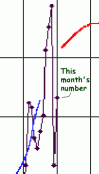
Late last week NOAA’s Space Weather Prediction Center released its monthly update of the ongoing solar cycle sunspot activity, covering February 2012. Though I am slightly late in posting it, as I do every month, you can now see the full graph below the fold. I have also created a close-up of the graph’s relevant area, shown on the left, because it is hard to decipher what is happening on the full graph.

Since the Sun began it ramp up to solar maximum back in 2009, the pattern has been consistent, two steps forward, one step back. First there are several months in a row in which the number of sunspots show a steep rise, followed immediately by several months in which the sunspot numbers decline just as steeply, though by not as much. All told, since 2009 we have seen this pattern repeat four times.

February’s numbers have continued that pattern.
» Read more

0 comments

smaller planets are preferentially found in low-eccentricity orbits.

More Kepler results: From the abstract of a preprint paper published today on the Los Alamos astro-ph website:

The mean eccentricity of the Kepler candidates decreases with decreasing planet size indicating that smaller planets are preferentially found in low-eccentricity orbits.

In other words, the smaller a planet is, the more likely its orbit will be circular like the Earth’s. This result is encouraging news for the search for life on other worlds. Before Kepler, astronomers had found that the orbits of most exoplanets were far more eccentric than the orbits of the planets in our solar system, a condition that scientists thought was unfriendly for the development of life. These new results counter that conclusion. The orbits of the planets in our solar system might not be as unusual as first thought.

0 comments

When a solar storm slammed into both the Earth and Mars in January 2008, scientists were able to directly measure the importance of the Earth’s magnetic field in protecting our atmosphere from oxygen loss.

When a solar storm slammed into both the Earth and Mars in January 2008, scientists were able to directly measure the importance of the Earth’s magnetic field in protecting our atmosphere from oxygen loss.

They found that while the pressure of the solar wind increased at each planet by similar amounts, the increase in the rate of loss of martian oxygen was ten times that of Earth’s increase. Such a difference would have a dramatic impact over billions of years, leading to large losses of the martian atmosphere, perhaps explaining or at least contributing to its current tenuous state. The result proves the efficacy of Earth’s magnetic field in deflecting the solar wind and protecting our atmosphere.

1 comment
1 603 604 605 606 607 729