
Tag: science
Inside the heart of the volcano
Arne Saknussemm would be proud: Inside the heart of the volcano.
The Sun in April – Steady as she goes!
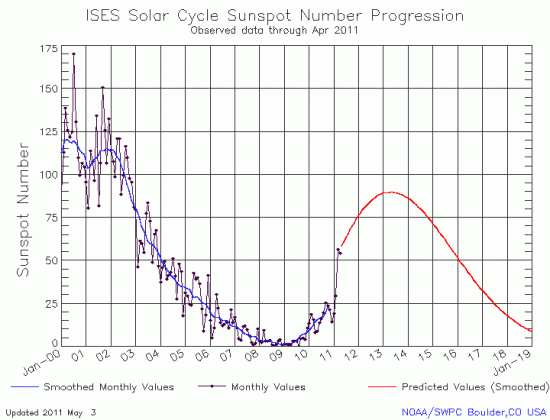
The monthly updated graph for April of the Sun’s solar cycle sunspot activity was posted yesterday by NOAA’s Space Weather Prediction Center. You can see it below.
Though the Sun remained active, you can see that the steep increase in sunspot activity that occurred in March has ceased. At the moment it looks as if the Sun’s sunspot activity is following the most recent scientific prediction, more or less exactly, though the small dip in April puts the numbers slightly below that prediction.
All in all, we still appear to be headed to the weakest solar maximum in two hundred years.
Amateur grabs images of solar sail Nanosail-D
An amateur astronomer has grabbed some spectacular images of solar sail Nanosail-D.

Why is the Meathook Galaxy lopsided?
Why is the Meathook galaxy lopsided?
Mock Soyuz countdown under way at Kourou, French Guiana
A mock Soyuz countdown is under way at Kourou, French Guiana.
Dawn has begun its final if slow approach to the asteroid Vesta
Dawn has begun its final if slow approach to the asteroid Vesta.
Indian scientists about to start drilling five mile deep borehole
Indian scientists are about to begin drilling a five-mile-deep borehole to study earthquakes.
Did Apollo 12 bring back a microbe from Surveyor 3?
Did a microbe survive 2.5 years attached to Surveyor 3 on the Moon, and then come home on Apollo 12? New research says no.
More info on the asteroid “flyby” of Earth this coming November 8
More information on the asteroid “flyby” of Earth this coming November 8.
“On November 8, asteroid 2005 YU55 will fly past Earth and at its closest approach point will be about 325,000 kilometers [201,700 miles] away,” said Don Yeomans, manager of NASA’s Near-Earth Object Program Office at the Jet Propulsion Laboratory in Pasadena, Calif. “This asteroid is about 400 meters [1,300 feet] wide – the largest space rock we have identified that will come this close until 2028.”
Hubble and Swift show that asteroid debris came from collision
Space telescopes Hubble and Swift have proven that the debris that suddenly surrounded asteroid Scheila last year was caused by a collision.
Are astronomers finally going to push for a replacement for Hubble?
Astronomers are considering the merger two space missions to create a new optical/ultraviolet space telescope. The mission would be designed to do both deep cosmology and exoplanet observations.
The two communities would both like to see a 4–8-metre telescope in space that would cost in excess of $5 billion. “Our interests are basically aligned,” says [Jim Kasting, a planetary scientist at Pennsylvania State University]. Such a mission would compete for top billing in the next decadal survey of astronomy by the US National Academy of Sciences, due in 2020.
This story is big news, as it indicates two things. First, the 2010 Decadal Survey, released in August 2010, is almost certainly a bust. The budget problems at NASA as well as a general lack of enthusiasm among astronomers and the public for its recommendations mean that the big space missions it proposed will almost certainly not be built.
» Read more