
Tag: science
Russia Speeds Up Moon, Mars Plans as U.S. May Cut Spending
Russia is accelerating its space program.
“It is the first time that the government has allocated decent financing to us,” Anatoly Perminov, head of the Russian space agency Roscosmos, said in a phone interview on April 2. The agency’s $3.5 billion budget for 2011 has almost tripled since 2007, reaching the highest since the collapse of the Soviet Union in 1991. “We can now advance on all themes a bit,” Perminov said.
Unlike 50 years ago, when beating the U.S. into space marked a geopolitical victory in the Cold War, Russia is focusing on the commercial, technological and scientific aspects of space travel. President Dmitry Medvedev has named aerospace one of five industries the government plans to nurture to help diversify the economy of the world’s largest energy supplier away from resource extraction.
The “Pioneer Anomaly”: Case Closed
Will EPA Lose Control of Greenhouse Gas Rules?
Will the EPA lose control of greenhouse gas rules?
The article above, written for the journal Science, is clearly on the side of the EPA. Nonetheless, it does outline well the political dynamics of this regulatory battle between the EPA and Congress.
Record loss of ozone over Arctic
I thought the banning of CFCs was going to change this? March sets a record for ozone loss over the Arctic.
Or to put it another way, climate science is far more complicated than too many climate scientists want to admit.
Exploring the floor of Copernicus
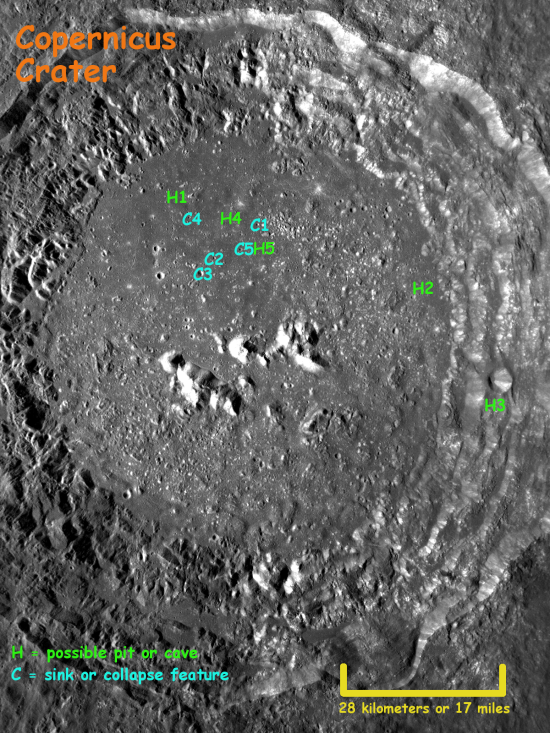
The Lunar Reconnaissance Orbiter website recently announced a new way to tour the Moon. The website, called QuickMap, allows a user with any home computer to zoom into any spot on the lunar surface and see the high resolution images being taken by Lunar Reconnaissance Orbiter.
Using QuickMap, I spent a few hours this past weekend strolling about on the northern half of the floor of the crater Copernicus. It is in this area, annotated in the image on the right, that NASA engineer James Fincannon has already located a slew of collapse features and possible caves, the images of which I have posted previously on behindtheblack. (Click on the image or here to see a larger version of this updated index map.)
(You also can go sightseeing there if you wish. Go to QuickMap and zoom in on 10.1 latitude and -20.1 longitude to get to the floor of Copernicus. Or pick your own spot on the lunar surface and do some of your own exploring!)
What I found in the northern half of Copernicus’s floor was a plethora of possible caves and collapse features. Literally, the crater floor is littered with what appear to be pits, fissures, rills, and sinks. More significantly, sometimes the cave entrances line up with long straight collapse features, suggesting strongly the existence of extensive underground passages beyond the initial entrance pits.
» Read more
Ultralights!
An evening pause: Who says humans can’t fly?
Playing with mercury
An evening pause:
EPA Whistleblower Criticizes Global Warming Science and Policy in New Peer-Reviewed Study
EPA whistleblower slams global warming science and policy in new peer-reviewed study. The paper’s conclusion:
The scientific hypotheses underlying global warming alarmism are overwhelmingly contradicted by real-world data, and for that reason economic studies on the alleged benefits of controlling greenhouse gas emissions are baseless.
The first permanent building at the South Pole, built in the mid-1950s, has been destroyed
The first permanent building at the South Pole, built by the U.S. in the mid-1950s, has been demolished with dynamite.
April Fools’ Roundup
China’s second lunar orbiter, Chang’e 2: still in operation after 180 days
China’s second lunar orbiter, Chang’e 2: still in operation after 180 days.
Unfortunately, little of its scientific results have been released.