
Budget problems might delay JWST until 2018
The telescope that ate astronomy: More budget problems for the James Webb Space Telescope, with its launch likely delayed again until 2018.
The telescope that ate astronomy: More budget problems for the James Webb Space Telescope, with its launch likely delayed again until 2018.
The uncertainty of science: An underground experiment in Italy has failed to detect dark matter, as theorized by scientists.
In a paper published online last night, the XENON100 researchers report three events detected during a 100-day run of the experiment last year that might have been due to dark matter1. However, as they expected to see between 1.2 and 2.4 background events — interactions mostly caused by a radioactive contaminant in the xenon — their result is statistically negative and therefore rules out the existence of many of the more strongly interacting and heavier WIMPs.
An evening pause:
ISS plans week-long simulated Mars mission.
This is the right idea, but to really learn something NASA needs to commit to a year-plus long simulated mission.
NASA, crunched for money due to overages on James Webb Space Telescope, has cancelled its participation in the space gravitational wave mission LISA.
Picking the landing spot for the next Mars rover: down to four finalists.
Kepler does asteroseismology on 500 sunlike stars. The data says that the theories of star formation need to be revised.
Walking in Nyiragongo Crater in Africa. The pictures are stupendous.
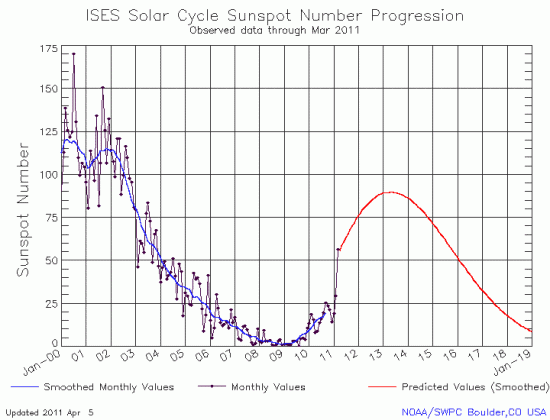
After literally years of inactivity, well below all initial predictions, the Sun truly came to life this past month. Below is the March monthly update of the Sun’s sunspot cycle, published by NOAA’s Space Weather Prediction Center. The red curve is the prediction, while the dotted black line shows the actual activity.
As you can see, the Sun’s sunspot activity shot up precipitously. Though I don’t have the data from past years, the March jump appears to me to probably be one of the fastest monthly rises ever recorded.
Does this mean the newest prediction from the solar scientists at the Marshall Space Flight Center calling for a weak solar maximum in 2013 is wrong? Probably not, though of course in this young field who knows? I would say, however, that the overall trend of the data still suggests the next maximum will be very weak.
Stay tuned! The next few months should finally give us a sense of where the next maximum is heading.
Scientists have found strong evidence that liquid water once existed in the interior of a comet.