Tag: science
Trees from space
We need to find them! Trees from space, planted here on Earth. You can see the known list here.
An Anomalous SETI Signal
Giant Ring of Black Holes
House Spending Plan cuts billions from federal research agencies
Stand by for oinks! The House spending plan would cut billions from federal research agencies such as NIH, NSF, NOAA, NASA, and a host of Department of Energy programs. Specifics at the link.
The Sun’s continuing wimpiness
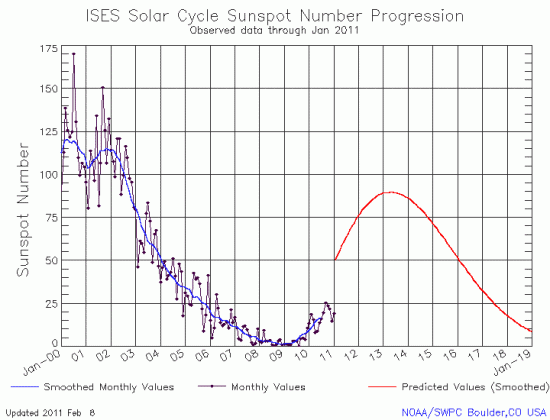
Get those winter coats out of storage! Yesterday NOAA’s Space Weather Prediction Center published its monthly update of the Sun’s sunspot cycle. I’ve posted the newest graph below, showing the continuing slow rise in sunspots (blue/black lines) in comparison with the consensis prediction made by the solar science community in May 2009 (red line).
Though the sunspot count made a slight recovery in January, it was not enough to make up for the plunge in December. Essentially, the Sun continues to act like a sleepy kitten that really doesn’t want to wake up. This suggests that even the newest and wimpiest prediction for the next solar maximum, from solar scientists at the Marshall Space Flight Center, is still overstating the Sun’s upcoming sunspot activity.
In the past a wimpy Sun has been linked to cold weather, for reasons that scientists as yet don’t quiet understand. And this next solar maximum continues to look like the wimpiest in more than 200 years (see the graph on this page)!
What Is Asteroid Apophis?
A fresh perspective from the new chairman of the House subcommittee that oversees National Science Foundation (NSF), NASA, the Department of Energy, and the Department of Commerce
Mo Brooks (R-Alabama), the new chairman of the House subcommittee that oversees National Science Foundation (NSF), NASA, the Department of Energy, and the Department of Commerce, gives his perspective on science and the budget. Two quotes of interest:
Q: Do you believe that federal research should be exempt from a rollback in federal spending to 2008 levels?
Brooks: I would love for that to happen. But we just don’t have the money. … We have no choice but to look at everything. If we don’t balance our budget over a short period of time, the federal government is going to collapse and there won’t be money for any of these things. So if we’re going to save money for research and advancement in science, we’re going to have to get our house in order now.Q: Do you think the government should increase funding on research once things turn around?
Brooks: Do you mean if the budgetary situation turns around? I don’t see that happening in the next 4 to 5 years. We’ve got a $1.5 trillion budget deficit, and Admiral Mullen, head of the Joint Chiefs of Staff, has declared it the number one security threat to the country. And if our creditors would cut us off, there would be zero money for national defense or NSF or anything else.
Note how the interviewer, from Science, can’t seem to get his head around the idea of budget cuts.
Q: Is human activity causing global warming?
Brooks: That’s a difficult question to answer because I’ve talked to scientists on both sides of the fence, especially at the University of Alabama at Huntsville. Some say yes, and some say no. I’m also old enough to remember when the same left-wing part of our society was creating a global cooling scare in order to generate funds for their pet projects. So 30-some years ago, the big scare was global cooling, and once they drained the government, they shifted to global warming. So I’m approaching the issue with a healthy degree of skepticism. If the evidence is there to prove it, then so be it.
Obama’s “tough budget cuts” in pictures
Obama’s “tough budget cuts” in pictures.
The Singing, Ringing Tree
An evening pause:
Republicans in House want to shift NASA’S climate funds back to Manned Spaceflight
The space war over NASA continues: A group of House Republicans want to cut NASA’s climate research budget — increased significantly by Obama — and put it back into manned spaceflight.
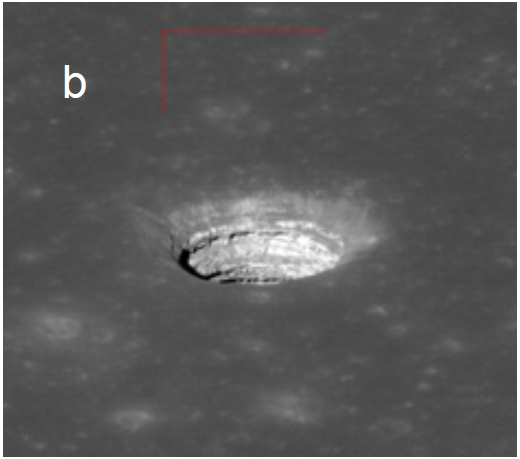
The underground Moon
More images of lunar cave pits have been posted by the scientists of Lunar Reconnaissance Orbiter (LRO). They have also published their first paper [pdf] about these cave pits for the 2011 Lunar and Planetary Science Conference taking place in March. The paper summarizes, with images, what is know about the three pits on the Moon that have each been imaged a number of times at different angles and lighting situations.