
Modern science
Why bother with research when all we need to do is ask our politicians? Scientist Hillary Clinton studies the floods in Pakistan and the forest fires in Russia and declares them both proof that global warming is happening!
Why bother with research when all we need to do is ask our politicians? Scientist Hillary Clinton studies the floods in Pakistan and the forest fires in Russia and declares them both proof that global warming is happening!
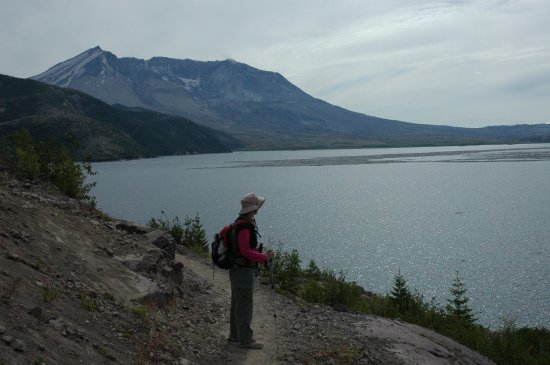
Today we hiked almost ten miles around Mt. St. Helens, walking down to the shore of Spirit Lake (see below) as well as tromping about on the debris field just below the crater. I will have a long post on the experience tomorrow.
Another scientific scandal, this time in the field of animal and human cognitive research: Harvard scientist Marc Hauser has admitted to eight instances of misconduct. Three key quotes:
The university said in a statement last week that Dr. Hauser or a co-author had been directed to correct three published papers for which the original data could not be found. [emphasis mine]
Harvard itself had faced growing criticism for not releasing more details of the inquiry since The Boston Globe reported on Aug. 10 that the university had found evidence of scientific misconduct in Dr. Hauser’s lab. On Friday, Michael D. Smith, dean of the Harvard faculty of arts and sciences, issued a letter to the faculty confirming the inquiry and saying the eight instances of scientific misconduct involved problems of “data acquisition, data analysis, data retention, and the reporting of research methodologies and results.” No further details were given.
Harvard’s findings against him, if sustained, may cast a shadow over the broad field of scientific research that depended on the particular research technique often used in his experiments.
Gee, this sure sounds a lot like the Phil Jones/East Anglia University climategate scandal, where both the researcher and his university provided cover for each other, thereby leaving a cloud over a vast amount of climate research that depends on Jones’s data.
Want to see what the Earth-Moon double planet looks like from 114 million miles away? Take a look at this image taken recently by the Messenger spacecraft on its long journey to Mercury.
Images from Lunar Reconnaissance Orbiter have proven that as the Moon cooled and solidified, it shrunk, leaving behind a network of cliffs, called thrust faults, across its entire face.
Astronomers have discovered the first star/neutron star binary system where the normal star is eclipsing the neutron star several times each week.
Despite increasing use by humans, the plastic pollution floating in the North Atlantic ocean has not increased over the last two decades,and scientists don’t know why. From the Science press notice:
The authors propose a handful of possible explanations for why more discarded plastic is not appearing out in the open Atlantic Ocean. It may break up into pieces too small to be collected by the nets, or it might be sinking beneath the surface. Or, it might be consumed by marine organisms. More research will be necessary to determine the likelihood of each scenario.
Mud volcanoes on Mars.
Though this only confirms what the Russians learned on Mir, scientists have determined that long periods in weightlessness cause a significant loss in muscle strength. More research like this — to both study the problem as well as possibly solve it — is exactly what we need to do on ISS. Key quote:
Damage caused to the tissue is such that it is equivalent to a 30- to 50-year-old crew member’s muscles deteriorating to that of an 80-year-old. Despite in-flight exercise, the report warns that the destructive effects of extended weightlessness to skeletal muscle poses a significant safety risk for future manned missions to Mars and further afield.
European scientists, using the Very Large Telescope at the European Southern Observatory, have determined that a magnetar (a neutron star pulsar with an extremely strong magnetic field) was formed from a star with a mass 40 times that of the Sun. This is a significant discovery, as most theories say that any star this heavy should instead become a black hole when it dies. That this particular star instead became a neutron star challenges present astronomical theory.
News you can use! Eating chocolate in reasonable quantities lowers your heart risk!