
Bigelow expands its space station factory
Bigelow expands its space station factory. Via Clark Lindsey.
Bigelow expands its space station factory. Via Clark Lindsey.
Endeavour lands safely, for the last time.
Astronaut Mike Fincke sets a new U.S. space endurance record.
An evening pause: Saying goodbye to the shuttle. A time-lapse movie showing the assembly and then the night launch of a shuttle.
Note that the film is silent until the end.
Life in space: A photo-op was interrupted today when a false fire alarm blared out on the International Space Station.
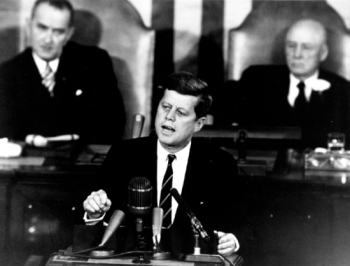
Fifty years ago today, John Kennedy stood before Congress and the nation and declared that the United States was going to the Moon. Amazingly, though this is by far the most remembered speech Kennedy ever gave, very few people remember why he gave the speech, and what he was actually trying to achieve by making it.
Above all, going to the Moon and exploring space was not his primary goal.
For Kennedy — whose presidential campaign included an aggressive anti-communist stance against the Soviet Union — the months before the speech had not gone well. Five weeks earlier, for instance, the CIA-led attempt to invade Cuba and overthrow Castro’s communist government had ended in total failure. When Kennedy refused to lend direct military support to the Bay of Pigs invasion, the 1,200 man rebel force was quickly overcome. “How could I have been so stupid as to let them go ahead?” Kennedy complained privately to his advisors.
In Berlin, the tensions between the East and the West were continuing to escalate, and would lead in only a few short months to Khrushchev’s decision to build the Berlin Wall, sealing off East Berlin and the citizens of East Germany from the rest of the world.
In the race to beat the Soviets in space, things were going badly as well. NASA had announced the United States’ intention to put the first man into space sometime in the spring of 1961. The agency hoped that this flight would prove that the leader of the capitalist world still dominated the fields of technology, science, and exploration.
Originally scheduled for a March 6, 1961 launch, the short fifteen minute sub-orbital flight was repeatedly delayed. The Mercury capsule’s first test flight in January, with a chimpanzee as test pilot, rose forty miles higher than intended, overshot its landing by a hundred and thirty miles, and when the capsule was recovered three hours later it had begun leaking and was actually sinking. Then in March another test of the Mercury capsule included the premature firing of the escape rocket on top of the capsule, the unplanned release of the backup parachutes during descent, and the discovery of dents on the capsule itself.
These difficulties caused NASA to postpone repeatedly its first manned mission. First the agency rescheduled the launch to late March. Then early April. Then mid-April. And then it was too late.
» Read more
A bullet dodged? The next Mars rover, the Mars Science Lab, appears to be okay after last week’s mishap.
An evening pause: Fifty years ago tomorrow, on May 25, 1961, John Kennedy spoke to Congress about the world situation and the war between freedom and tyranny. “We stand for freedom,” he began, and finished by committing the United States to sending a man to the Moon and bringing him back safely by the end of the decade.
The clip below shows the first five minutes of that speech. It makes it clear that Kennedy’s main point was not to send the United States to the stars, but to stake out our ground in the battle for freedom and democracy. I will write more about this tomorrow.
To see the whole speech, go to the following link at the Miller Center for Public Affairs.
NASA announces that the Orion program will continue, though under a different name.
This is a non-announcement, made to appease those in Congress who are requiring NASA to build the program-formerly-called-Constellation. NASA will do as Congress demands, and in the process will build nothing while spending a lot of money for a rocket and space capsule that can’t be built for the amount budgeted.
Facing a launch window that ends December 18, the next rover mission to Mars was damaged last week upon arriving at the Kennedy Space Center.
Another Soyuz upgrade in the works.
Soyuz TMA-20 lands safely in Kazakhstan.