The largest commercial antenna reflector ever flown in space has successfully unfurled
The largest commercial antenna reflector ever flown in space has successfully deployed in orbit.
The largest commercial antenna reflector ever flown in space has successfully deployed in orbit.
In competition with the Orbital/Virgin Galactic proposal I mentioned yesterday, Boeing has submitted its own proposal to provide crew and cargo ferrying service to ISS.
Considering the federal budget debt and the political winds for reducing that debt, I have great doubts the subsidies for these proposals will ever arrive. Nonetheless, with the end of the shuttle program and nothing to replace it, the United States has a serious need for a system to get crew and cargo into space. And in a free society, fulfilling that need means profits, which is why these proposals are beginning to appear, and will get built, regardless of whether Congress funds them up front or later buys the services.
After a 33 year journey, Voyager 1 has detected evidence that it is about to enter interstellar space.
Lockheed has won a $171 million NASA contract to pack cargo for ISS through 2017.
My question however is this: How do they plan on getting the cargo into space?
Orbital Sciences and Virgin Galactic have teamed up to propose a four person reusable orbital spacecraft to ferry crews to ISS. Key quote:
The spacecraft, designed to launch atop an Atlas 5 rocket and dock with the international space station, could be ready for test flights as early as 2014. The remotely piloted spacecraft would be able to carry four passengers initially, including three astronauts and one paying ticketholder, though based on market demand the number of private rides aboard the vehicle could grow to two, with four astronaut seats available, sources said. In the works at Orbital for the past year, the reusable spacecraft would be built using existing materials and technologies, employ standard hypergolic propellants and rely on a pusher escape system in the event of a launch mishap, sources said. [emphasis mine]
Note their insistence that they be allowed to fly tourists. This is a major change from how NASA has operated in the past, as a Soviet-style government agency hostile to commercial profits.
Correction: Clark Lindsey notes that the Orbital press release makes no mention of Virgin Galactic, as reported above.
The new colonial movement continues: Brazil successfully launched and recovered a suborbital rocket this past weekend.
The Navy set a new world record with the firing of an electromagnetic railgun on December 10. Though intended as a military weapon Keith Cowing speculates about the railgun’s off-world applications.
The first report is back of the X-37B following the completion of its first flight.
A nano-sized solar sail, built by NASA and launched in mid-November, appears to have been lost. Sadly, this has been the history of almost all solar sail efforts: failure before the sail can even deploy.
The rise and fall of Rocketplane.
The new colonial movement, in space! South Africa joins the race, launching its own space agency.
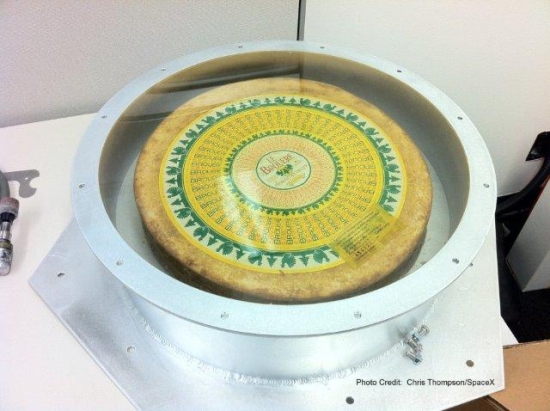
So, what was the top secret payload carried by Dragon on its first orbital mission? SpaceX revealed this secret today: their tribute to Monty Python.
A wheel of cheese.