Musk settles with SEC, pays fine, reduces control at Tesla for 3 years

Elon Musk and Tesla have negotiated a settlement with the SEC, agreeing to each pay a fine of $20 million while Musk reduces his role with the company for the next three years.

Musk and Palo Alto-based Tesla agreed to pay a total of $40 million to settle the case, and he will give up his chairmanship for at least three years. The electric-car maker also is required to install an independent chairman and two new board members, though Musk will remain on the board, according to terms of the settlement.

Musk and Tesla will each pay $20 million to settle the case; both reached the deal without admitting wrongdoing.

I suspect this will not reduce Musk’s influence on Tesla very much. To me, this whole kerfuffle was the SEC acting like a bunch of mobsters, pulling its weight against someone it apparently doesn’t like. “Nice business you have there, Elon. Sure would be a shame if something happened to it.”

11 comments

SEC goes after Musk

The Securities and Exchange Commission today filed a complaint against Tesla in an effort to force Elon Musk out as head of the company.

The complaint filed by the Securities and Exchange Commission came after a last-minute decision by Mr. Musk and his lawyers to fight the case rather than settle the charges.

The filing by the SEC in federal court in Manhattan threatens to deal a severe blow to the Palo Alto, Calif., electric car maker. Its brand and Mr. Musk are closely intertwined, and analysts have said the company’s roughly $50 billion market value is driven by Wall Street’s appreciation for Mr. Musk’s vision and skill as an innovator.
SEC Sues Elon Musk for Fraud, Seeks Removal From Tesla

Tesla wasn’t named in the suit as a defendant, but the SEC is seeking to bar Mr. Musk, Tesla’s largest shareholder and its top executive, from serving as an officer or director of any U.S. public company. Tesla shares, which have been under intense pressure amid questions about the firm’s financial strength and Mr. Musk’s behavior, tumbled 9.9% to $277 in after-hours trading Thursday on Nasdaq.

This is very bad news for Tesla. However, it might be good news for SpaceX, as Musk has admitted to being very overworked. If he is forced from Tesla, he will have an enormous load removed from him.

13 comments

SpaceX gets contract to launch private lunar rover missions

Capitalism in space: SpaceX has won a contract for two launches of lunar rovers built by a private Japanese company.

Tokyo-based lunar-exploration startup Ispace has signed up for launches on SpaceX’s Falcon 9 rocket in 2020 and 2021. The first will carry a lunar lander into orbit around the moon, and the second aims to put one on the moon’s surface so it can deploy a pair of rovers, Ispace said Wednesday. “We share the vision with SpaceX of enabling humans to live in space, so we’re very glad they will join us in this first step of our journey,” Ispace Chief Executive Officer Takeshi Hakamada said in a statement.

SpaceX already has a contract for another private lunar rover, built by the Israeli company SpaceIL, that is set to launch as a secondary payload in December.

Both companies are former competitors in the Google Lunar X-Prize competition. Based on these contracts, as well as the pending launch of Moon Express’s private lunar rover on a Rocket Lab Electron rocket, it appears that private commercial planetary missions are about to become routine.

0 comments

Update on SpaceX and Boeing’s private commercial crew capsules

Link here. The key piece of news is that both companies now believe they meet NASA’s safety requirements.

[D]uring a panel discussion at the American Institute of Aeronautics and Astronautics (AIAA) Space Forum here Sept. 18, executives of the two companies said they now believed their vehicles met that and related safety requirements.

John Mulholland, vice president and program manager for the commercial crew program at Boeing, said the company was assessing three separate requirements, including the overall loss of crew as well as ascent and entry risks and loss of mission. “Our teams have been working that for a number of years,” he said, noting those analyses have driven changes to the vehicle design, such as increased micrometeoroid and orbital debris protection. “Where we are now is that our analysis shows we can exceed the NASA requirements for all three of those criteria,” he said.

Benjamin Reed, director of commercial crew mission management at SpaceX, said his company was in a similar situation. “We’re looking right now to be meeting the requirements,” he said.

Kathy Lueders, NASA’s commercial crew program manager, didn’t confirm that the companies have, in fact, met those safety requirements. “We’re learning from a NASA perspective about how to understand the assessments that we’re getting from each of the contractors and how to apply it,” she said. “We at the NASA team are assessing the modeling that each of the providers has done.”

It should be understood that the requirements being discussed here really have nothing to do with actual engineering, but are based on a statistical analysis that estimates the risk to any passenger. In other words, it is a pure guess, and can be manipulated any way anyone wants. This is why NASA’s manager above is so vague. What she is really saying is that NASA is slowly being forced to accept the analysis of the contractors.

The article at the link also details the present schedule, which appears mostly unchanged (though Musk indicated there might be a slight delay in Dragon during his BFR presentation earlier this week), and the efforts by both companies to make their capsules reusable.

0 comments

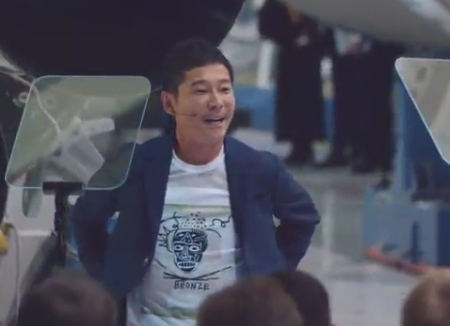
SpaceX’s first BFR passenger is Yusaku Maezawa, owner of Japanese fashion company

Yusaku Maezawa

Capitalsm in space: SpaceX’s first BFR passenger will be Yusaku Maezawa, the owner of Japanese fashion company, shown on the right.

Maezawa began his statement by echoing John Kennedy with these words, “I choose to go to the Moon.” He purchased the entire first flight, and will invite six to eight artists to join him on the flight and ask them to create art afterward inspired by the flight. They are aiming for a launch in 2023.
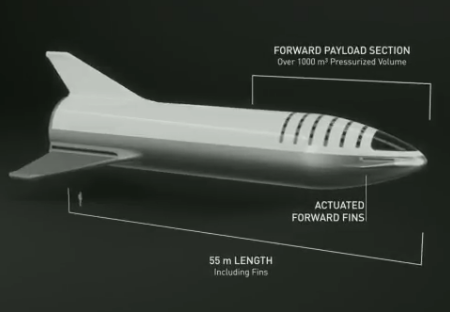
BFR

Musk began the presentation tonight with an overview of the status of BFR, noting that they plan unmanned test launches before putting humans on the rocket. The image an the right shows the habitable upper stage.

During the question and answer session after the announcement Musk was asked questions about the present stage of BFR design, and whether it has been finalized. He said they plan “a lot of test flights” and are aiming for first orbital flights in 2 to 3 years, “if things go really well.”

Musk made it clear that Maezawa chose SpaceX for the flight, rather than the other way around. Musk also said that Maezawa was paying them a lot of money for the flight, though they were not going to reveal the amount. Musk did note that the price was not trivial, and that Maezawa has already made a significant deposit. Maezawa had first approached them for a Dragon/Falcon Heavy flight, but because of the limitations of of those spacecraft, they decided it better to go with the bigger rocket.

Musk noted that the first test hops of the upper stage to test its landing capabilities will take place at Boca Chica in Texas. The launch site for the orbital missions is not yet decided.

Musk estimated that the cost for developing BFR is going to probably be around $5 billion, which he also noted rightly is quite small for this kind of project. He also said that right now they are only devoting 5% of SpaceX’s resources to this mission. As they complete the crew Dragon project, they will then begin to shift resources to BFR. He estimated that will happen sometime late next year.

Overall, it strikes me that they really do not have all the details yet worked out, with the rocket or their flight schedule. As Musk openly admitted when asked if they are sure about the schedule, “We are definitely not sure.” This is not necessarily a bad thing, since it is often better to keep an open-mind in planning something this ambitious. At the same time it tells us not to expect any of this to happen, as described.

One final point: Musk at one point said he wants a base on the Moon. “It’s 2018, why don’t we have a base on the Moon?” To me, this was an almost direct dig at NASA’s Gateway/FLOP-G project, which isn’t a base but locks us in lunar orbit. Musk was being very careful to avoid criticizing NASA, his biggest customer, but anyone who knows what is going on will quickly recognize that BFR is in direct competition with SLS/Orion/Gateway.

Based on SpaceX’s history, going from first orbit flight to flying the world’s largest rocket in only ten years, I am very confident that this company could get that first base on the Moon, long before NASA even gets Gateway launched.

30 comments

SpaceX announcement of first passenger for Lunar BFR

Capitalism in space: SpaceX will have a webcast today at 6 pm (Pacific) to announce the name of the first passenger to fly on a lunar mission using their Big Falcon Rocket (BFR).

The embed of that webcast is below, so if you wish you can watch right here.

Note that my initial post mistaken said this was happening at 6 pm Eastern time. That was an error.

10 comments

SpaceX to name on Monday its first customer for BFR flight around Moon

Capitalism in space: In a tweet SpaceX announced that it will name on Monday its first customer for flight around Moon, using its Big Falcon Rocket rather than the Falcon Heavy as previously announced.

There will be a lot of speculation over the next few days, but we must remember that the BFR is years away from launch, so nothing here is either set in concrete, nor even likely to happen.

24 comments

SpaceX successfully launches communications satellite

Capitalism in space: SpaceX last night successfully launched a communications satellite as well as recovered the Falcon 9 first stage.

The biggest news here is how routine the landings of the first stage have become, getting its first mention eight paragraphs into the article above, with its landing described almost as an aside. This was a new Block 5 first stage, and it will likely fly again within a relatively short period of time.

The leaders in the 2018 launch race:

24 China
16 SpaceX
8 Russia
6 ULA
5 Arianespace (Europe)

China still leads the U.S. in the national rankings, 24 to 23.

2 comments

SpaceX’s Big Falcon Rocket and the colonization of Mars

Link here. Lots of details about what SpaceX wants to do, as well as the company’s request for help in areas it is weak.

Below the fold is the youtube video from the Mars Society conference last week which forms the basis of the article at the link.

I only have one comment at this time: I worry that SpaceX is developing a rocket, the BFR, that has no marketable value, at this time. They succeeded with the Falcon 9 and the Falcon Heavy because they could market them and make money from them. The commercial space industry needed these rockets that could fly at lower cost, and that has paved the way for SpaceX’s success.

There are real questions whether a similar market exists for BFR. To paraphrase a line from the movie Field of Dreams, it is possible that if they build it the customers will come, but few businesses succeed with that market strategy.
» Read more

15 comments

Launch schedule shuffles for SpaceX

Link here. A combination of payload issues, scheduling conflicts, and rocket refurbishment demands has forced SpaceX to shuffle and delay many of its remaining launches scheduled for the rest of 2018.

The biggest conflict appears to be between the first manned Dragon test flight, and the second Falcon Heavy flight, both of which are now listed for a November launch. Since both will use the same launchpad, there must be some space between them.

1 comment

Dragon/Starliner schedules firming up

At a meeting at NASA this week a status update of SpaceX’s manned Dragon and Boeing’s manned Starliner capsules indicated that their proposed flight schedules, with the first manned flights occurring next year, are increasingly firm.

Overall, the updates were quite positive with most of the flight hardware nearing completion. The two companies must each execute two test flights to the International Space Station (ISS) in order to be certified to perform operational crew rotation missions.

On the SpaceX side, the company will first execute an uncrewed test flight of the Crew Dragon spacecraft called Demonstration Mission 1 (DM-1) – currently scheduled for this coming November. It will then be followed by a crewed test flight designated Demonstration Mission 2 (DM-2). In between the two missions, SpaceX will also execute an in-flight abort test.

In terms of Boeing, they will perform an uncrewed Orbital Flight Test (OFT) with the CST-100 Starliner followed by a Crewed Flight Test (CFT). A pad abort test will be also conducted between the two missions.

While Boeing’s schedule for these flights is somewhat uncertain as they investigate the recent failure of several valves to close during an engine test, SpaceX’s schedule has become very solid. Assuming nothing goes wrong on the unmanned test flight in November and the in-flight abort test, they will fly humans in April, 2019.

2 comments
1 158 159 160 161 162 234