
Dragon cargo fees to rise, due to NASA demands

A government audit has found that the fees that SpaceX charges for its Dragon cargo missions to ISS will rise as much as 50%, and the cause of that price rise is almost entirely due to NASA redesign demands.

[T]he auditors pinned much of the blame on NASA for the increase. They also emphasized that the program still seems like a good deal for lowering launch costs. Auditors cited NASA for missing opportunities to cut redundancies and bargain on pricing, and noted that the agency forced SpaceX to (expensively) redesign its Dragon spaceship from the bottom up.

The report did hint, however, that SpaceX has done some reckoning as the startup has matured. “[SpaceX] also indicated that their CRS-2 pricing reflected a better understanding of the costs involved after several years of experience with cargo resupply missions,” the auditors wrote. (A SpaceX representative declined to comment on the report.)

None of this is a surprise. There are factions in NASA that have been working for the past decade to stymie or defeat the arrival of privately built and owned spacecraft like Dragon, as it makes the NASA-built spacecraft like Orion look bad. By demanding redesigns that raise the cost for Dragon, these factions gain ammunition to attack it. I guarantee we will see op-eds doing exactly that in the next year.

No matter. In the end the private market still does it better and cheaper than the government, as the audit found.

Despite the cost increases, the report ultimately called the CRS contracts with private companies “positive steps” for NASA — especially since the agency could find discounts by launching cargo on used SpaceX Falcon 9 rocket boosters. “NASA’s continued commitment to the commercial space industry also helps spur innovations in the commercial launch vehicle market,” the auditors said.
2 comments

A NASA astronaut’s detailed look at Dragon and Starliner

Link here. Lots of interesting details about both spacecraft from an experienced astronaut’s perspective.

The Commercial Crew program will launch uncrewed ships first. SpaceX is aiming to do that in September and Boeing in October. If successful, crewed launches will follow on December 31 (Boeing) and January 17 (SpaceX).

“We’ve gotten into the cockpit in both spacecraft. We’ve run through parts of the profile, from launch to rendezvous docking, un-docking, and [atmospheric] entry. But everything’s not been tied up, not quite yet,” Williams said. She didn’t say which company’s spaceship is her favorite.

In fact, crewed launch dates may slip to mid-2019. Williams said she expects NASA to announce her official mission selection this summer, and from there about a year of more deliberate mission training will follow.

This is a delay from the previously planned summer launches. This had been expected, but it also looks like both companies are trying hard to get things off the ground this year.

0 comments

SpaceX’s Falcon Heavy wins Air Force launch contract

Capitalism in space: SpaceX has won a $130 million Air Force contract to use its Falcon Heavy rocket to launch a military satellite.

The Falcon Heavy beat out a bid from United Launch Alliance for the mission labeled Air Force Space Command-52, or AFSPC-52, which is targeting liftoff from KSC’s pad 39A in 2020.

United Launch Alliance’s most powerful launcher, the Delta IV Heavy, has a price tag approaching $400 million.

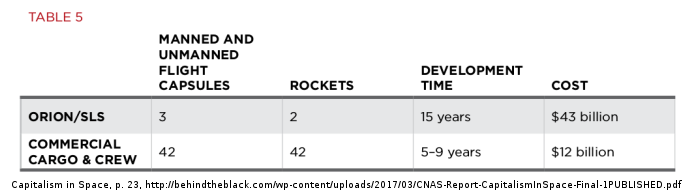
The price comparison bears repeating: ULA: $400 million, SpaceX: $130. It is not surprising that SpaceX got the contract, though it does illustrate the difference between the Air Force’s space effort and NASA’s. The Air Force is making a concrete and real effort to lower its launch costs, using competition as a tool to do so. NASA, which faces the same kind of price comparison when comparing SLS to SpaceX, continues however to ignore that price difference and insist its future interplanetary manned programs must go with SLS, and SLS only.

In this context, I think this graph from Capitalism in Space is worth another look:

SLS vs commercial space

8 comments

SpaceX outlines plans for major expansion at Kennedy

Capitalism in space: According to plans outlined in a draft environmental statement, SpaceX is planning a major mission control and new rocket processing facility at the Kennedy Space Center.

It will be an operational monument to Elon Musk’s vision: a towering SpaceX launch control center, a 133,000-square-foot hangar and a rocket garden rising in the heart of Kennedy Space Center.

According to plans detailed in a draft environmental review published recently by KSC, SpaceX will undertake a major expansion of its facilities at the space center sometime in the not-too-distant future. The review says SpaceX is seeking more room and a bigger presence “in its pursuit of a complete local, efficient, and reusable launch vehicle program.” The expansion would enable SpaceX to store and refurbish large numbers of Falcon rocket boosters and nose cones at the operations center down the road from NASA’s Vehicle Assembly Building.

The most eye-opening detail in this environmental draft is a statement that this SpaceX facility will be designed to support an expectation of up to 63 launches per year. In the first decade of this century that’s about how many launches the entire world accomplished per year. SpaceX’s ambitions here however are not absurd. They instead hearken to the expected upcoming boom in the entire aerospace, mostly fueled by the lower launch costs that SpaceX forced on the launch industry. SpaceX might manage that many launches, but it will be only a part of the entire booming launch market.

12 comments

SpaceX successfully launches commercial satellite

Capitalism in space: SpaceX has successfully launched a commercial satellite using a previously flown first stage.

They did not attempt to recover the used first stage as it was one of their older stages, which they are clearing out as they move to the final Block 5 version of the Falcon 9.

The top leaders in the 2018 launch race:

16 China
11 SpaceX
5 Russia
5 ULA

In the national standings the U.S. has moved back ahead of China, 17-16.

7 comments

Reuseability lowers SpaceX launch price to $50 million

Capitalism in space: Reuseability lowers SpaceX launch price to $50 million.

The article is mostly about tonight’s commercial launch of an SES communications satellite. In it however it notes this comment by Musk:

SpaceX is in the process of flying and discarding older, less advanced Block 4 first stages to clear inventory – the company will likely fly just one more before moving its entire manifest to the Block 5 iteration, which CEO Elon Musk says can fly up to 10 times with minimal refurbishment between missions. Beyond that, the boosters could launch up to 100 times with moderate inspections and changes.

The next-generation vehicles feature improved reusability, upgraded thrust, retractable black landing legs that can reduce time between launches, a new black interstage and a slightly larger payload fairing, to name a few. It will also help SpaceX reduce costs from $60 million to about $50 million per launch, Musk said in May. [emphasis mine]

This price is about a third less than what both Arianespace and ULA have estimated they will charge for their new rockets, Ariane 6 and Vulcan respectively. This is also about half the price that the Russians had been charging for their Proton, which used to be the lowest price in town.

I’ll make a prediction: The drop in prices has only just begun.

11 comments

The upcoming Falcon Heavy schedule

Link here. After the estimated October launch of an Air Force technology demonstration satellite, the next launch is a communications satellite for Saudi Arabia set for the December/January time frame.

After that there are no scheduled Falcon Heavy launches, though three companies, Intelsat, Viasat, and Inmarsat, have options for launches.

In related SpaceX news, the company came within 200 feet of catching one half of the fairing from last week’s launch. The picture of the fairing coming down by parachute is very cool, and indicates that SpaceX is very close to recovering them.

8 comments

A close look at SpaceX’s new domination in the commercial launch industry

Link here. This is a surprisingly accurate and detailed article outlining the present state of the worldwide launch industry and how SpaceX has come to dominate it. It includes a graph that illustrates what I noted in my own summary in January: SpaceX has served to rejuvenate the American rocket industry.

From the Pentagon to financial analysts, many are heralding SpaceX as responsible for bringing the rocket industry back to the United States. For decades, rockets built by United Launch Alliance flew U.S. Air Force and NASA missions on Russian engines or other systems bought overseas. “They’re an all U.S. launcher. For a long time our military and intelligence capability was not launched using all U.S. capability,” Carissa Christensen, CEO of consulting firm Bryce Space and Technology, told CNBC.

The Air Force continues to award SpaceX hundreds of millions of dollars in launch contracts, with Secretary Heather Wilson telling Congress in March that the decreasing cost to launch is “enabling business plans to close in space that never were possible before.”

“For a decade and a half, launch costs were ballooning until SpaceX came in and said, ‘We can do it cheaper,'” Sam Korus, ARK Invest analyst, told CNBC.

SpaceX senior vice president Tim Hughes told Congress in a July testimony that “the U.S. had effectively ceded” the commercial rocket launch market “to France and to Russia.” Hughes showed how, before 2013, the U.S. lacked a foothold in this market. SpaceX helped the United States reclaim not just a portion but a majority in the global launch market in 2017 and represented more than 60 percent of U.S. launches while doing so.

The lower costs introduced by SpaceX has not merely allowed the U.S. to retake market share from the Russians and Europeans. It is also causing a re-awakening of the entire space industry. Satellites are being built and launched now that could not have been financed in the past, solely because the cost to put them in orbit has dropped. As a result the total number of launches is rising, providing more business for everyone.

0 comments

SpaceX successfully launches seven satellites, including two NASA science satellites

Capitalism in space: SpaceX today successfully launched seven satellites, including two NASA science satellites and five Iridium communications satellites.

They did not attempt to recover the first stage, and though they tried to recover the rocket’s fairing it missed the ship and landed in the Pacific.

Intriguingly, all of these satellites were originally going to launch on a Russian/Ukrainian rocket.

Tuesday’s launch came about as a result of Russia’s Dnepr rocket becoming unavailable, in part due to the ongoing political situation in Ukraine. Grace Follow-On had been booked to fly aboard Dnepr, while Iridium had contracted for launches of the Russian vehicle to carry pairs of its spacecraft into orbit for testing, and later replenishment of its constellation. Early last year, Iridium and the GFZ – who are responsible for arranging GRACE’s ride to orbit – agreed to share a launch on SpaceX’s more powerful Falcon 9 rocket, splitting the costs while allowing the GRACE mission to continue and Iridium to get further satellites into orbit.

In other words, SpaceX has taken this business directly away from Russia.

The leaders in the 2018 launch standings:

15 China
10 SpaceX
5 Russia
5 ULA

In the national rankings, the U.S. is now in the lead with 16 total launches (including Orbital ATK’s Antares launch on Monday).

2 comments

Block 5 Falcon 9 first stage returns to port

SpaceX’s first Block 5 first stage for its Falcon 9 rocket, designed to fly a minimum of ten times, has returned to port after its first flight last week.

This is the most interesting detail revealed:

While not visible, the most significant improvements are likely to be found at the base of the first stage’s octaweb – now assembled with bolts instead of welds – in the form of a dramatically improved heat shield around its nine Merlin 1D engines (also upgraded, of course). One of the Falcon recovery technicians showed some exceptional interest in the shield and Merlins, likely documenting their condition in extreme detail to inform engineering reviews of the pathfinder rocket after its first flight test.

The pictures show those bolts quite clearly.

4 comments

SpaceX successfully launches in Block 5 Falcon 9

Capitalism in space: SpaceX today successfully placed in orbit Bangladesh’s first communications satellite, successfully using its upgraded Block 5 version of the Falcon 9 rocket, its first stage designed to be reused a minimum of ten times.

They successfully recovered the first stage, and will now take it apart to confirm this new version worked as planned. If so, it will be put back together and returned to service.

The leaders in the 2018 launch standings:

14 China
9 SpaceX
5 Russia
5 ULA

The U.S. and China are once again tied at 14 for the nation lead. SpaceX’s launch rate is presently double what it achieved last year, when it launched the most rockets of any private company ever.

5 comments
1 161 162 163 164 165 234