
The Sun fizzles in April
NOAA’s Space Weather Prediction Center today posted its monthly update of the ongoing sunspot cycle of the Sun. I have posted the new graph for April below the fold.
» Read more
NOAA’s Space Weather Prediction Center today posted its monthly update of the ongoing sunspot cycle of the Sun. I have posted the new graph for April below the fold.
» Read more
Scientists have found that a solar Grand Minimum 2800 years ago might have caused a period of cooling in Europe.
The evidence for this link is at this moment slim, based upon a single data point from a lake in Germany. Nonetheless, it is further evidence that the Sun’s production of sunspots is more important to global climate than climate scientists had previously believed.
Though I am a bit late in covering this story (due to moving, unpacking, Passover, and an unexpected visit to the dentist), NOAA’s Space Weather Prediction Center on April 9 released its monthly update of the ongoing sunspot cycle of the Sun. The most recent graph is below the fold.
In order to understand the context of this new graph, however, it is necessary to make a correction and clarification.
» Read more
Something new found on the Sun.
Despite lacking a magnetic field of its own, scientists have discovered magnetic storms occurring in the space surrounding Venus.
The finding, reported today in Science1, suggests that magnetic reconnection may generate auroras on Venus, and could have contributed to the loss of a thick, water-rich atmosphere that scientists believe surrounded the planet during its early history, some 4 billion years ago.
A solar tornado five times the size of the Earth.
Venus Express was blinded for four days last week after being hit by a coronal mass ejection from the Sun.
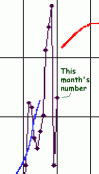
Late last week NOAA’s Space Weather Prediction Center released its monthly update of the ongoing solar cycle sunspot activity, covering February 2012. Though I am slightly late in posting it, as I do every month, you can now see the full graph below the fold. I have also created a close-up of the graph’s relevant area, shown on the left, because it is hard to decipher what is happening on the full graph.
Since the Sun began it ramp up to solar maximum back in 2009, the pattern has been consistent, two steps forward, one step back. First there are several months in a row in which the number of sunspots show a steep rise, followed immediately by several months in which the sunspot numbers decline just as steeply, though by not as much. All told, since 2009 we have seen this pattern repeat four times.
February’s numbers have continued that pattern.
» Read more
Chicken Little wrong again: The strongest solar storm since 2006 hit the Earth today, and has so far caused no damage.
The sun yesterday emitted its second biggest flare since 2006, with two coronal mass ejections heading for the Earth.
None of this will kill us, so stay calm. It is, however, a wonderful opportunity for solar scientists to study an active sun, something that might become rare in the coming decades.
Set your calendar: The last transit of Venus across the face of the Sun for the next century is only three months away.
Solar scientists at the Marshall Space Flight Center have once again adjusted their prediction for the upcoming solar maximum.
The current prediction for Sunspot Cycle 24 gives a smoothed sunspot number maximum of about 70 in May of 2013. We are currently over two and a half years into Cycle 24. Five out of the last six months with average daily sunspot numbers above 40 has raised the predicted maximum above the 64.2 for the Cycle 14 maximum in 1907. This predicted size still make this the smallest sunspot cycle in over 100 years.
This new prediction is slightly higher than their prediction of 63 from two weeks ago. As they note, even this new number leaves us with a very weak solar maximum.