
OSIRIS-Rex cleared for launch
NASA has approved OSIRIS-Rex’s Thursday launch on an Atlas 5 rocket.
Launch time is 7:05 pm (Eastern).
NASA has approved OSIRIS-Rex’s Thursday launch on an Atlas 5 rocket.
Launch time is 7:05 pm (Eastern).
NASA today awarded ULA the contract to launch in 2020 its next Martian rover.
The contract is for $243 million, which isn’t cheap, but I think NASA decided to pay the extra money because they used an Atlas 5 to launch Curiosity, and they have been attempting to simplify the 2020 mission by duplicating Curiosity as much as possible.
The competition heats up: A ULA Delta 4 rocket last night successfully placed two Air Force satellites into geosynchronous orbit.
The launch completes the four satellite constellation, designed to monitor satellites in geosynchronous orbit.
In a press interview published in late July, a ULA executive confirmed that the company is going to pick Blue Origin’s BE-4 engine for its new Vulcan rocket.
ULA used a Russian engine for its expendable Atlas V booster but has long relied on U.S. suppliers such as Aerojet Rocketdyne. For Vulcan’s reusable engine, ULA is turning to Jeff Bezos’s Blue Origin. The company’s cutting-edge BE-4 is powered by liquid natural gas instead of kerosene or liquid hydrogen.
By partnering with a startup like Blue Origin, ULA gains other advantages. “There is a world of difference between the culture at Blue Origin and the culture at Aerojet Rocketdyne,” said [Dr. George F. Sowers, ULA’s vice president for advanced programs]. “We knew we could absorb some of their culture by osmosis, just by working with them.” That influence shows up in cross-team collaboration. “We are literally breaking down walls to create a ‘Silicon Valley’ workspace,” Sowers said.
Sowers is very careful to say nothing about the Atlas 5 and the engine that will replace the Russian engine in its first stage. ULA originally signed its deal with Blue Origin with the Atlas 5 in mind, but has not made a final decision between Blue Origin and Aerojet Rocketdyne because Congress appears to favor Aerojet Rocketdyne’s engine, and Congress is a very big gorilla you do not upset. However, their development plans for Vulcan are incremental and closely linked with the Atlas 5. They plan to introduce Vulcan piecemeal in various upgrades of Atlas 5 as they go, so if they are set on using Blue Origin’s engine in the Vulcan rocket, it probably means that they plan on using it to replace the Russian engine in Atlas 5. This interview appears to confirm this.
The competition heats up: ULA and SpaceX will likely face-off for the right to launch the Air Force’s next GPS satellite.
SpaceX won the last GPS launch with an unopposed bid of $83 million. ULA has said that their average price for an Air Force launch under the EELV program has been $225 million. I suspect that their bid here will be significantly less than that.
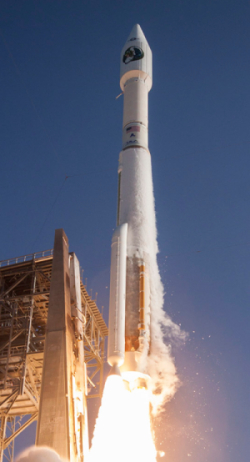
The competition heats up: A ULA Atlas 5 rocket today successfully launched a National Reconnaissance Office (NRO) surveillance satellite, dubbed NROL-61.
The image on the right is courtesy of Orbital ATK. From the link above:
NROL-61, however, launched atop an Atlas V 421 rocket, a configuration that has not previously been used by the NRO. The spacecraft itself was encapsulated within an Extra-Extended Payload Fairing (XEPF) – at 14 metres (46 feet) in length the longest of three available four-metre (13-foot) diameter fairings – which has also never before been used for an NRO mission.
…The most likely explanation is that NROL-61 will be the first in a new generation of Quasar satellite; which would appear to be larger in both size and mass than its predecessors. Quasar, also known as the Satellite Data System, or SDS, is a constellation of communications satellites operated by the NRO to support its other intelligence-gathering activities; relaying data from other satellites to the ground in real-time, without having to wait for the intelligence-gathering satellites to pass over ground stations on friendly territory. If NROL-61 represents a new version of Quasar, it will be the fourth generation of the constellation.
The competition heats up: A team of ULA interns, working in their spare time, have successfully launched the largest model rocket every built.
On Sunday (July 24), ULA launched the 50-foot-tall (15.24 meters) Future Heavy rocket out of Fort Carson Army Post, breaking the record for “the largest sport rocket launched anywhere in the world,” according to a statement from ULA. The Future Heavy is also notable because it was built entirely by company interns and their mentors. “We like [our interns] to have a very realistic experience,” ULA President and CEO Tory Bruno told Space.com at the Space Symposium meeting in Colorado Springs, Colorado, last April.
Calling it a “model rocket” really isn’t fair. The thing is big, and really ranks up there with many of the suborbital rockets NASA used to routinely fly out of Wallops Island. That ULA has provided support for this effort again suggests that the leadership of Bruno is reshaping the company into a much more innovative and competitive company.
The competition heats up: The CEO of ULA, Tory Bruno, said in an industry publication interview today that the Congressional deal that allows the company to buy 22 more Russian engines for its Atlas 5 clears the way for their eventual transition to the Vulcan rocket and an end to dependence on those Russian engines.
The article is worth a careful read, as it also provides a very detailed look at ULA’s future plans for its Atlas 5, Delta 4 Heavy, and Vulcan rockets. This paragraph was especially interesting:
The next major milestone is determining what engine will replace the [Russian] RD-180. Washington-based Blue Origin is developing the BE-4, a privately funded Liquid Oxygen (Lox) and Liquefied Natural Gas (LNG) engine capable of 550,000 pounds of thrust (lbf); and California-based Aerojet Rocketdyne is creating the AR1, a government-supported Lox/Kerosene (RP-1) engine capable of 500,000lbf. Either replacement will require two engines to match the power of the RD-180. Blue Origin claims its engine, already four years into development, will be flight qualified by 2017, while Aerojet Rocketdyne, having started its development later, says the AR1 will be flight qualified by 2019. Bruno said ULA would make its decision soon.
“Sometime close to the end of the year we are going to down-select, and then move into our Critical Design Review (CDR) and start manufacturing the rocket,” he said.
I strongly suspect they want to go with Blue Origin’s engine, because it is more powerful, farther along in development, and almost certainly less expensive. The question will be whether pressure from Congress, which favors Aerojet Rocketdyne’s engine for pork barrel reasons (Congress is funding it), will force ULA to go with it instead.
The competition heats up: As announced in March, ULA this week moved ahead with layoffs that reduced its work force by 350 people.
They are essentially trying to make the company leaner so that they can charge less per launch and thus better compete with SpaceX for launch contracts.
The competition heats up: After a two month delay because of an engine issue on its previous launch, ULA’s Atlas 5 rocket today successfully placed a military communications into orbit.
In the heat of competition: ULA has completed its investigation into the premature shutdown of the Atlas 5 first stage during its March launch of Orbital ATK’s Cygnus capsule and has corrected the problem.
An extensive review of all post-flight data observations determined that at approximately T+222 seconds, an unexpected shift in fuel pressure differential across the RD-180 Mixture Ratio Control Valve (MRCV) and a reduction in fuel flow to the combustion chamber caused an oxidizer-rich mixture of propellants and a reduction in first stage performance. The imbalanced propellant consumption rate resulted in depletion of the first stage oxidizer with significant fuel remaining at booster engine shutdown. The engine supplier has implemented a minor change to the MRCV assembly to ensure the anomaly does not occur on future flights.
Engine hot-fire testing, extensive component and assembly level testing and analyses have been performed to confirm the findings. Detailed inspections and minor hardware replacement on all engines will support the current launch manifest.
They have now scheduled the next Atlas 5 launch for June 24.
In the heat of competition: The review of Orbital ATK’s May 31st static fire test of its Antares rocket has caused the company to delay the upgraded rocket’s first launch until August.
Additional information pointed to data on “vibrations” during the Static Fire test that could be deemed as a problem for the vehicle’s avionics. A “fix” was already understood to have been approved.
Orbital ATK, while admitting the launch is slipping from its early July launch date estimate to a date likely to be in the August timeframe, pointed to trajectory evaluations as a specific relation to the launch date deliberations. “Final trajectory shaping work is also currently underway, which is likely to result in an updated launch schedule in the August timeframe,” added Orbital ATK.
They expect to make a decision on launch date in a few weeks.