The movement of surface ash on Mars over a half century
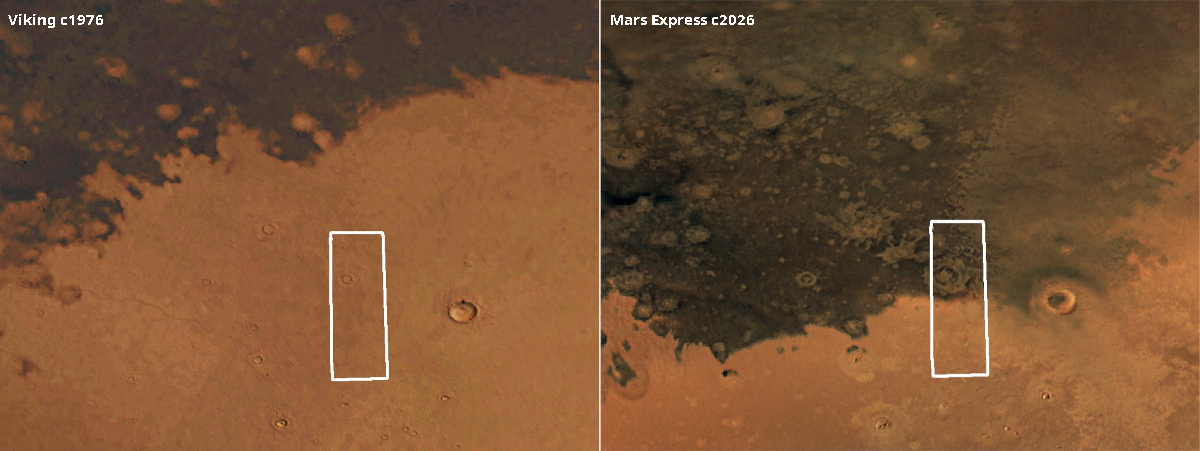
Viking and Mars Express images side-by-side for comparison
Go here and here for original images.
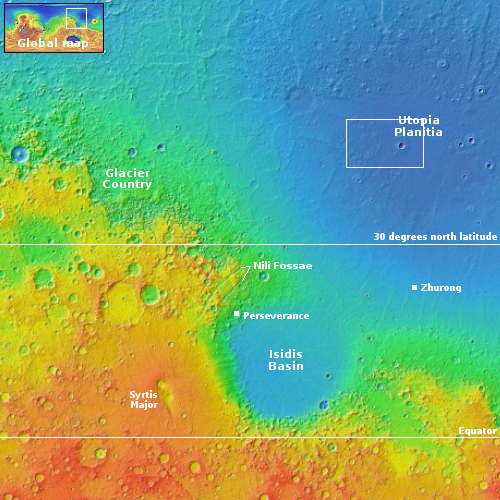
Overview map

Cool image time! In comparing images of one location on Mars taken a half century apart, scientists using Europe’s Mars Express orbiter have discovered that the dark ash covering this region has shifted south by about 200 miles.

The two images above show the change, with a Viking orbiter image taken sometime in 1976 on the left and the Mars Express image taken in 2026 on the right. Both images have been enhanced to match each other, with the white box marking an area seen in close-up by Mars Express.

The overview map to the right provides the context. This region is inside Utopia Basin, one of the largest ancient impact basins on Mars, thought to have been formed by an impact that occurred a little more than four billion years ago. Much of Mars’ dark volcanic dust is thought to come from the Medusae Fossae Formation, a gigantic volcanic ash field the size of India and located on the other side of the planet, in between all of the red planet’s largest volcanoes. Over the eons that ash has gotten distributed across the globe.

In this case, it not only covers large areas of Utopia Basin, but over a half century the prevailing winds in the thin Martian atmosphere has been enough to shift the edge of this particular ash field south by 200 miles.

Gil Levin passes away

Gil Levin, a instrument project scientist for one of the science experiments on the Mars Viking landers in the 1970s, has passed away at 97.

Levin deserves special mention because he believed for years that his experiment, called “labeled release,” had possibly found evidence of life.

Dr. Levin’s experiment employed a nine-foot arm to scoop Martian soil into a container, where it was treated with a solution containing radioactive carbon nutrients. Monitors detected the release of radioactive gas, which Dr. Levin interpreted as evidence of metabolism.

“Gil, that’s life,” Straat said when they saw the results.

The findings held true for both Viking 1 and Viking 2, which took samples from different regions of the planet. Other experiments aboard the Viking, however, used different methods to conclude that Martian soil did not contain carbon, an element found in all living things.

Dr. Levin stood by his findings, but top NASA scientists disagreed, saying that the response he observed was the result of inorganic chemical responses, not biological processes. “Soon thereafter,” Dr. Levin told the Johns Hopkins University School of Engineering Magazine last year, “I gave a talk at the National Academy of Sciences saying we detected life, and there was an uproar. Attendees shouted invectives at me. They were ready to throw shrimp at me from the shrimp bowl. One former adviser said, ‘You’ve disgraced yourself, and you’ve disgraced science.’”

I met Levin once and interviewed him several times. With amazing grace and cheerfulness he always emphasized that his results needed to be confirmed, and there was certainly room for skepticism, but to reject them outright was not how the scientific method worked.

Levin however was never awarded another NASA project, essentially blackballed because of his 1970s claims, even though later research hinted at the possibility that he may have been right.

R.I.P. Gil Levin. Though the overall data we have gotten from Mars in the half century since still favors a non-life explanation for his experiment, the uncertainty remains quite large. He could have been right.

More important than his uncertain result, however, was his dedication to the proper scientific method, where you let the data speak for itself and never dismiss any possibility if that is what the data shows you.

The Viking landers and its possible discovery of extraterrestrial life

Link here. One of the scientists involved in the Viking project has written a memoir of her experience, and the article interviews her.

Patricia Straat served as co-experimenter on one of the most controversial experiments ever sent to Mars: the Labeled Release instrument on the Viking Mars landers. The experiment’s principal investigator, Gilbert Levin, insists to this day that the project found extraterrestrial life. Most scientists doubt this interpretation, but the issue has never been fully settled.

Read it. It illustrates how uncertain science can be, even when an experiment produces a result that everyone involved dreamt of. As Straat notes,

The results met the pre-mission definition of a positive life response. But of course as soon as we got it everyone came up with alternative proposals to account for the results nonbiologically.

The problem was that though their experiment found evidence of life, none of the other Viking experiments did. Most significant was the apparently complete lack of organic material (based on carbon) in the soil.

To this day, no one has a good explanation for these results on Viking. The results remain a mystery, one that really will only be solved when we can return to Mars in force, and find out what it is really like.

Did Viking discover life on Mars?

Link here. The article provides a very detailed review of the conflicting results from the various 1970s Viking lander experiments, one of which strongly suggested the presence of microorganisms.

Overall, these life-detection experiments produced surprising and contradictory results. One experiment, the Labeled Release (LR) experiment, showed that the Martian soil tested positive for metabolism—a sign that, on Earth, would almost certainly suggest the presence of life. However, a related experiment found no trace of organic material, suggesting the absence of life. With no organic substances, what could be, or seem to be, metabolizing?

In the forty years since these experiments, scientists have been unable to reconcile the conflicting results, and the general consensus is that the Viking landers found no conclusive evidence of life on Mars. However, a small minority of scientists argues that the Viking results were positive for life on Mars.

The contradictory Viking results have never been fully explained. Many theories have been proposed, ranging from the chemical to the biological, but none have satisfied anyone.