
NASA’s ISS Twitter feed hacked
Spam is everywhere! Today NASA’s Twitter feed from ISS was hacked with unintended ads.
Spam is everywhere! Today NASA’s Twitter feed from ISS was hacked with unintended ads.
Russian mission control has indicated that the debris left over from destruction of a Chinese satellite in 2007 poses a “danger” to the International Space Station. Key quote from a Russian official:
“If the calculations show that the debris is approaching the station at an unacceptably close range, the six astronauts will receive the order to take shelter in the two Russian Soyuz spacecraft which are docked with the ISS.”
Astronomers have concluded that the high levels of carbon monoxide that they have detected in the upper layers of Neptune’s atmosphere are the leftover fingerprint of a cometary impact some 200 years ago.
An evening pause: In the 1960s, the Jackie Gleason Show was one of television’s most popular variety shows. Each episode had one regular routine, where Gleason played Joe the bartender, visited by an unseen Mr. Dunnaghy. Invariably, Joe would bring out his friend, Crazy Guggenheim, played by Frank Fontaine. Fontaine, as Crazy, would then hold everyone spellbound for five plus minutes with the most silly charactor humor one can imagine.
Zephr, a British-built solar-powered unmanned plane was ordered to return to Earth after flying continuously for two weeks without refueling. Key quote:
Zephyr is set to be credited with a new world endurance record (336 hours, 24 minutes) for an unmanned, un-refuelled aircraft – provided a representative of the world air sports federation, who was present at Yuma, is satisfied its rules have been followed properly.
In today’s version of global warming fear-mongering, Senator John Kerry (D-Massachusetts) declared that the Arctic will be ice-free in “five or 10 years.” He apparently based this statement on a 2009 Geophysical Research Letters paper [pdf] that, using computer models, predicted an ice-free Arctic in September could occur as soon as the late 2020s but was more likely in the late 2030s.
Wanna bet? Since that 2009 paper was published, Arctic ice has seen a rebound in ice extent. Moreover, the Arctic oscillation remains in the deepest freeze it has seen in years. And the sun remains quiet, less active than we have seen it since scientists began tracking its behavior from space. Such inactivity means a dimmer sun, which in turn brings with it cold temperatures. Here is the most recent graph (updated on July 20) from the Total Solar Irradiance Time Series produced by Physikalisch- Meteorologisches Observatorium Davos (PMOD) using satellite data since 1978:
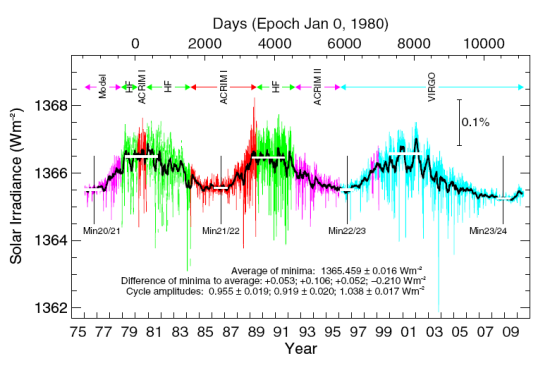
Even though the sun’s total irradiance has shown an up-tick recently as it slowly moves from solar minimum towards solar maximum, if you look closely you will see this up-tick still remains below the lowest points for the previous three solar minimums. And as I have noted here, we appear to be heading for the weakest solar maximum in two centuries.
Of course (as stock brokers say), the past performance of all of these trends is no guarantee of the future performance. Nonetheless, the data indicates clearly the simplistic nature of statements like Kerry’s.
On the subject of caves on the Moon, Paul Spudis has directed me to his very cogent October 2009 post for Air & Space magazine. Here he notes correctly that though lava tube caves on the Moon have value, they are unfortunately apparently not located in the best places for settlement.
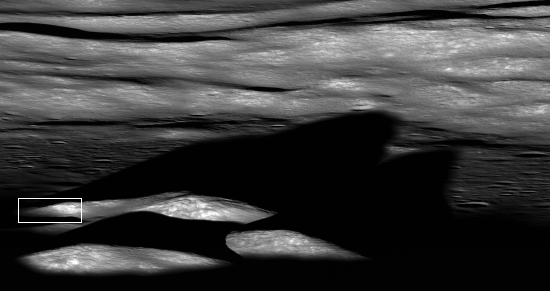
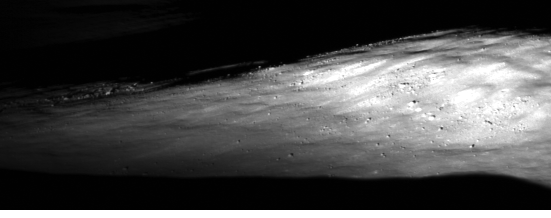
As the sun sets on Bhabha crater on the Moon’s farside, small boulders on the crater’s central peaks become visible in this Lunar Reconnaissance Orbiter image, with inset below. (It is very worthwhile to click on the link above and stroll through the full resolution image.) Scientists believe that the impact which created this crater excavated these boulders from deep within the Moon’s crust, thereby making them valuable tools for determining the geological history of the Moon. Of course, to use these tools requires the geologist to be there, something that might not happen for a while.
Keith Cowing at NasaWatch notes quickly that the current budget battles over NASA have people in NASA concerned about the future of the James Webb Space Telescope. The telescope has further cost overruns, and should NASA end up operating under a continuing resolution rather than a full budget, there won’t be enough money to keep the project above water.
This Slate article not only describes the new symbol India has chosen for its currency, it also gives a nice thumbnail description of the origins of other currency symbols, such as the U.S. dollar sign and the English pound sign.
Using Google Earth, a curator at an Italian museum has discovered a previously unknown, very young, and almost pristine impact crater hidden in the deserts of Egypt.
This Orlando Sentinel analysis of the various Congressional NASA budget proposals working their way through the House and Senate right now concludes, as I have been saying for months, that the future for NASA is not good. Key quote:
The plan orders NASA to build a heavy-lift rocket and capsule capable of reaching the International Space Station by 2016. But it budgets less money for the new spacecraft — about $11 billion during three years, with $3 billion next year — than what the troubled Constellation program would have received. That — plus the short deadline — has set off alarms.